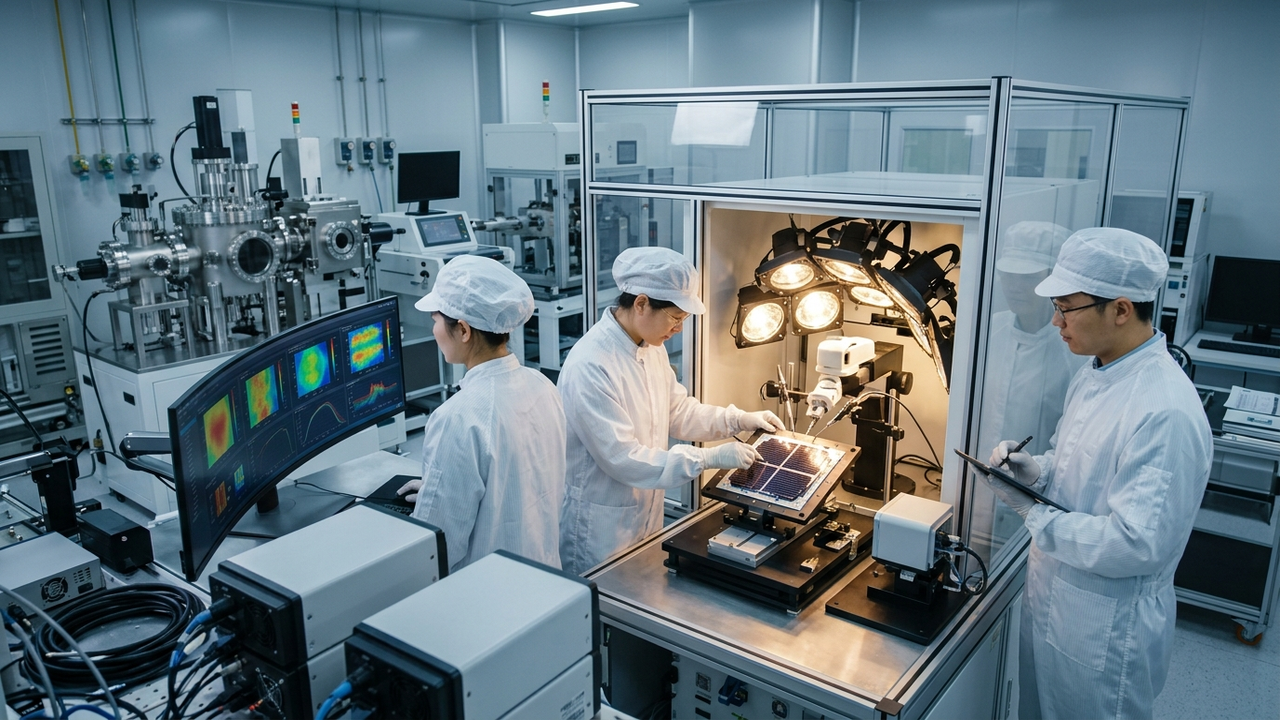
A Chinese research group has set a new world record for power conversion efficiency in perovskite solar cells, achieving an remarkable 27.39%. This outstanding performance was realized with an inverted perovskite solar cell incorporating a newly developed molecular design, and its efficiency has been rigorously verified by an independent third-party certification body. This breakthrough successfully reduced defect density within the perovskite film, optimizing charge carrier transport and extraction, thereby simultaneously enhancing both device performance and long-term stability.
Technical & Material Details
The core of this research lies in a new molecular design functioning at the interface between the perovskite layer and the charge transport layer. The researchers utilized organic molecules to effectively passivate unsaturated sites (defects) on the perovskite crystal surface, thereby suppressing non-radiative recombination losses. This led to improvements in both open-circuit voltage (Voc) and fill factor (FF), ultimately achieving the high efficiency of 27.39%. Moreover, this passivation layer contributes to improved operational stability, enhancing resistance to moisture and heat. The technology has also been successfully scaled up to bifacial mini-modules with transparent electrodes on both sides, demonstrating a clear path towards efficient large-area fabrication.
Background & Industry Context
Perovskite solar cells are the subject of intense global research and development due to their potential to achieve high efficiencies comparable to, or even exceeding, traditional silicon solar cells, at a lower manufacturing cost. Specifically, controlling defects at interfaces has been identified as one of the most critical challenges for improving the performance and stability of perovskite solar cells. This Chinese research demonstrates significant progress on both efficiency and stability fronts by overcoming this challenge through precise molecular-level control. The inverted structure is also well-suited for applications on flexible substrates and in tandem solar cells, raising high expectations for practical implementation.
Strategic Significance & Outlook
The achievement of 27.39% efficiency with third-party certification clearly indicates that perovskite solar cells are approaching practical efficiency levels. The successful scale-up to bifacial mini-modules, in particular, will accelerate deployment in diverse applications such as Building-Integrated Photovoltaics (BIPV) and power supply for mobile devices. As further validation of the manufacturability and long-term reliability of this molecular design progresses, the competitiveness of perovskite technology in the next-generation solar cell market is expected to strengthen further, serving as a new driving force for renewable energy adoption.
Get our weekly technology intelligence — free
Receive an infographic that lets you judge at a glance whether each field’s analysis report is worth reading.
Subscribe Free — Weekly Tech Intelligence
By subscribing, you’ll receive Troy-Technical’s weekly technology intelligence newsletter.
- Your email and selected fields are used only to deliver the newsletter.
- We never share your information with third parties.
- You can unsubscribe anytime via the link in each email.
See our Privacy Policy for details.
Takes about a minute · Unsubscribe anytime









Comments