Key Findings: Nanjing University Sets New Efficiency Record of 27.35% for Perovskite-Organic Tandem Solar Cells with Enhanced Stability
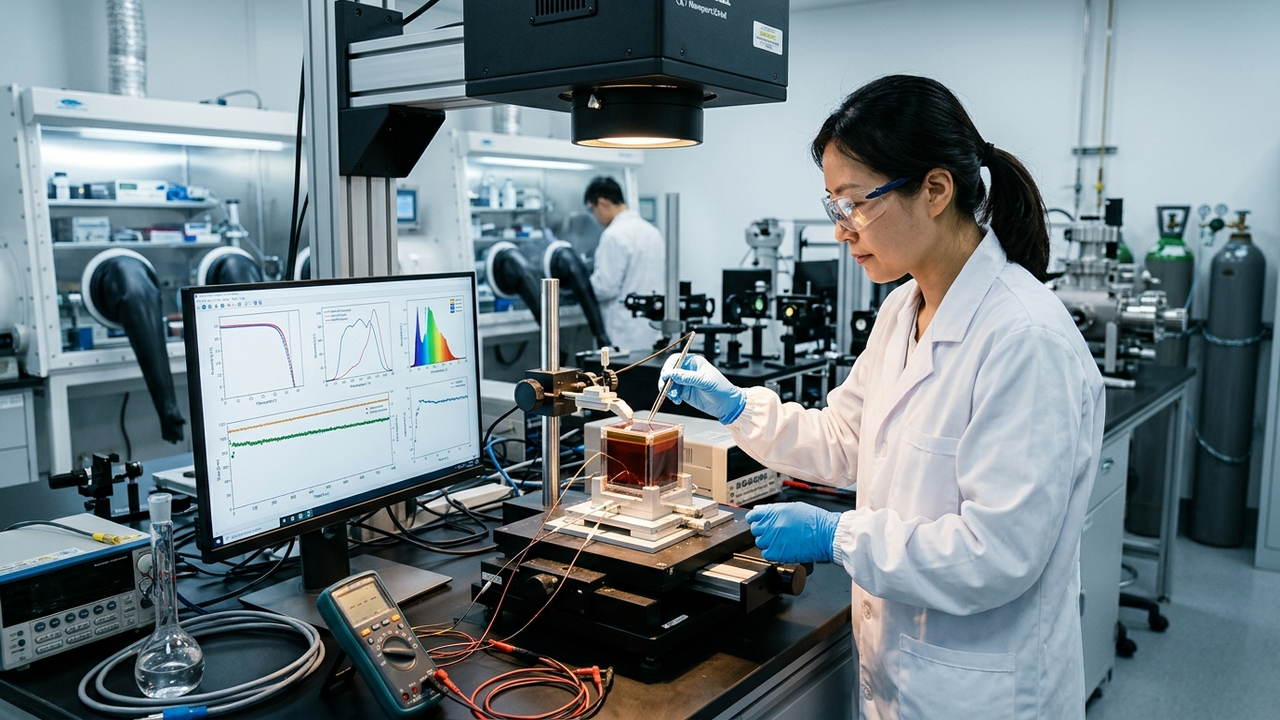
Researchers at Nanjing University in China have announced a significant achievement in the field of perovskite-organic tandem solar cells, fabricating a device that reached a record-breaking power conversion efficiency of 27.35%, with a certified efficiency of 26.88%. This new world record for perovskite-organic tandems is primarily attributed to the incorporation of a novel low-bandgap acceptor. This material effectively boosts near-infrared light harvesting and dramatically improves photocurrent matching between the perovskite and organic sub-cells. This advancement marks a critical step towards the realization of lightweight and flexible solar cells, accelerating their potential application in building-integrated photovoltaics (BIPV) and portable devices.
Technical Details and Performance Metrics
The record efficiency was achieved through a tandem architecture, combining the broad spectral absorption of perovskites with the unique properties of organic solar cells, such as flexibility and transparency. While organic solar cells typically offer flexibility but lower standalone efficiencies, their combination with a wide-spectrum-absorbing perovskite layer allows for maximal utilization of each material’s strengths. The research team specifically designed a new low-bandgap acceptor, integrated into the organic bottom cell, which significantly enhances the absorption of photons from the near-infrared portion of the solar spectrum. This improved light harvesting consequently boosts the overall photocurrent generation of the tandem cell, leading to more efficient current matching between the top and bottom cells.
Beyond efficiency, the stability of the device is a crucial aspect of this research. The developed tandem cell demonstrated promising operational stability, retaining 80% of its initial performance after 744 hours of continuous illumination. This level of stability is vital for outdoor deployment and partially mitigates concerns regarding the environmental robustness of perovskite materials, especially when combined with organic components. The enhanced stability, resulting from advancements in both device design and material science, represents a significant hurdle overcome on the path to practical commercialization for this class of next-generation solar cells.
Background and Industry Context
Perovskite solar cells are widely considered a promising successor to silicon PV, but expanding their application scope requires achieving lightweight, flexibility, and transparency. Perovskite-organic tandem structures are a compelling approach to meet these requirements while pursuing high efficiencies. While perovskite-silicon tandems often lead in pure efficiency metrics, perovskite-organic tandems are particularly well-suited for niche markets that demand specific characteristics like flexibility, transparency (for solar windows), and integration into wearable electronics. Nanjing University’s research significantly broadens the potential applications of perovskite technology within these emerging markets, offering alternatives to conventional rigid solar panels.
Strategic Significance and Outlook
This breakthrough from Nanjing University is expected to be a strong catalyst for accelerating the commercialization of perovskite-organic tandem solar cells. Their lightweight nature, design freedom, and high efficiency will provide a significant competitive advantage in BIPV applications and the flexible device market. Researchers and engineers are now poised to build upon these results, focusing on further stability enhancements and the development of large-scale manufacturing techniques. For investors, this new technological frontier signals substantial growth potential, contributing to the diversification of the clean energy technology portfolio. In the future, these tandem solar cells could be seamlessly integrated into our living and working environments, contributing to a more sustainable society.
Get our weekly technology intelligence — free
Receive an infographic that lets you judge at a glance whether each field’s analysis report is worth reading.
Subscribe Free — Weekly Tech Intelligence
By subscribing, you’ll receive Troy-Technical’s weekly technology intelligence newsletter.
- Your email and selected fields are used only to deliver the newsletter.
- We never share your information with third parties.
- You can unsubscribe anytime via the link in each email.
See our Privacy Policy for details.
Takes about a minute · Unsubscribe anytime








Comments