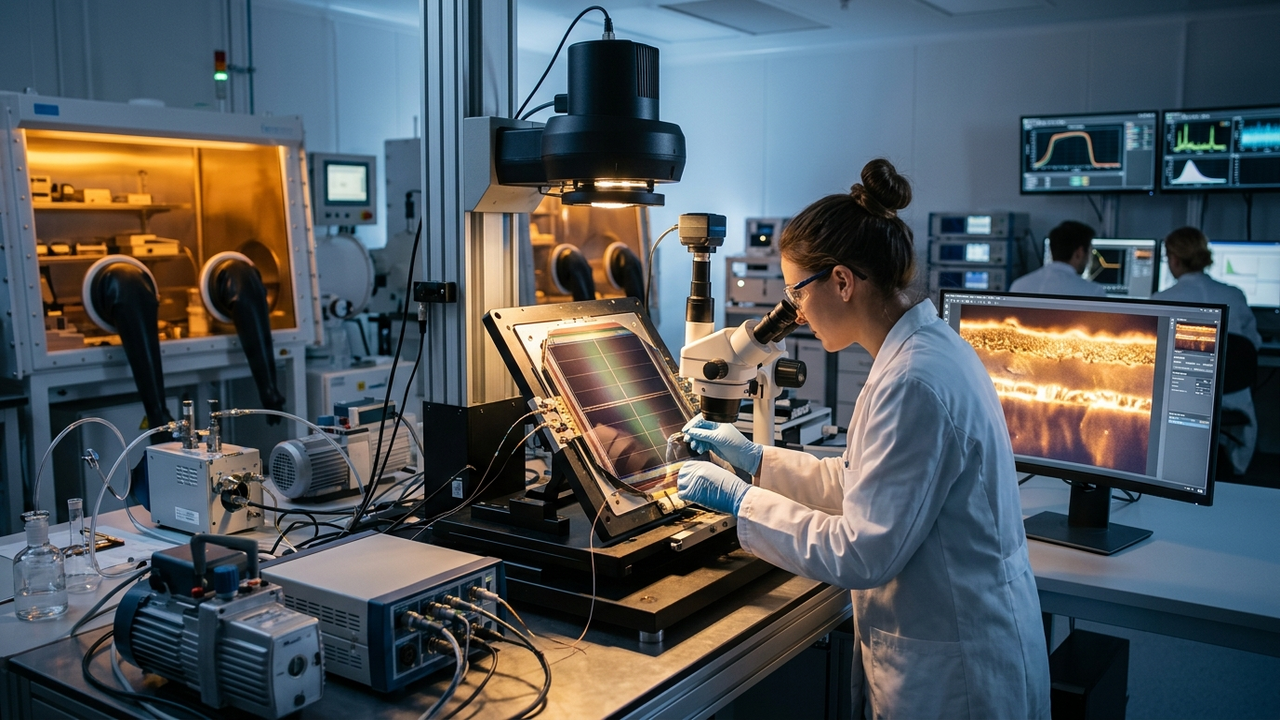
Key Findings: LONGi and Soochow University Breakthrough with 34.0% Efficient Perovskite-Silicon Tandem Cell, Demonstrating Superior Stability
Researchers from China’s Soochow University and solar giant LONGi have published a study in “Science Bulletin” detailing the development of a perovskite-silicon tandem solar cell achieving an impressive 34.0% power conversion efficiency. This significant breakthrough is attributed to a unique ZrO₂ (zirconium dioxide) interfacial strategy, which effectively suppresses non-radiative recombination and dramatically improves charge extraction within the device. This advance represents a major step towards the commercial viability of next-generation solar cells, pushing the boundaries of existing photovoltaic technology.
Technical Details and Performance Metrics
The newly developed tandem solar cell recorded a high open-circuit voltage (Voc) of 2.014 V, a critical parameter for high-efficiency devices. This high voltage indicates that the ZrO₂-based interfacial layer minimizes charge carrier losses and maximizes the potential difference across the device. Even more notably, the device demonstrated exceptional stability, retaining 84% of its initial efficiency after 2,000 hours of continuous operation. This addresses one of the most persistent challenges facing perovskite solar cells: long-term durability, particularly against environmental factors like moisture and heat. The ZrO₂ interfacial strategy provides a novel pathway to enhance both efficiency and environmental robustness, crucial for real-world deployment.
Research Context and Innovation
Perovskite solar cells are garnering significant attention as a next-generation photovoltaic technology due to their high efficiency potential and low manufacturing costs. As single-junction perovskite devices approach their theoretical efficiency limits, tandem structures combining perovskite with silicon offer a promising route to even higher efficiencies by leveraging broader solar spectrum absorption. This research specifically targets the suppression of non-radiative recombination caused by interfacial defects. ZrO₂, known for its high dielectric constant and chemical stability, acts as an effective interface layer, preventing recombination without impeding charge carrier transport. This approach offers a new paradigm for designing tandem cells that concurrently pursue both high efficiency and enhanced stability.
Future Outlook and Market Impact
This achievement is expected to accelerate the commercialization of high-efficiency and long-lasting perovskite-silicon tandem solar cells. The demonstrated stability, with 84% efficiency retained after 2,000 hours, is particularly attractive to investors and industry players looking for robust, practical solutions. Should this technology be successfully scaled for mass production, it could further drive down the cost of solar electricity, facilitating broader adoption of renewable energy globally. In the long term, such tandem technologies have the potential to complement or even partially replace conventional silicon solar cells, becoming an indispensable part of the world’s energy mix, offering superior performance in diverse applications.
Get our weekly technology intelligence — free
Receive an infographic that lets you judge at a glance whether each field’s analysis report is worth reading.
Subscribe Free — Weekly Tech Intelligence
By subscribing, you’ll receive Troy-Technical’s weekly technology intelligence newsletter.
- Your email and selected fields are used only to deliver the newsletter.
- We never share your information with third parties.
- You can unsubscribe anytime via the link in each email.
See our Privacy Policy for details.
Takes about a minute · Unsubscribe anytime









Comments