
Key Findings
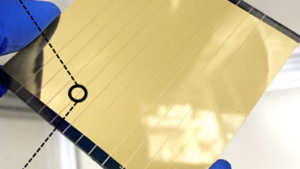
A research team led by Academician Zheng Nanfeng and Professor Wu Binghui from Xiamen University, in collaboration with Jinan University and Tsinghua University, has demonstrated that adding Prussian Blue nanoparticles to perovskite solar cells improves both efficiency and stability. The team achieved a third-party certified power conversion efficiency of 26.2% for small-area inverted cells, 23.4% for 6cm×6cm upright modules, and 22.9% for 30cm×30cm inverted modules.
Technical Details
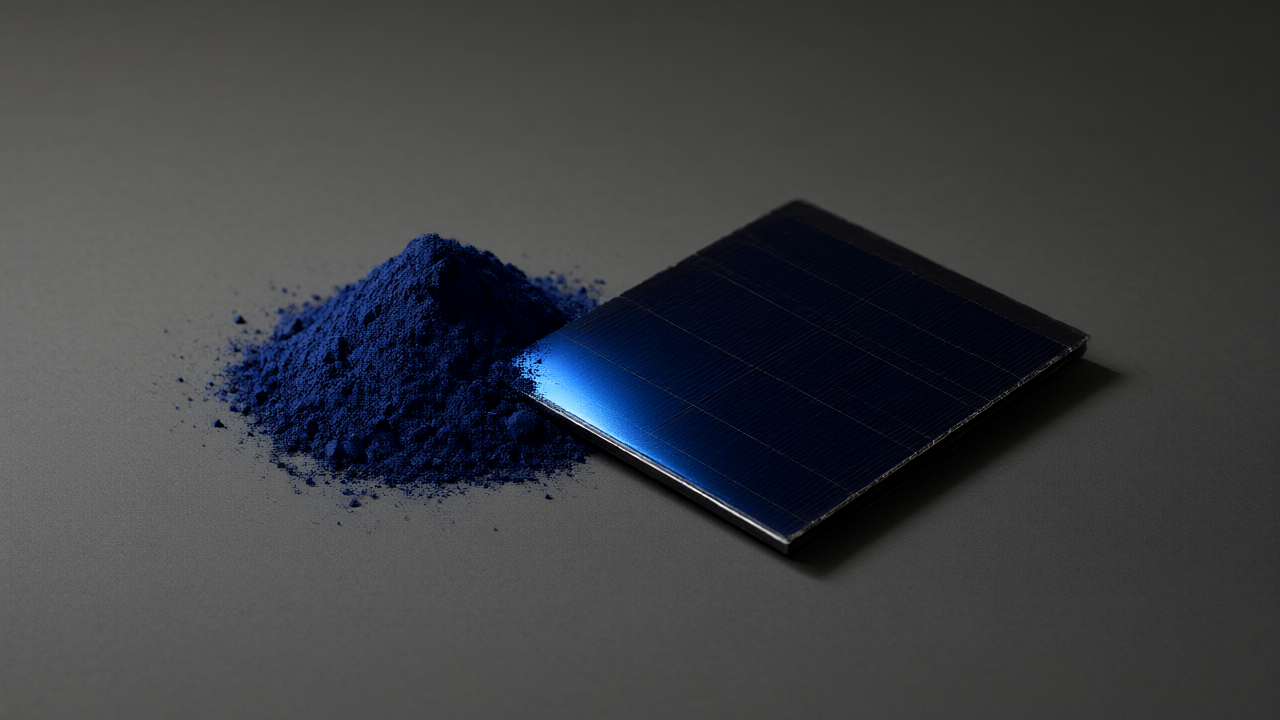
Prussian Blue, an iron-containing compound with an open framework structure, acts as a regulator during two critical stages: film formation and device operation. During the solution-based fabrication of the perovskite light-absorbing layer, Prussian Blue nanoparticles control nucleation, intermediate phase transformation, and crystal growth. This results in films with more distinct preferential orientation and reduced local lattice deformation.
During operation, the material addresses ion migration—a primary cause of performance decay. The open framework and the redox activity of iron ions inhibit the long-range redistribution of cations, particularly cesium ions. Specifically, the iron ions facilitate the conversion of abnormal valence species, such as zero-valent lead and iodine, back into their ionic forms.
Stability and Validation
The team conducted rigorous stability tests to validate the material strategy:
- Damp Heat Test: 6cm×6cm upright modules retained over 90% of initial efficiency after 2500 hours at 85°C and 85% relative humidity.
- Maximum Power Point Tracking: Modules retained over 80% efficiency after 2200 hours at 65°C and 50% relative humidity.
- Outdoor Testing: 30cm×30cm inverted modules monitored in Zhuhai for 151 days showed no significant decline in relative efficiency compared to commercial silicon references.
Significance and Outlook
This research provides a methodology for screening materials that can simultaneously guide crystal growth and regulate defects and ions. Future work will focus on scaling the process for large-area coating, ensuring batch consistency, and exploring other open-framework materials or chemical modifications of Prussian Blue to further optimize charge collection and long-term reliability.
Source: https://www.stdaily.com/web/gdxw/2026-10/23/content_601751.html
Get our weekly technology intelligence — free
Receive an infographic that lets you judge at a glance whether each field’s analysis report is worth reading.
Subscribe Free — Weekly Tech Intelligence
By subscribing, you’ll receive Troy-Technical’s weekly technology intelligence newsletter.
- Your email and selected fields are used only to deliver the newsletter.
- We never share your information with third parties.
- You can unsubscribe anytime via the link in each email.
See our Privacy Policy for details.
Takes about a minute · Unsubscribe anytime