

Key Findings
Self-Driving Labs (SDLs) are fundamentally transforming the process of nanomaterial synthesis and property prediction by integrating machine learning algorithms with highly automated hardware. These closed-loop systems autonomously design, execute, analyze, and subsequently refine experiments without continuous human intervention. This approach efficiently constructs surrogate models by starting with small initial datasets and then prioritizing exploration in regions of high predictive uncertainty or areas where performance is likely to exceed current benchmarks. This dramatically shortens nanomaterial development lead times, proving particularly effective when rapid iteration of numerous formulation variables is required, or when scaling academic prototypes into manufacturable processes.
Technical / Clinical Details
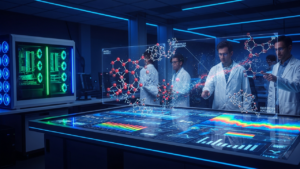
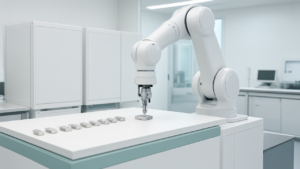
The operation of an SDL relies on the tight integration of intelligent decision-making, automated experimentation, and real-time data feedback. First, machine learning models (often employing techniques like Bayesian optimization or Gaussian processes) propose optimal synthesis conditions (e.g., temperature, pressure, reactant concentrations, reaction times) for targeted nanomaterial properties, based on past experimental data and theoretical insights. Second, automated experimental platforms, such as robotic arms, automated liquid handlers, or microfluidic synthesis devices, precisely synthesize nanomaterials under these conditions. The synthesized materials are then characterized in real-time by automated analytical systems (e.g., spectroscopy, electron microscopy, X-ray diffraction) to determine their structure, morphology, and function. These measurement results are immediately fed back into the machine learning models, which update their predictions and refine the next experimental steps. This iterative, closed-loop process allows SDLs to cover the exploration space thousands of times faster than traditional manual processes, efficiently discovering optimal nanomaterials. This efficiency offers significant advantages in the development of advanced quantum dots, nanocatalysts, and nanoparticles for drug delivery, among others.
Background & Context
Nanomaterials hold promise for innovative applications across a wide range of fields, including electronics, energy, medicine, and environmental remediation. However, their synthesis is often highly sensitive to numerous parameters, and identifying materials with desired properties within the vast exploration space is a time-consuming and costly endeavor using manual methods. Furthermore, the gap between academic prototypes and manufacturable processes at scale has been a significant challenge. SDLs provide a powerful solution to overcome these bottlenecks. By adopting SDLs, companies and research institutions can substantially reduce new product development lead times and enhance their market competitiveness. This accelerates the industrialization of nanotechnology and contributes to the realization of a sustainable society.
Strategic Significance & Outlook
SDL technology is poised to expand its influence beyond nanomaterials science to other chemical and materials domains. Future research will focus on controlling the synthesis of more complex nanostructures (e.g., multilayered structures, heterojunctions), optimizing multiple objective functions simultaneously (e.g., balancing performance and cost), and strengthening the adherence of machine learning models to physical constraints. The establishment of cloud-based SDL networks could also enable global researchers to share resources and collaborate on large-scale material discovery projects. This is expected to dramatically increase the pace of discovery in nanomaterials and strongly drive the creation of next-generation technologies.
Get our weekly technology intelligence — free
Receive an infographic that lets you judge at a glance whether each field’s analysis report is worth reading.
Subscribe Free — Weekly Tech Intelligence
By subscribing, you’ll receive Troy-Technical’s weekly technology intelligence newsletter.
- Your email and selected fields are used only to deliver the newsletter.
- We never share your information with third parties.
- You can unsubscribe anytime via the link in each email.
See our Privacy Policy for details.
Takes about a minute · Unsubscribe anytime