Key Findings
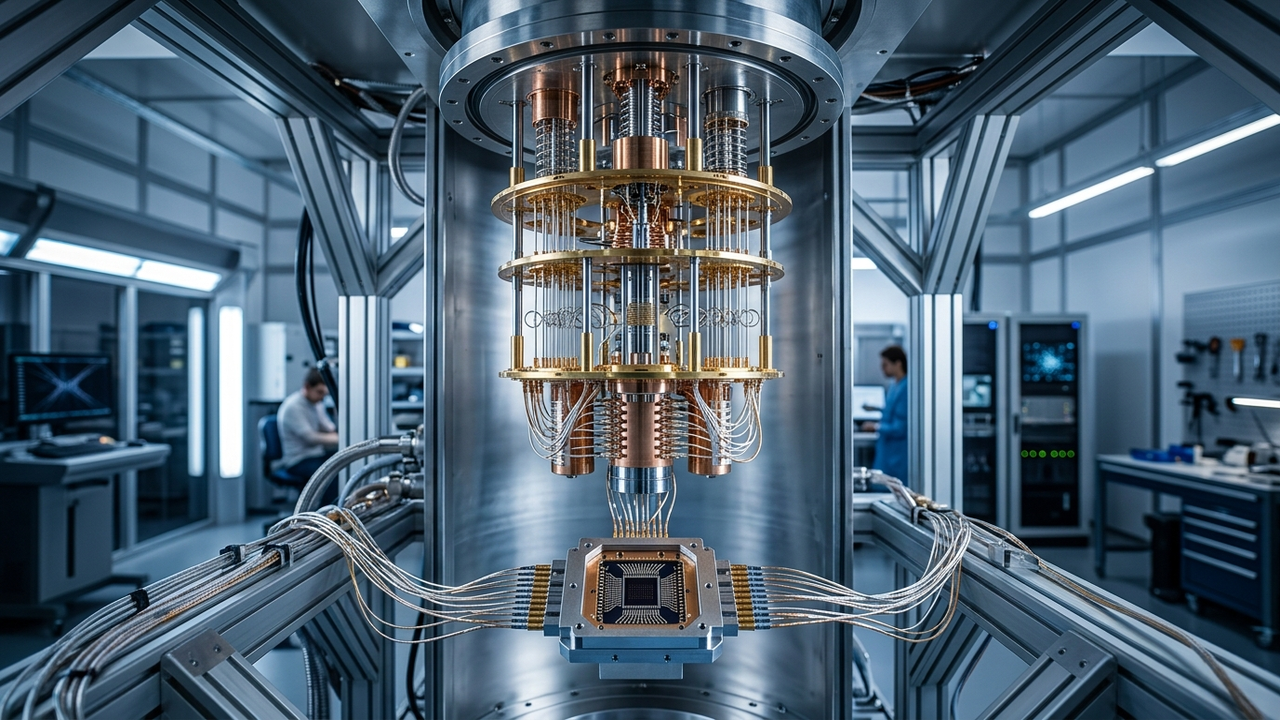
Despite the minuscule size of quantum chips, the overall quantum computer system, particularly in superconducting implementations, remains massive. This disparity arises because extensive, complex support infrastructure is indispensable for maintaining the delicate quantum states of qubits and preventing decoherence. This infrastructure encompasses extreme cryogenic environments, precise control systems, signal amplification, and robust shielding.
Technical / Clinical Details
A quantum chip, the core quantum processor, is typically built on a small silicon or sapphire substrate, often just a few square centimeters in size. However, for the qubits on this tiny chip to maintain their quantum mechanical properties, an extremely specialized environment is required. The most critical element is an ultra-low temperature environment, hovering around 15 millikelvin (colder than deep space), achieved by a large apparatus known as a ‘dilution refrigerator.’ This device, often visually described as a ‘gold chandelier,’ is the central cooling system for superconducting quantum computers. In addition, a complex microwave control system is needed to precisely deliver microwave pulses for qubit manipulation and readout. Amplifiers process the extremely weak signals, multi-layer shielding protects qubits from external electromagnetic noise, and classical electronics manage the entire operation. All these components are essential for maximizing qubit coherence (the duration quantum states can be maintained) and ensuring computational fidelity.
Background & Context
Quantum computing garners significant attention for its computational potential, but its technological realization presents numerous physical and engineering challenges. Superconducting qubits, while benefiting from compatibility with semiconductor manufacturing techniques and relative ease in achieving higher qubit counts, impose the strict requirement of cryogenic temperatures. This leads to the current imbalance where the quantum chip shrinks, but the surrounding operational apparatus grows to enormous sizes. This physical footprint directly impacts the quantum computer’s installation space, power consumption, and maintenance costs, serving as a significant barrier to practical deployment and widespread adoption.
Strategic Significance & Outlook
Current quantum computing R&D efforts are focused not only on increasing qubit count and quality but also on system miniaturization, energy efficiency, and cost reduction. In the future, advancements in cryogenic technologies, increased integration, and the development of new room-temperature qubit technologies (such as topological qubits) could significantly reduce the physical footprint of quantum computers. This explanatory article provides foundational insight into the current physical constraints of quantum computers and hints at how future technological innovations might overcome these limitations, making quantum computing more accessible and deployable for a broader range of applications.
Source: https://nexuswild.com/news/why-quantum-chip-tiny-machine-huge/
Get our weekly technology intelligence — free
Receive an infographic that lets you judge at a glance whether each field’s analysis report is worth reading.
Subscribe Free — Weekly Tech Intelligence
By subscribing, you’ll receive Troy-Technical’s weekly technology intelligence newsletter.
- Your email and selected fields are used only to deliver the newsletter.
- We never share your information with third parties.
- You can unsubscribe anytime via the link in each email.
See our Privacy Policy for details.
Takes about a minute · Unsubscribe anytime








Comments