
Key Findings
An international research team led by Prashanth Menezes at Helmholtz-Zentrum Berlin (HZB) has achieved a significant breakthrough in the electroreduction of CO2 to CO (carbon monoxide) through systematic investigation of silver nanoparticle catalyst layers. By utilizing 10-nanometer silver nanoparticles, the team successfully maintained a remarkable nearly 100% Faradaic efficiency for over 100 hours. Furthermore, this optimized catalyst enables the simultaneous production of valuable formic acid and hydrogen, while reducing the overall energy consumption of the process by more than 30%.
Technical/Clinical Details
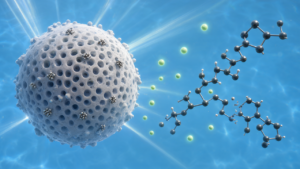
- Catalyst Optimization: The research team meticulously analyzed the influence of silver nanoparticle size and density on the efficiency and selectivity of the CO2 reduction reaction. They discovered that a particle size of approximately 10 nanometers provided the highest catalytic activity and stability. This specific size facilitates optimal interaction between CO2 molecules and reactive sites, suppressing undesirable side reactions.
- High Efficiency and Selectivity: The achieved near 100% Faradaic efficiency signifies that almost all the supplied electrical energy is effectively utilized for the CO2-to-CO conversion. Concurrently, other valuable chemicals like formic acid (HCOOH) and hydrogen (H2) are also produced efficiently, demonstrating the potential for a single process to yield multiple high-value products.
- Energy Consumption Reduction: This optimized electroreduction system reduces overall energy consumption by more than 30% compared to existing CO2 reduction processes. This is a critical factor for economically realizing carbon-neutral fuel and chemical production, especially when integrated with renewable energy sources.
Background & Context
In response to global warming, the development of Carbon Capture and Utilization (CCU) technologies, which aim to reduce atmospheric CO2 and convert it into useful chemical feedstocks or fuels, is rapidly accelerating worldwide. The electroreduction of CO2 to CO is particularly important as a precursor for syngas (a mixture of CO and H2), with wide-ranging applications in the chemical industry. However, the development of catalysts with high energy efficiency and long-term stability has been a major challenge for the practical implementation of this technology. The current silver nanoparticle catalyst represents a significant breakthrough in overcoming this challenge.
Strategic Significance & Outlook
This highly efficient and stable silver nanoparticle catalyst is poised to significantly advance the commercialization of CO2 electroreduction technology. In particular, when coupled with renewable energy sources, it opens pathways for the sustainable production of synthetic fuels and plastic precursors. This can contribute to the decarbonization of the chemical industry and offer substantial economic benefits. Future research and development are expected to focus on further enhancing durability and scaling up the process for industrial applications, solidifying its role in a circular carbon economy.
Source: https://www.miragenews.com/nanosilver-powers-co-reduction-as-1749796/
Get our weekly technology intelligence — free
Receive an infographic that lets you judge at a glance whether each field’s analysis report is worth reading.
Subscribe Free — Weekly Tech Intelligence
By subscribing, you’ll receive Troy-Technical’s weekly technology intelligence newsletter.
- Your email and selected fields are used only to deliver the newsletter.
- We never share your information with third parties.
- You can unsubscribe anytime via the link in each email.
See our Privacy Policy for details.
Takes about a minute · Unsubscribe anytime





Comments