
Key Findings
An international research team has successfully achieved a significant increase in the power conversion efficiency of perovskite solar cells designed for indoor environments. This breakthrough was accomplished by precisely engineering three key elements: bandgap, solvent systems, and passivation techniques. This optimized approach dramatically improves power generation performance under low-light conditions, paving the way for self-powered diverse indoor electronic devices, including IoT devices and smart sensors.
Technical / Clinical Details
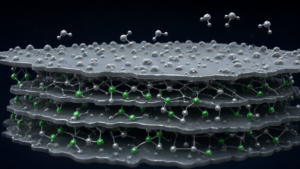
Specifically, the research team first designed perovskite materials with an optimal bandgap tailored to the unique light spectrum of indoor environments (e.g., LED lighting). Next, they optimized the solvent system used during the deposition of the perovskite layer, enhancing the quality of grain boundaries and the uniformity of the film. This led to improved charge carrier mobility and reduced recombination losses. Furthermore, by introducing ‘passivation’ techniques to fill defects at the perovskite layer’s surface and grain boundaries, non-radiative recombination was further suppressed, improving both device stability and efficiency. Through this composite engineering, the team achieved power conversion efficiencies surpassing conventional indoor solar cells under standard indoor illumination (e.g., white LED lighting around 1000 lux).
Background & Context
With the proliferation of IoT devices, there’s a strong demand for energy harvesting technologies that can reduce the burden of battery replacement and enhance device autonomy. Especially in indoor environments, where illumination is much lower and the light spectrum differs significantly from sunlight, efficient energy conversion has been challenging. Conventional silicon solar cells exhibit low efficiency under low-light conditions, limiting their application. Perovskite solar cells, with their excellent light absorption properties and ease of bandgap tunability, have been promising candidates for indoor energy harvesting, but required further efficiency and stability improvements. This research addresses these challenges, maximizing the potential of perovskites in indoor energy harvesting.
Strategic Significance & Outlook
This efficiency enhancement through bandgap, solvent, and passivation engineering will significantly accelerate the commercialization of indoor perovskite solar cells. In the future, battery-free or significantly extended battery-life products are expected in fields such as IoT devices, wearable sensors, and smart home appliances. High-efficiency perovskite solar cells that operate stably under low-light conditions are poised to redefine the energy harvesting market and become an indispensable technology for building sustainable smart device ecosystems. This technology will quietly, yet decisively, bring about changes in various aspects of our daily lives.
Get our weekly technology intelligence — free
Receive an infographic that lets you judge at a glance whether each field’s analysis report is worth reading.
Subscribe Free — Weekly Tech Intelligence
By subscribing, you’ll receive Troy-Technical’s weekly technology intelligence newsletter.
- Your email and selected fields are used only to deliver the newsletter.
- We never share your information with third parties.
- You can unsubscribe anytime via the link in each email.
See our Privacy Policy for details.
Takes about a minute · Unsubscribe anytime




Comments