Key Findings
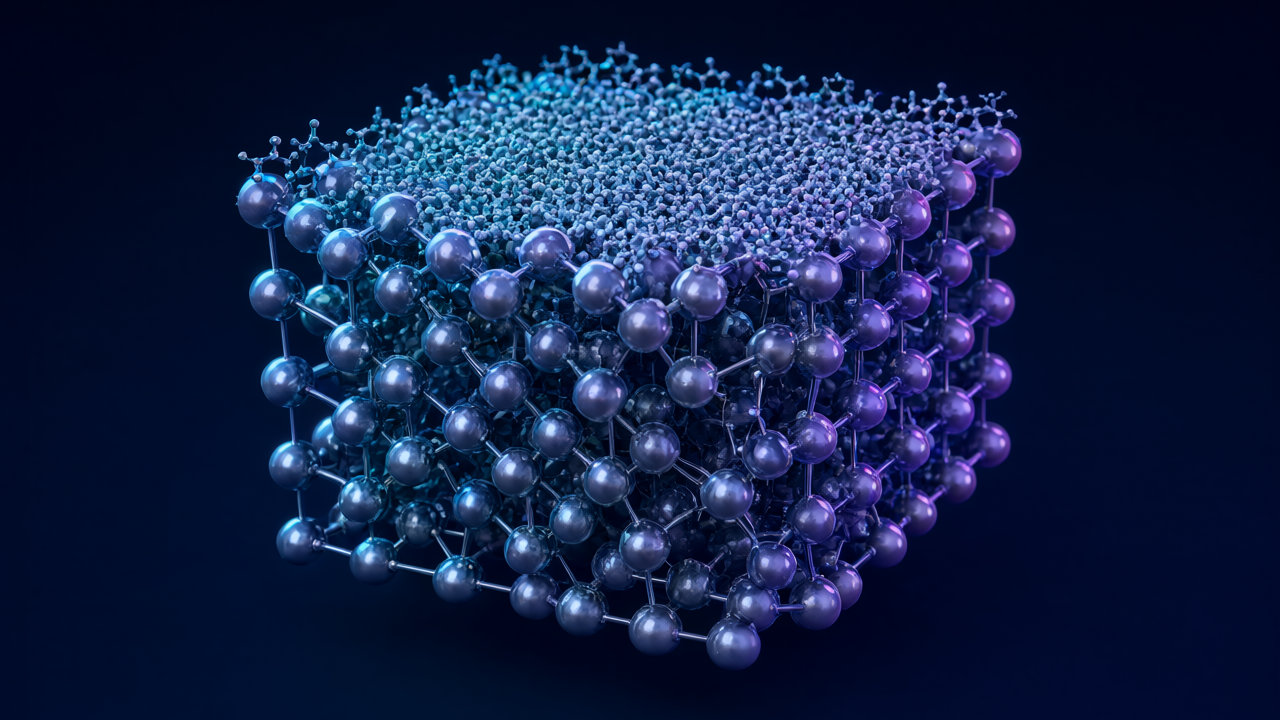
An international research team has developed a novel approach that dramatically enhances the performance of perovskite solar cells, achieving over 25.6% certified power conversion efficiency along with excellent long-term stability. This groundbreaking achievement was realized through a ‘symmetry-breaking co-assembly approach’ that introduces ‘asymmetric molecules’ at the interface between the perovskite layer and the charge transport layer.
Technical / Clinical Details
In this new approach, commonly used symmetric self-assembled monolayers (SAMs), such as MeO-2PACz, are co-assembled with a simple asymmetric molecule, DTCA. This combination effectively suppresses molecular self-aggregation, leading to a much more uniform and dense coverage across the entire perovskite surface and significantly reducing interface defects. As a result, non-radiative recombination of charge carriers is inhibited, and the extraction efficiency of electrons and holes is improved, leading to a substantial enhancement in the overall solar cell efficiency. Furthermore, the improved interface quality contributes to the long-term operational stability of the device, addressing a critical challenge for practical application.
Background & Context
While perovskite solar cells have rapidly achieved high photoelectric conversion efficiencies, charge losses at interfaces and low stability against environmental stress have been major barriers to commercialization. Crucially, precise control of the interface between the perovskite layer and the charge transport layer is paramount for determining device performance. Conventional SAMs faced challenges in forming uniform interfaces due to molecular self-aggregation, a problem fundamentally resolved by the introduction of asymmetric molecules in this research. This technology holds the potential to accelerate the widespread adoption of low-cost, high-performance perovskite solar cells.
Strategic Significance & Outlook
The ‘symmetry-breaking co-assembly approach’ provides new design guidelines for further improving the efficiency and stability of perovskite solar cells. It is expected that this approach will be applied to other perovskite material systems and device architectures, thereby elevating the overall technological level of the industry. Consequently, perovskite solar cells will further enhance their competitiveness against traditional silicon solar cells, solidifying their position as a sustainable energy source. The path to commercialization becomes clearer, with significant potential to contribute to a low-carbon society.
Source: https://www.thecooldown.com/green-tech/perovskite-solar-cell-efficiency-improvement/
Get our weekly technology intelligence — free
Receive an infographic that lets you judge at a glance whether each field’s analysis report is worth reading.
Subscribe Free — Weekly Tech Intelligence
By subscribing, you’ll receive Troy-Technical’s weekly technology intelligence newsletter.
- Your email and selected fields are used only to deliver the newsletter.
- We never share your information with third parties.
- You can unsubscribe anytime via the link in each email.
See our Privacy Policy for details.
Takes about a minute · Unsubscribe anytime





Comments