Key Findings
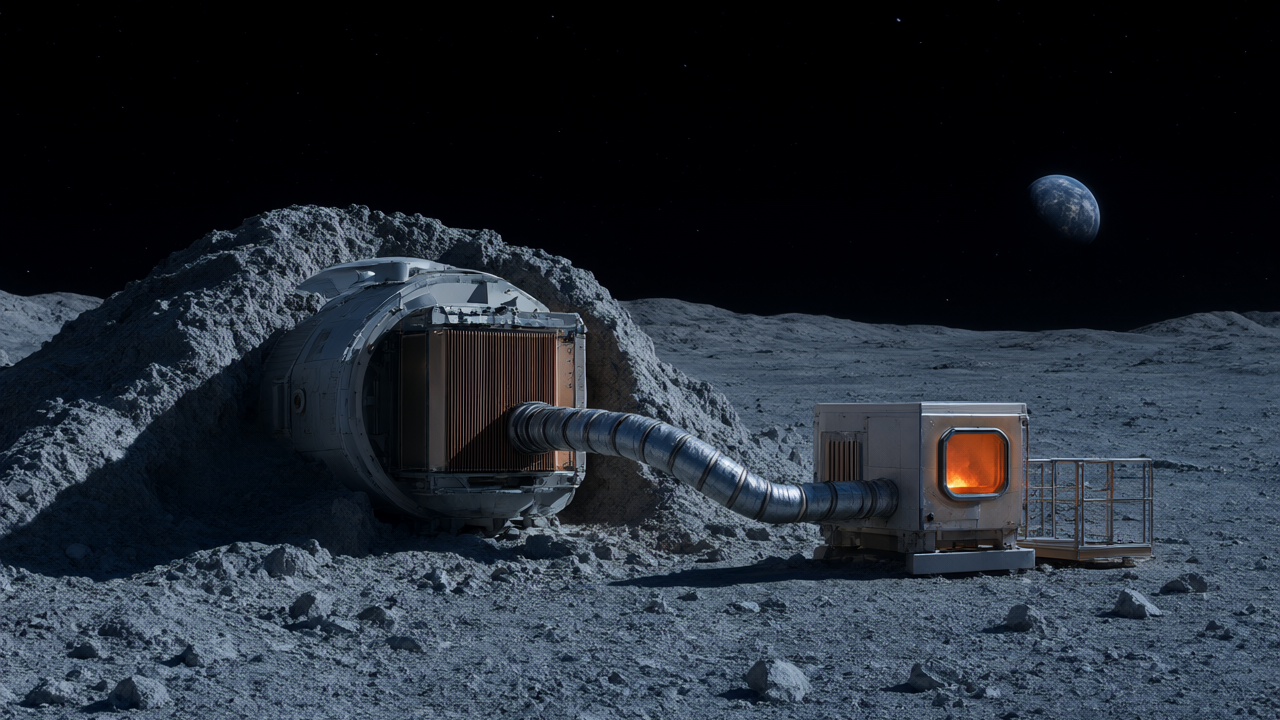
A new preprint paper on arXiv by Julius Mercz and colleagues introduces the concept of an innovative 1,000°C lunar microreactor, dubbed “MULE” (Molten Salt Electrolysis Unit and Reactor), designed to enable next-generation moon base operations. This proposed reactor not only addresses the extreme cold of lunar nights (-223°C) but also offers unprecedented efficiency by directly supplying thermal energy to the molten salt electrolysis process—a critical component of In-Situ Resource Utilization (ISRU) on the Moon.
Technical / Clinical Details
- MULE Microreactor Characteristics: MULE is envisioned to operate at exceptionally high temperatures, around 1,000°C, which is significantly higher than conventional space-grade reactors. This high temperature is crucial for various industrial processes on the Moon, especially for efficient resource extraction in ISRU. The reactor is designed to function stably in the harsh lunar environment, particularly during the prolonged, extremely cold lunar nights (approximately 14 Earth days).
- Direct Heat Supply for ISRU Molten Salt Electrolysis: The molten salt electrolysis process, used to extract industrial materials like oxygen and metals from lunar regolith, requires temperatures exceeding 900°C. MULE directly supplies the necessary thermal energy to this process, minimizing energy conversion losses and achieving very high efficiency. This capability allows for self-sufficient industrial production on the Moon, reducing dependence on Earth-based resupply.
- Autonomous Operation and Safety: MULE is designed for autonomous operation on the lunar surface, aiming to provide safe and reliable power with minimal remote control from Earth or astronaut intervention. Its compact design reduces transportation costs to the Moon and increases deployment flexibility.
Background & Context
Modern lunar exploration missions, such as NASA’s Artemis program, aim to establish a sustained human presence on the Moon and use it as a stepping stone for future Mars exploration. Stable power supply and local resource production capabilities are indispensable for achieving this goal. Conventional solar power systems are inoperative during lunar nights, and batteries provide only limited power. Fission microreactors are emerging as one of the most promising technologies to overcome these challenges, enabling 24/7 power supply on the Moon and facilitating a self-sufficient economy through ISRU.
Strategic Significance & Outlook
The realization of high-temperature microreactors like MULE would make industrial-scale oxygen production, metal refining, and construction material manufacturing on the Moon a reality. This could transform lunar bases from mere exploration outposts into true “off-world habitats.” The MULE concept lays the foundation for a self-sustaining lunar economy, ushering in a new era for humanity’s ability to live and work persistently beyond Earth. This technological development is an indispensable component for the future of space resource utilization and deep-space exploration.
Get our weekly technology intelligence — free
Receive an infographic that lets you judge at a glance whether each field’s analysis report is worth reading.
Subscribe Free — Weekly Tech Intelligence
By subscribing, you’ll receive Troy-Technical’s weekly technology intelligence newsletter.
- Your email and selected fields are used only to deliver the newsletter.
- We never share your information with third parties.
- You can unsubscribe anytime via the link in each email.
See our Privacy Policy for details.
Takes about a minute · Unsubscribe anytime