Key Findings
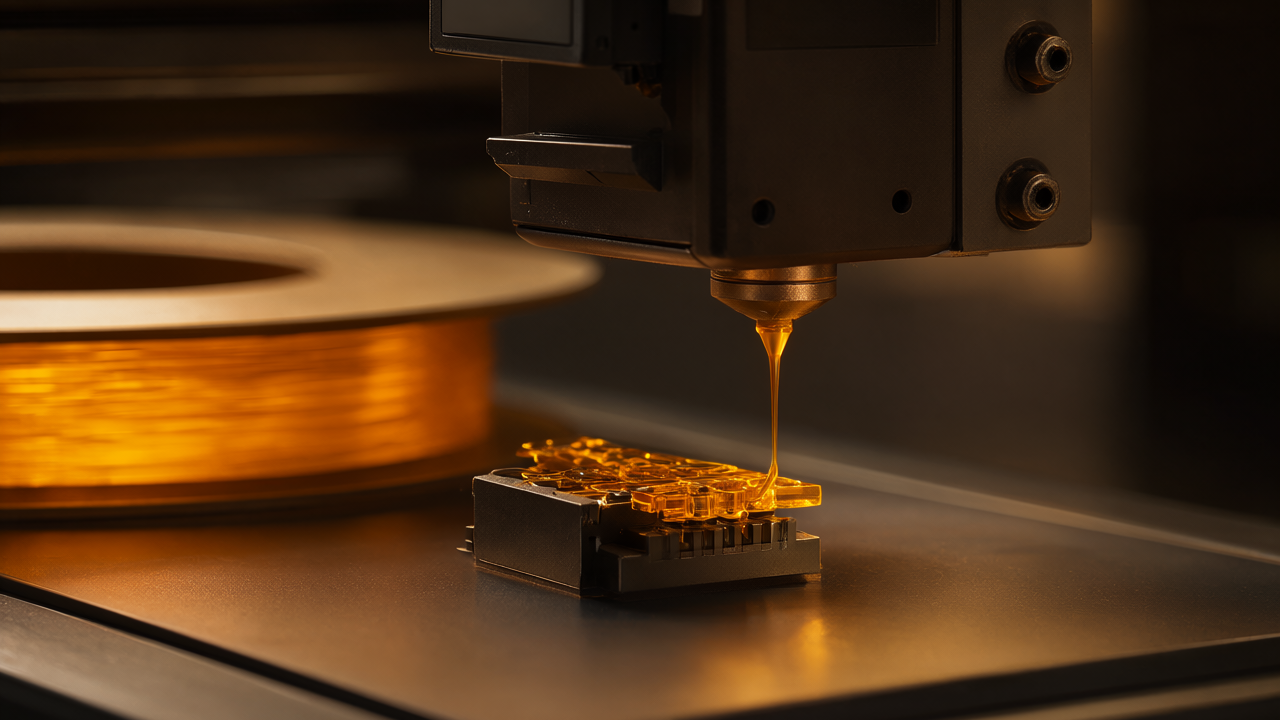
Japanese chemical giants Sumitomo Chemical and Asahi Kasei are accelerating strategic investments and technological innovations in the semiconductor and AI material sectors. Sumitomo Chemical, in partnership with Gutenberg Co., Ltd., has developed a liquid crystal polymer (LCP) filament and proprietary molding technology for FFF (Fused Filament Fabrication) 3D printers, with sample availability beginning in 2026. This breakthrough will enable the manufacturing of complex-shaped parts, such as semiconductor components, humanoid robot parts, and aerospace components, which are difficult to produce with conventional injection molding. Concurrently, Asahi Kasei has developed a new photosensitive polyimide (PSPI) film designed for uniform lamination processes on large square panels and increased insulating layers in advanced packaging, while expanding its production capacity for the existing “SUNFORT” dry film resist (DFR) by 40% to meet surging demand.
Technical / Clinical Details
Sumitomo Chemical’s LCP filament technology is groundbreaking in its ability to make LCP, a material known for its excellent high-frequency characteristics, heat resistance, and dimensional stability, amenable to 3D printing. Traditional LCPs presented challenges in 3D printing due to high melt viscosity, but the company overcame this through optimized material design and process technology. This enables on-demand manufacturing of high-performance parts with complex internal structures, such as semiconductor test sockets, or lightweight aerospace components, which were previously impossible. This dramatically increases design freedom, contributing to reduced development times and costs.
Asahi Kasei’s new PSPI film addresses the demands for multi-layering and miniaturization in advanced packaging. Uniform lamination processes, especially on large panels, directly lead to improved yields. PSPI is used as an insulating layer, ensuring reliable signal transmission between chips and contributing to higher speeds. Moreover, the 40% expansion of production capacity for their existing “SUNFORT DFR,” a photoresist enabling high-precision pattern formation, strengthens their ability to meet robust demand in the semiconductor packaging market. This expansion particularly contributes to stabilizing the supply of AI chips and data center semiconductors, which require high-density integration.
Background & Context
The semiconductor industry, facing the limits of Moore’s Law, increasingly relies on advanced packaging technologies for performance improvement alongside miniaturization. The rise of AI and High-Performance Computing (HPC) has dramatically increased demand for materials with excellent high-frequency signal transmission, high-density integration, and superior heat dissipation. 3D printing technology is gaining traction for diverse applications ranging from prototyping to final product manufacturing, and the availability of high-performance materials will further expand its scope. Japan’s chemical industry has long been a global leader in developing advanced functional materials, and the initiatives by Sumitomo Chemical and Asahi Kasei further enhance Japan’s presence in the global semiconductor supply chain.
Strategic Significance & Outlook
Sumitomo Chemical’s LCP filament will provide unprecedented design flexibility in semiconductor manufacturing equipment components and advanced electronics prototyping, significantly shortening development cycles. Applications in humanoid robots and aerospace sectors will also address needs for lightweighting and complex geometries. Asahi Kasei’s PSPI film and increased DFR production capacity will strongly support trends in advanced packaging, particularly the proliferation of chiplet technology and 3D ICs. This will contribute to enhancing the performance and reducing the cost of AI chips, accelerating the realization of next-generation electronic devices. The initiatives from both companies are critical strategies for the Japanese chemical industry to open new growth areas by meeting the high-performance material needs of the AI era.
Source: https://www.adsalecprj.com/en/news/article_details/90201.html
Get our weekly technology intelligence — free
Receive an infographic that lets you judge at a glance whether each field’s analysis report is worth reading.
Subscribe Free — Weekly Tech Intelligence
By subscribing, you’ll receive Troy-Technical’s weekly technology intelligence newsletter.
- Your email and selected fields are used only to deliver the newsletter.
- We never share your information with third parties.
- You can unsubscribe anytime via the link in each email.
See our Privacy Policy for details.
Takes about a minute · Unsubscribe anytime