


Key Findings
The GNN representation of junction–block graphs outperforms MLP-based fixed descriptors and transformer-encoded canonical sequences in predicting the critical segregation parameter (χN)*. Specifically, the GNN provides the best balance between interpolation within training ranges and extrapolation to larger chain graphs. The model’s effectiveness was further validated through transfer learning to predict instability-wavenumber (k*), demonstrating that the learned representations can be reused across different tasks.
Technical Details
The researchers utilized the random-phase approximation (RPA) as a physics-grounded benchmark, as RPA predictions of disordered-state instability depend on intramolecular correlations organized by blocks, shared junctions, and intervening contour paths. The GNN maps junction–block graphs to fixed-dimensional vectors, effectively linking chain architecture to field-theoretic response. To understand the mechanism of extrapolation, the study employed layerwise diagnostics to track the development of RPA-related structural information during the message-passing process.
Background & Context
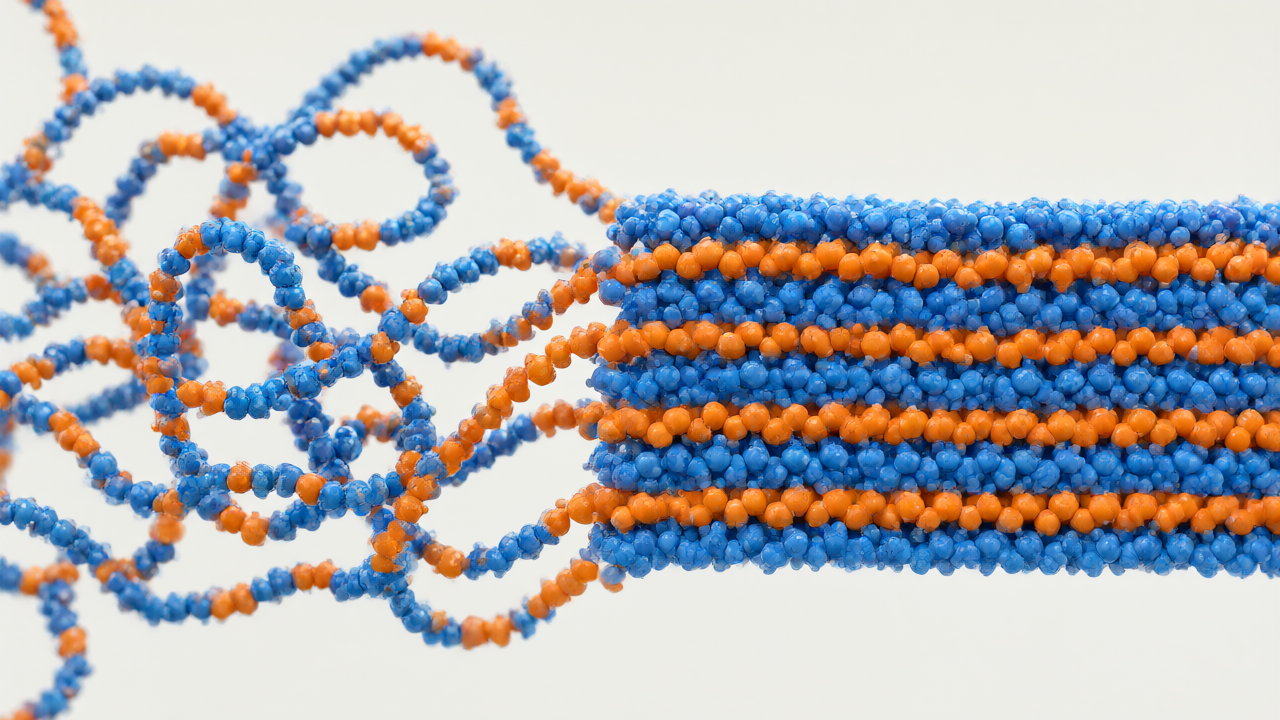
Block copolymers (BCPs) form periodic nanostructures based on composition, segregation strength, and chain architecture. While advances in synthesis and field-theoretic simulation allow for the investigation of diverse topologies, the parameter space expands rapidly with each additional block or junction. Previous graph-based methods have automated field-theoretic calculations or reused structurally equivalent branches, but these required separate solutions for nonequivalent architectures. Similarly, existing polymer informatics tools like BigSMILES, TransPolymer, and G2RINS have focused primarily on property prediction or conformational observables rather than architecture-dependent field-theoretic responses.
Significance & Outlook
By creating a representation that reuses response information across different chain architectures while retaining physical structural data, this GNN approach accelerates the exploration of the BCP architecture space. This framework allows for the reconstruction of stability-limit curves and establishes a foundation for future self-consistent field theory exploration of ordered phase space across complex topologies.
Source: https://arxiv.org/html/2610.20374v1
Get our weekly technology intelligence — free
Receive an infographic that lets you judge at a glance whether each field’s analysis report is worth reading.
Subscribe Free — Weekly Tech Intelligence
By subscribing, you’ll receive Troy-Technical’s weekly technology intelligence newsletter.
- Your email and selected fields are used only to deliver the newsletter.
- We never share your information with third parties.
- You can unsubscribe anytime via the link in each email.
See our Privacy Policy for details.
Takes about a minute · Unsubscribe anytime