


Key Findings
A collaborative research team from Southwest Petroleum University, the Chinese Academy of Sciences, Shanghai Normal University, Chongqing University, and the University of Chinese Academy of Sciences has pushed the certified efficiency of perovskite-silicon tandem solar cells to 32.28%, with a champion efficiency reaching 33.06%. This performance gain was achieved specifically through the redesign of the front electrode rather than modifications to the light-absorbing layers.
Technical Details
The team replaced the conventional indium zinc oxide in the front electrode with tungsten-doped indium oxide (IWO). IWO provides a lower work function, which improves electron extraction, and increases the transmission of near-infrared light to the bottom silicon cell. With identical metal grids, this change increased champion efficiency from 31.65% to 32.49%, driven primarily by a fill factor increase from 78.74% to 79.51%.
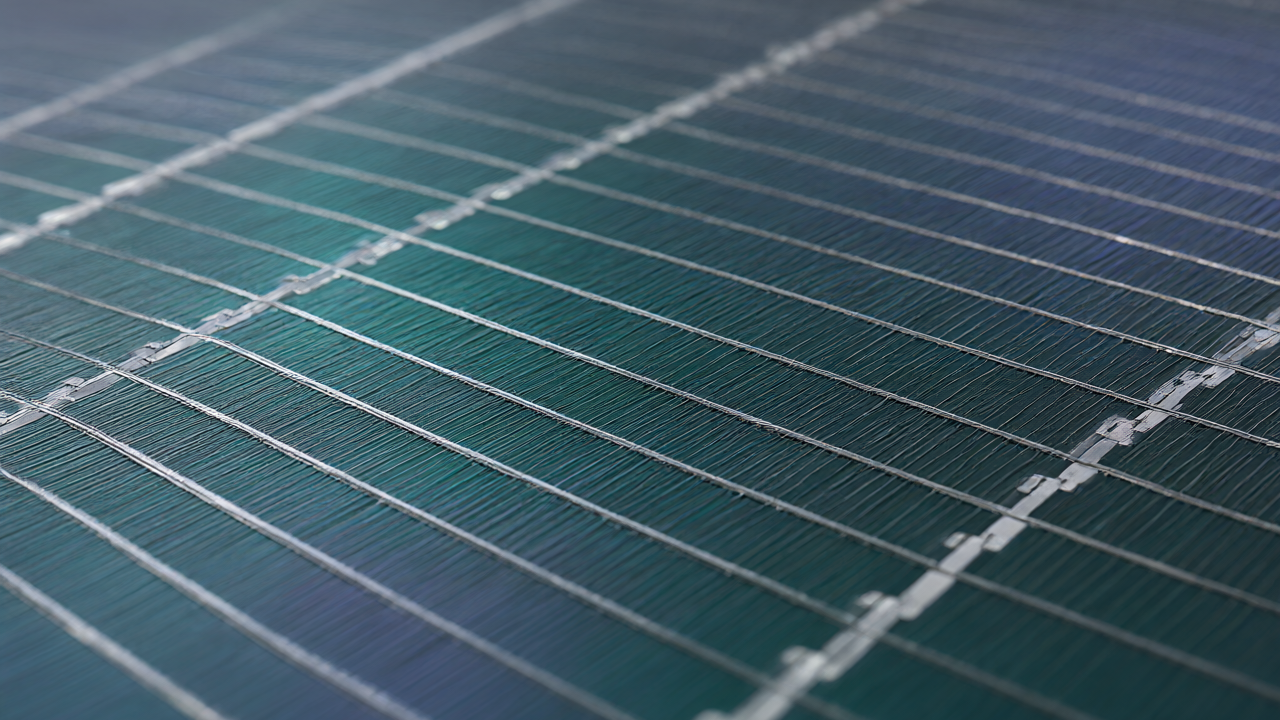
To further optimize performance, the researchers developed a simulation tool to balance the trade-off between grid line shading and resistance losses. Experimental results indicated that the optimal configuration consisted of lines approximately 50 µm wide with a spacing of 2.5 mm. This optimization resulted in a champion cell with the following specifications:
- Open-circuit voltage: 1.973 V
- Short-circuit current density: 20.72 mA/cm²
- Fill factor: 80.87%
Stability and Manufacturing
Stability tests on unencapsulated cells showed that those using the IWO electrode retained 91.3% of their initial efficiency after 500 hours of maximum power point tracking under one-sun illumination, outperforming the 86.1% retention of standard electrodes.
The researchers noted that the design rules are applicable to industrial manufacturing, as current methods—including electroplating, screen printing, and laser transfer printing—can produce metal lines as narrow as 10 µm.
Significance and Outlook
While these results were achieved on small-area devices, the team identified several remaining challenges for scaling. These include the reduction of indium usage and the achievement of uniform, large-area deposition of the transparent oxide within the temperature constraints of perovskites.
Get our weekly technology intelligence — free
Receive an infographic that lets you judge at a glance whether each field’s analysis report is worth reading.
Subscribe Free — Weekly Tech Intelligence
By subscribing, you’ll receive Troy-Technical’s weekly technology intelligence newsletter.
- Your email and selected fields are used only to deliver the newsletter.
- We never share your information with third parties.
- You can unsubscribe anytime via the link in each email.
See our Privacy Policy for details.
Takes about a minute · Unsubscribe anytime