

Key Findings
The latest microfabricated monolithic 3D ion traps demonstrate heating rates of approximately 1 quanta per second with Yb+ ions, a performance level comparable to cryogenic ion traps despite operating at room temperature. These traps achieve electric field depths in the electron volt range and support long motional Ramsey coherence times of around 96 milliseconds. Additionally, the design provides high multidirectional optical access with a numerical aperture (NA) of 0.7, facilitating precise state detection and single-ion manipulation.
Technical Details
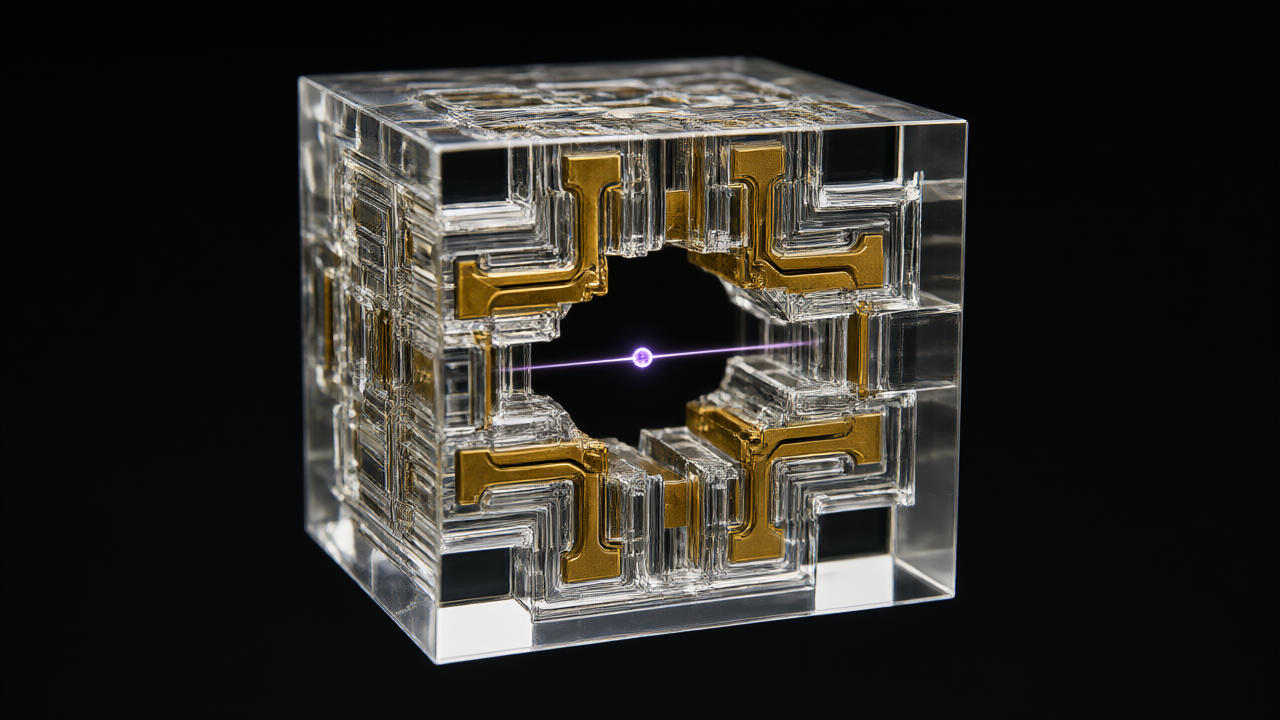
The traps are fabricated using Translume Inc.’s femtoEtch process on fused silica substrates, allowing for micron-level precision and the support of high voltages exceeding 450V peak to peak. Key technical features include:
- Segmented Electrode Geometry: Enables zone-based control and the creation of stable, reconfigurable trapping potentials for manipulating individual ions within a larger chain.
- Ion-Electrode Distance: The design maximizes the distance between ions and electrodes to minimize disruptive interactions and reduce heating rates.
- Voltage Control: Researchers demonstrated the ability to manipulate heating rates of each radial mode frequency by inverting the sign of the “twist” voltage.
- Trapping Potentials: The traps support axially homogeneous radial trapping potentials and exhibit low excess micromotion.
Background & Context
Previous monolithic 3D traps faced challenges manipulating heavier ionic species, such as barium and ytterbium, because these ions typically require higher radio frequency voltages or shorter ion-electrode distances to match the frequencies of lighter ions like beryllium or calcium. However, reducing the distance usually increases heating rates, which degrades motional mode coherence. This new design overcomes these hurdles by maintaining a relatively large ion-electrode distance without compromising trap integrity or performance.
Significance & Outlook
The combination of low heating rates, high photon collection efficiency, and fabrication repeatability provides a pathway toward scalable quantum computing architectures. By enabling the individual addressing of ions within a crystal, this platform extends the application of ion trapping beyond simulation to include quantum networking and metrology.
Source: https://quantumzeitgeist.com/translume-3d-traps-ion-crystals-host/
Get our weekly technology intelligence — free
Receive an infographic that lets you judge at a glance whether each field’s analysis report is worth reading.
Subscribe Free — Weekly Tech Intelligence
By subscribing, you’ll receive Troy-Technical’s weekly technology intelligence newsletter.
- Your email and selected fields are used only to deliver the newsletter.
- We never share your information with third parties.
- You can unsubscribe anytime via the link in each email.
See our Privacy Policy for details.
Takes about a minute · Unsubscribe anytime