


Key Findings
NTT and Professor Hiroyuki Osaka of Ritsumeikan University have developed a new calculation method to determine the success probability limits of “inter-chip quantum operations” in distributed quantum computing architectures. By applying algebraic geometry to classify and search for the most efficient realization methods of quantum operations, the researchers achieved calculation speeds over 100 times faster and precision over 10 times higher than previous methods.
Technical Details
The research focuses on the relationship between the quality of quantum entanglement and the maximum success probability of quantum gates, referred to as the “limit curve.” The technical breakthrough consists of two primary components:
- Algebraic-Geometric Decomposition: The researchers used algebraic geometry to mathematically organize the realization methods of inter-chip quantum gates, decomposing the vast “search space” of possible processing combinations into smaller, manageable elements.
- Individual Element Exploration: Instead of approximating the entire search space at once, the method explores these decomposed elements individually and incrementally increases approximation accuracy.
Additionally, the study theoretically demonstrated that achieving a 100% success probability for a wide range of inter-chip quantum operations requires the highest possible quality of quantum entanglement.
Background and Context
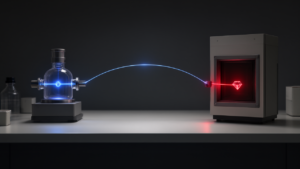
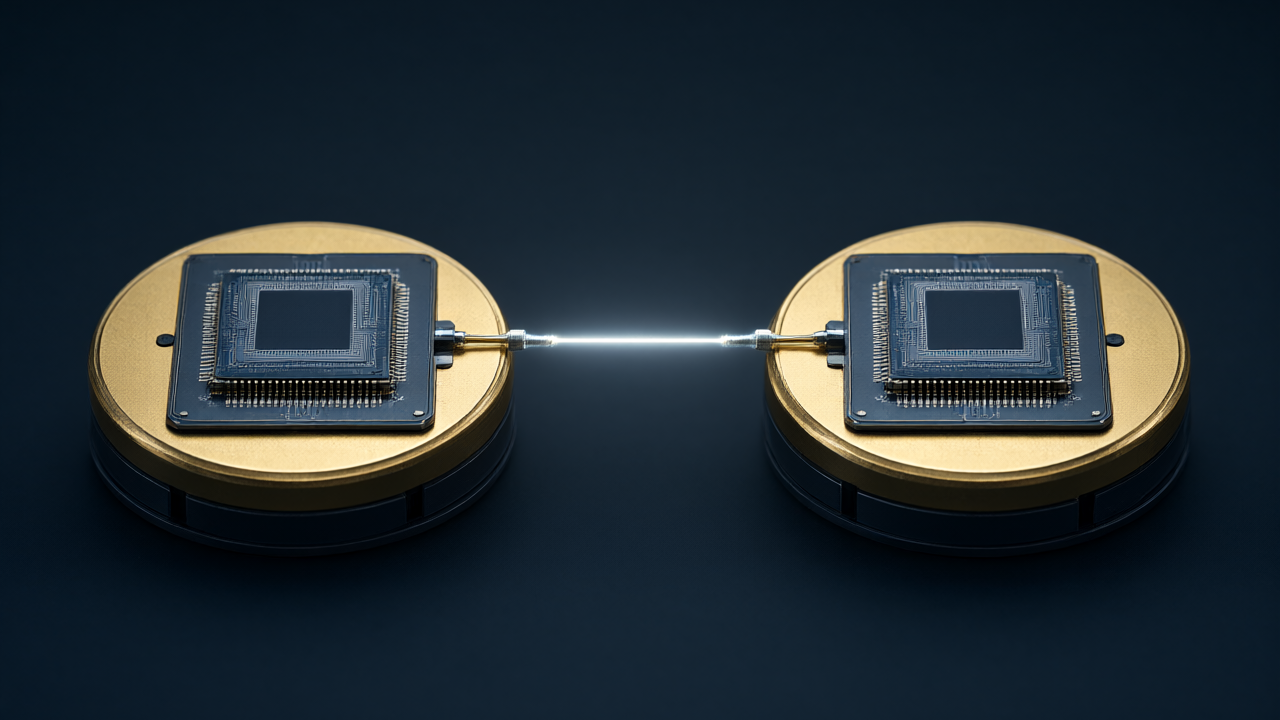
Scaling quantum computers is hindered by the physical limits of single chips, which often require extreme cooling in refrigeration units. Distributed architectures, which link multiple chips via quantum entanglement, offer a path to larger systems. However, entanglement is susceptible to noise, which reduces the success rate of inter-chip quantum gates and degrades overall computational accuracy. Previously, calculating these limits was either too time-consuming or required custom redesigns for every specific quantum gate.
Significance and Outlook
This method is compatible with various quantum computer implementations, including optical quantum computing, and adapts to different chip configurations and noise types. The findings were published in Letters in Mathematical Physics. Future work will focus on verifying these theoretical optimal procedures using actual quantum devices to refine chip design and connection methods.
Source: https://prtimes.jp/main/html/rd/p/000000053.000181531.html
Get our weekly technology intelligence — free
Receive an infographic that lets you judge at a glance whether each field’s analysis report is worth reading.
Subscribe Free — Weekly Tech Intelligence
By subscribing, you’ll receive Troy-Technical’s weekly technology intelligence newsletter.
- Your email and selected fields are used only to deliver the newsletter.
- We never share your information with third parties.
- You can unsubscribe anytime via the link in each email.
See our Privacy Policy for details.
Takes about a minute · Unsubscribe anytime