


Key Findings
The integrated plasmonic and machine learning system can rapidly and selectively detect Escherichia coli, a primary indicator of contamination in food and water. The sensor demonstrates high sensitivity, with a refractive index sensitivity of 195.3 nanometers per refractive index unit. The team identified two independent limits of detection: 21.2 CFU based on absorbance intensity variation and 36.9 CFU based on peak shift analysis, across a bacterial concentration range from 1 to 10^7 colony-forming units (CFU).
Technical Details
The sensor utilizes core-shell Ag@Au nanoparticles designed to exploit localized surface plasmon resonance (LSPR). The architecture combines a silver core for high sensitivity to refractive index changes with a gold shell for chemical stability and ease of functionalization. The optimal configuration was achieved using 75 microliters of chloroauric acid (HAuCl4) during synthesis.
- Selectivity: Nanoparticles are functionalized with anti-E. coli antibodies, verified via Fourier-transform infrared (FTIR) spectroscopy, allowing the sensor to distinguish E. coli from other microorganisms.
- Signal Processing: As bacterial concentration increases, the LSPR peak shifts toward longer wavelengths and absorbance intensity decreases.
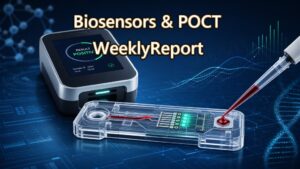
- Integration: A smartphone camera captures images of the sensing platform, which are then processed by a k-nearest neighbors (k-NN) machine learning algorithm to classify samples into regulatory compliance categories.
Background & Context
Conventional E. coli detection typically requires culturing bacteria over several days in a laboratory setting, which is often too slow to prevent contaminated products from reaching consumers. While silver nanoparticles offer high sensitivity, they are prone to oxidation; the addition of the gold shell protects the silver core while maintaining the necessary optical responsiveness.
Significance & Outlook
By pairing a low-cost optical transducer with lightweight machine learning, this system removes the need for expensive benchtop spectrometers. This integration allows for the rapid sorting of food and water safety results according to established regulatory standards, providing a scalable alternative for environmental monitoring and public health intervention.
Source: https://bioengineer.org/core-shell-nanoparticles-and-smartphones-team-up-to-catch-e-coli-in-minutes/
Get our weekly technology intelligence — free
Receive an infographic that lets you judge at a glance whether each field’s analysis report is worth reading.
Subscribe Free — Weekly Tech Intelligence
By subscribing, you’ll receive Troy-Technical’s weekly technology intelligence newsletter.
- Your email and selected fields are used only to deliver the newsletter.
- We never share your information with third parties.
- You can unsubscribe anytime via the link in each email.
See our Privacy Policy for details.
Takes about a minute · Unsubscribe anytime