
Key Findings
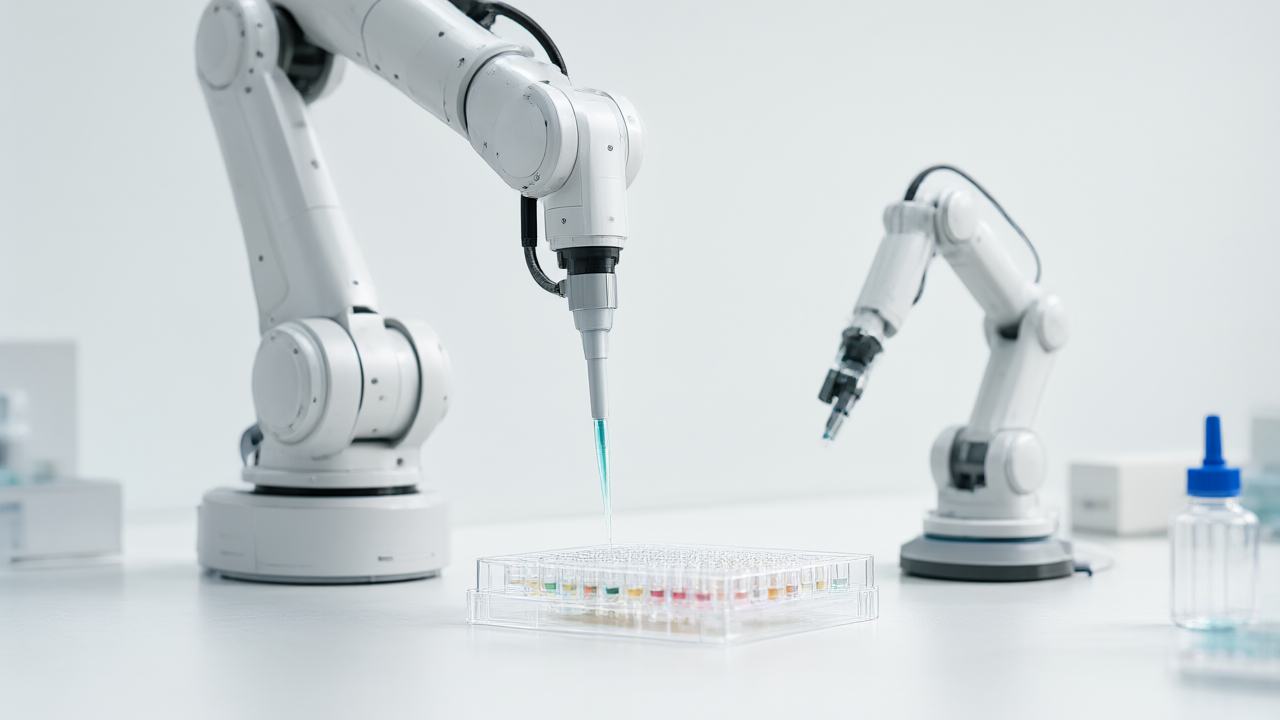
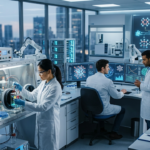
Google Research has developed a system to bridge the gap between in-silico AI exploration and real-world wet-lab experimentation. The primary achievement is the creation of a closed-loop system where AI agents ideate, execute experiments, and learn from results. This approach has successfully discovered single-digit nanomolar protein binders for cancer targets and improved the accuracy of blinded dye mixture reconstruction by more than fivefold through iterative self-play.
Technical Details: The VERID Framework
The VERified Infrastructure for Discovery Laboratories (VERID) acts as a semantic digital twin of the laboratory workcell. Built on the open-source PyLabRobot framework, it tracks a 3D volumetric entity tree including robotic arm geometry, reagent identities, pipette tip inventory, and well volumes. VERID provides four core capabilities:
- Live 3D state tracking: Real-time monitoring of deck layout and volumes.
- Fast virtual dry runs: Rapid simulation to detect collisions or empty wells.
- Hardware safety checks: Blocking physically impossible or logistically invalid commands.
- Synchronized logs: Combining multi-camera views with action logs for reproducibility.
In practice, this allowed agents to refine mixing strategies after detecting uneven dye stratification via video and to recover from plate-reader failures mid-run without re-pipetting.
Background and Context
Biology research faces a massive combinatorial search space; for example, a single 100-amino-acid protein has at least 20100 possible sequences. While AI hypothesis generation is advancing, physical wet-lab experiments have become a bottleneck. Furthermore, frontier models often struggle with 3D geometry and physical state reasoning, which is critical for operating liquid-handling robots.
Significance and Outlook
To prototype lab-in-the-loop discovery, Google used protein-binding DNA aptamers as a “sandbox” due to their fast 7–10 day design-test-analyze cycles. By iteratively designing, synthesizing, selecting, and sequencing candidates, agents can separate biological signals from experimental noise. This framework establishes a foundation for autonomous agents to navigate complex biological landscapes with minimal human intervention.
Get our weekly technology intelligence — free
Receive an infographic that lets you judge at a glance whether each field’s analysis report is worth reading.
Subscribe Free — Weekly Tech Intelligence
By subscribing, you’ll receive Troy-Technical’s weekly technology intelligence newsletter.
- Your email and selected fields are used only to deliver the newsletter.
- We never share your information with third parties.
- You can unsubscribe anytime via the link in each email.
See our Privacy Policy for details.
Takes about a minute · Unsubscribe anytime