
Key Findings
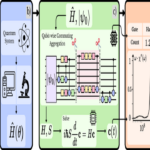
Yonsei University researchers have introduced a neural QEC decoder based on the Mamba structured state-space architecture that significantly lowers the computational overhead of deep-learning decoding. The team demonstrated that this architecture reduces complexity from $O(d^4)$ to $O(d^2)$ in code distance $d$. In benchmarks using experimental memory and the Google Quantum AI Sycamore hardware dataset, the Mamba decoder matched the accuracy of Transformer-based models, such as AlphaQubit, while providing a distinct advantage in error suppression when accounting for decoder-induced latency noise.
Technical Details
In planar surface codes, syndrome extraction generates sequences based on the number of stabilizers ($N_{stab} = d^2 – 1$). While standard Transformer decoders rely on multi-head self-attention mechanisms that perform pairwise comparisons between all stabilizer tokens—resulting in $O(d^4)$ scaling—the Mamba decoder utilizes selective state-space layers. This approach employs input-dependent linear scans to maintain historical syndrome contexts within compressed hidden states, bypassing the quadratic bottlenecks of self-attention.
Background and Context
The necessity for this architecture stems from the strict timing constraints of fault-tolerant quantum computing. On superconducting hardware, physical cycle times typically range between 200 and 1,000 ns; if a decoder cannot process syndromes within this window, idling physical data qubits accumulate uncorrected environmental noise. Under the circuit-level depolarizing SI1000 model, the latency-induced error gap between the Mamba model and Transformer models expanded monotonically from $d = 3$ through $d = 9$.
Significance and Outlook
While the Mamba architecture resolves the scaling bottleneck, the researchers note that physical deployment requires overcoming edge-compute limitations. To execute inference within sub-microsecond cycle budgets, the recurrent core, dilated convolutions, and ResNet feature embedders must be ported onto custom application-specific integrated circuits (ASICs) or low-latency field-programmable gate arrays (FPGAs). The research has been published in npj Quantum Information, with numerical datasets available on GitHub.
Get our weekly technology intelligence — free
Receive an infographic that lets you judge at a glance whether each field’s analysis report is worth reading.
Subscribe Free — Weekly Tech Intelligence
By subscribing, you’ll receive Troy-Technical’s weekly technology intelligence newsletter.
- Your email and selected fields are used only to deliver the newsletter.
- We never share your information with third parties.
- You can unsubscribe anytime via the link in each email.
See our Privacy Policy for details.
Takes about a minute · Unsubscribe anytime