
Key Findings
Researchers in China have developed a printable perovskite solar ink that reaches a certified efficiency of 21.07% on paper-sized panels. By adding a slow-curing epoxy resin to the precursor liquid solution, the team successfully mitigated the performance drops typically associated with scaling up from small lab-scale spin-coated cells to larger substrates.
Technical Details
The primary technical challenge in solvent-based solar cells is the rapid evaporation of solvents over large surfaces, which often leads to uneven grain formation and the creation of pinholes. To counter this, the engineers utilized a controlled cross-linking agent within the liquid semiconductor ink to regulate polymerization during solvent stripping.
- Support Matrix: The low-polymerization-rate epoxy creates a transient support matrix that slows crystallization.
- Crystal Uniformity: This control prevents crystals from clumping and ensures the ink is distributed evenly across the substrate.
- Interface Optimization: Cross-linking reactions align ion precursors into dense perovskite crystal grains, reducing small voids that typically dissipate electrical charges as heat.
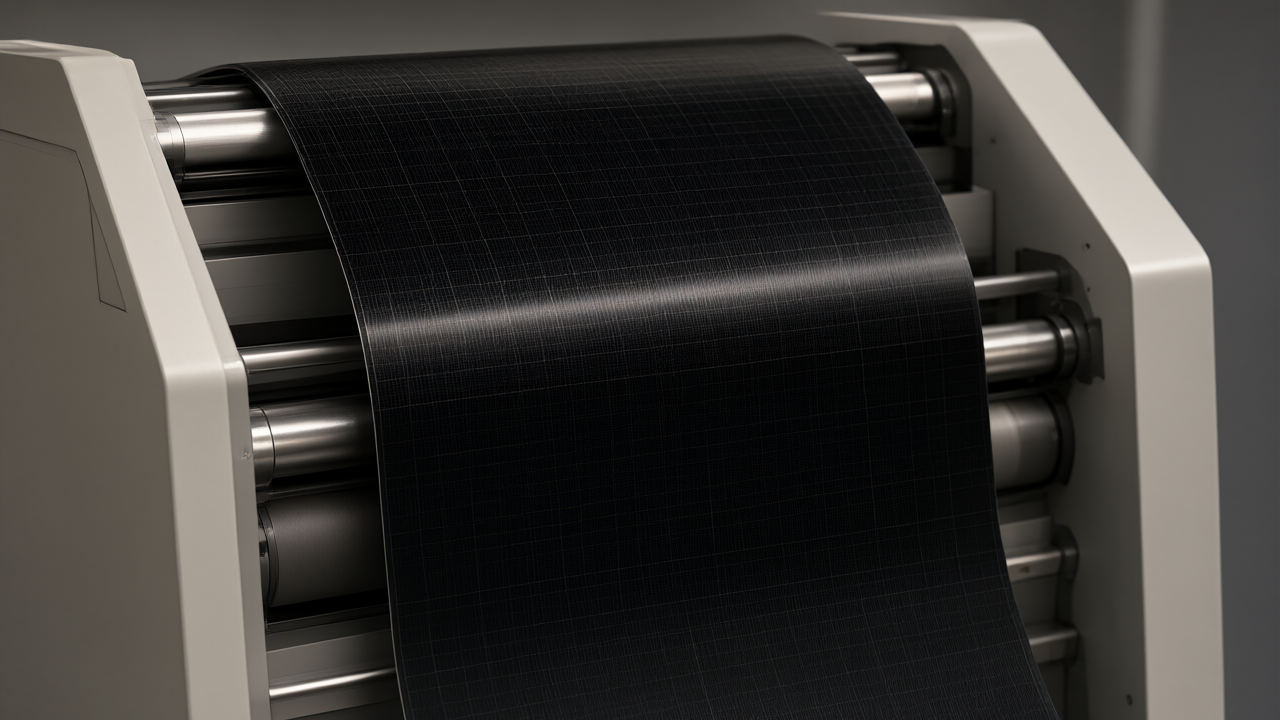
- Application Method: The ink was applied to paper-sized substrates using an automated blade-coating system.
Background and Context
While small-scale cells often show excellent efficiency, increasing the scale during manufacturing usually results in drastic performance losses. The use of the epoxy additive allows for stable optoelectronic characteristics across the entire active semiconductor surface area, although slight deviations in thickness on larger surfaces may still prevent the absolute highest efficiencies seen in smaller panels.
Significance and Outlook
The transition to commercial application faces several industrial barriers. While step-growth polymerization works for paper-sized samples, commercial production will require faster roll-to-roll equipment and stricter control of thermal and environmental conditions to prevent edge inconsistencies. Additionally, the cost of special epoxy additives is currently higher than the precursors used in silicon technology. Long-term durability under outdoor conditions and the reduction of polymer synthesis costs remain critical requirements for industrial implementation.
Source: https://www.ecoportal.net/en/chinese-engineers-epoxy-printable-solar/43624/
Get our weekly technology intelligence — free
Receive an infographic that lets you judge at a glance whether each field’s analysis report is worth reading.
Subscribe Free — Weekly Tech Intelligence
By subscribing, you’ll receive Troy-Technical’s weekly technology intelligence newsletter.
- Your email and selected fields are used only to deliver the newsletter.
- We never share your information with third parties.
- You can unsubscribe anytime via the link in each email.
See our Privacy Policy for details.
Takes about a minute · Unsubscribe anytime