Key Findings
Researchers have developed a Pt/Fe-NC catalyst that sustains hydrogen production for 500 hours at a high current density of 1.5 A cm−2 and for more than 2,000 hours at 10 mA cm−2. This performance was achieved by combining the catalyst with pulsed electrolysis, ammonia replenishment, and intermittent acid washing. The catalyst reached an ammonia oxidation mass activity of 733 A per gram of platinum.
Technical Details
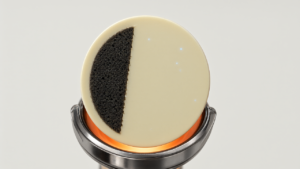
The catalyst consists of platinum nanoparticles supported on nitrogen-doped carbon containing atomically dispersed iron sites. It addresses two primary deactivation pathways common in platinum-based catalysts: the oxidation of the platinum and poisoning by nitrogen species that bind to active sites.
- Activity Enhancement: Electron transfer from the support suppresses platinum oxidation and accelerates the rate-determining dehydrogenation step of the ammonia oxidation reaction.
- In Situ Regeneration: The iron-nitrogen-carbon substrate facilitates a water-assisted pathway. This process hydrogenates poisonous adsorbed nitrogen species back into reactive NH-containing intermediates, which then dimerize and leave the surface.
Background & Context
Ammonia is considered an attractive hydrogen carrier due to its ease of storage and transport. While electrochemical cracking offers a sustainable route for decentralized hydrogen production, conventional platinum catalysts typically fail as they “choke” on accumulated nitrogen. The study utilizes operando spectroscopy and characterization of the platinum oxidation state to demonstrate the integrated design for managing this poisoning.
Significance & Outlook
If these durability figures are reproduced outside the laboratory, the approach could be critical for the emerging hydrogen economy. However, as the reported performance figures and mechanistic claims are based on the authors’ own measurements and the original article is behind a subscription paywall, independent replication is required to determine how the catalyst performs in practical electrolyzer hardware over longer timescales.
Get our weekly technology intelligence — free
Receive an infographic that lets you judge at a glance whether each field’s analysis report is worth reading.
Subscribe Free — Weekly Tech Intelligence
By subscribing, you’ll receive Troy-Technical’s weekly technology intelligence newsletter.
- Your email and selected fields are used only to deliver the newsletter.
- We never share your information with third parties.
- You can unsubscribe anytime via the link in each email.
See our Privacy Policy for details.
Takes about a minute · Unsubscribe anytime