Key Findings
The simulation reveals that operating temperature and current density are the primary drivers of PEM electrolyzer failure. Increasing the temperature from 50 to 90 degrees Celsius reduces the predicted lifetime from 7000 hours to 1445 hours, with the degradation rate rising from 25 to 76 microvolts per hour. Similarly, raising the current density from 1 to 3 amperes per square centimeter cuts the simulated lifetime from 6440 hours to 520 hours, accelerating the degradation rate from 16.7 to 259.6 microvolts per hour.
Technical Details
Developed by Boshi Xu, Qiang Liao, and colleagues, the three-dimensional multiphysics model couples three dominant degradation processes:
- Ionomer Chemical Degradation: Hydrogen peroxide forms at the cathode, and Fe2+ impurities drive a Fenton reaction that generates hydroxyl radicals, which cleave the polymer backbone and destroy proton-conducting sulfonate groups.
- Catalyst Dissolution: Iridium dioxide (IrO2) forms an intermediate during the oxygen evolution reaction; a fraction of this becomes soluble trivalent iridium species, permanently removing the catalyst.
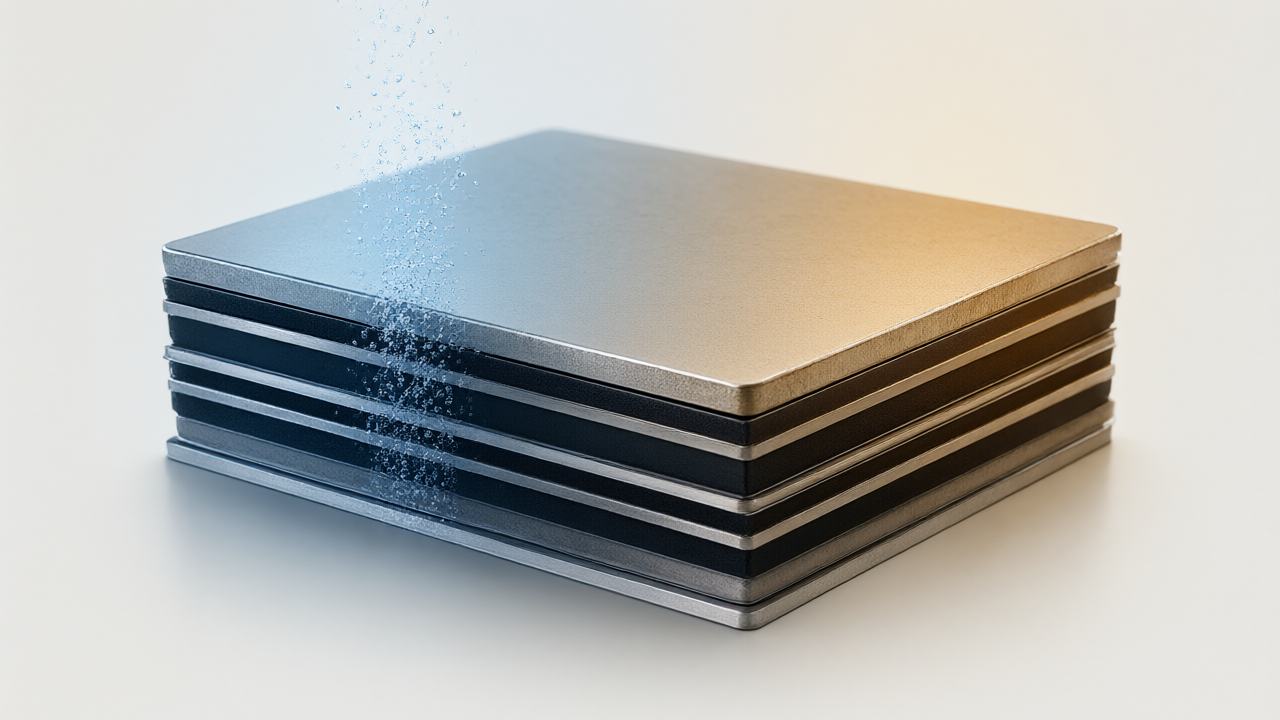
- Titanium Corrosion: The model tracks the growth of a semiconducting TiO2 passivation film on bipolar plates and porous transport layers, which increases contact resistance.
Validation via a 300-hour test on a 2.6 by 2.6 centimeter cell showed a maximum absolute error of 20 millivolts. Experimental data confirmed membrane thinning from 127 micrometers to 121 micrometers and a surge in contact resistance from 0.602 to 2.235 milliohms.
Background & Context
PEM electrolyzers face commercialization hurdles due to poor durability. Because multiple degradation mechanisms occur simultaneously, experimental data alone cannot easily quantify individual contributions. This model addresses the gap by simulating the entire history from startup to failure.
Significance & Outlook
The model identifies shifts in failure mechanisms based on conditions. At 50 to 80 degrees, failure is defined by voltage reaching 110 percent of its initial value, but at 90 degrees, failure occurs when catalyst particles dissolve to 80 percent of their initial size. Ionomer degradation is the dominant factor overall, contributing 42 to 61 percent of total degradation.
Source: https://bioengineer.org/new-model-tracks-how-pem-electrolyzers-fail-over-thousands-of-hours/
Get our weekly technology intelligence — free
Receive an infographic that lets you judge at a glance whether each field’s analysis report is worth reading.
Subscribe Free — Weekly Tech Intelligence
By subscribing, you’ll receive Troy-Technical’s weekly technology intelligence newsletter.
- Your email and selected fields are used only to deliver the newsletter.
- We never share your information with third parties.
- You can unsubscribe anytime via the link in each email.
See our Privacy Policy for details.
Takes about a minute · Unsubscribe anytime