

Key Findings
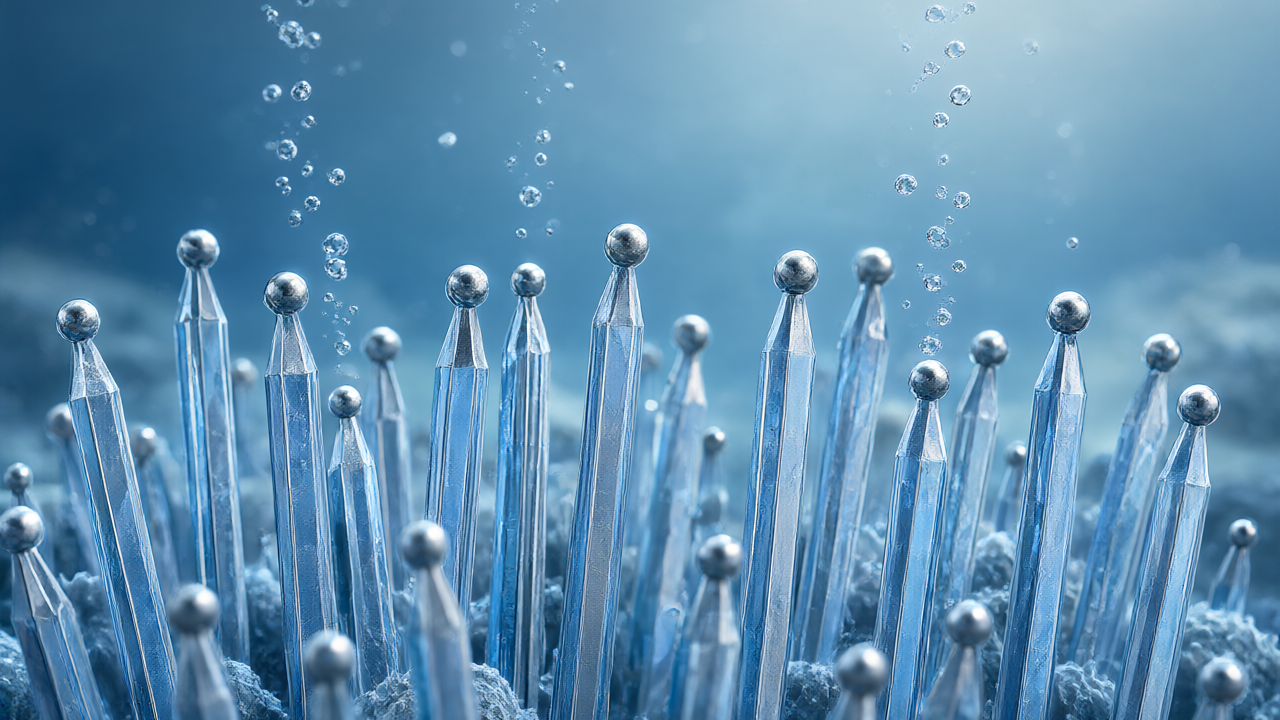
A research team led by Zetian Mi has developed a photocathode using atomically dispersed chromium hydroxide clusters on platinum-decorated gallium nitride (GaN) nanowires for the photoelectrochemical splitting of neutral seawater. Under concentrated sunlight and neutral saline conditions, the catalyst delivered a photocurrent density of around 100 milliamperes per square centimetre at 0 volts versus the reversible hydrogen electrode, maintaining operation for over 50 hours.
Technical Details
The system utilizes a triple-interface architecture defined as Cr(OH)x–Pt//Cr(OH)x–GaN//Pt–GaN. Unlike conventional single-interface systems, this design couples water activation, hydrogen transfer, and platinum–hydrogen formation across adjacent interfaces. The subnanometre scale of the atomically dispersed chromium hydroxide species allows hydrogen intermediates to be handed off efficiently between the platinum and gallium nitride surfaces.
The team also tested a hydrazine-assisted seawater photoelectrolyser. In this configuration, a chemical oxidant at the anode side reduces energetic demands, allowing the photocathode to reach a bias-free photocurrent density of roughly 70 milliamperes per square centimetre.
Background & Context
Hydrogen production from neutral water is typically hindered by sluggish reaction kinetics caused by limited hydrogen supply and transfer to active sites. While the reported figures are significant, the 70 milliampere result reflects an assisted process rather than a fully spontaneous one because hydrazine acts as an energy carrier. Additionally, the 50-hour stability period is substantial for neutral saline environments but remains below the multi-year lifetimes required for commercial deployment.
Significance & Outlook
This research, published in Nature Synthesis on 30 October 2026, shifts the focus of catalyst design from discovering new elements to solving architectural problems of spacing and sequencing interfaces. This “hydrogen-pumping” motif provides a design principle applicable to other semiconductor and catalyst combinations. The next critical test will be whether this architecture can be scaled from laboratory-scale nanowire arrays to full-size photoelectrochemical stacks.
Source: https://bioengineer.org/triple-interface-catalyst-pumps-hydrogen-fast-in-neutral-seawater/
Get our weekly technology intelligence — free
Receive an infographic that lets you judge at a glance whether each field’s analysis report is worth reading.
Subscribe Free — Weekly Tech Intelligence
By subscribing, you’ll receive Troy-Technical’s weekly technology intelligence newsletter.
- Your email and selected fields are used only to deliver the newsletter.
- We never share your information with third parties.
- You can unsubscribe anytime via the link in each email.
See our Privacy Policy for details.
Takes about a minute · Unsubscribe anytime