
Key Findings
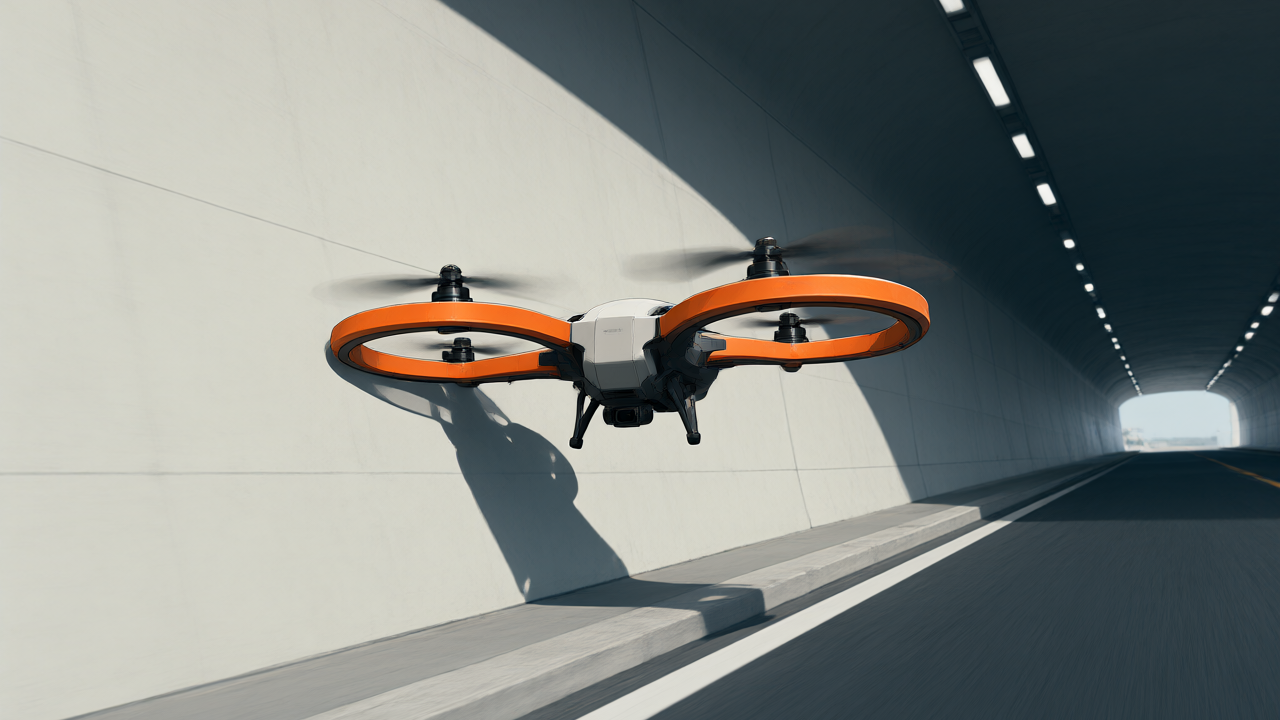
FlexiQuad demonstrates that a flexible airframe can maintain high agility and speed while providing significant crash resistance. In manually piloted outdoor tests, the 405 g aircraft exceeded 84 km/h vertically and 77 km/h horizontally, with a thrust-to-weight ratio of 4.15. Impact tests showed the drone suffered no damage when hitting a panel head-on at 4.5 m/s (16.2 km/h). Additionally, experiments using an improved version showed the drone could autonomously regain stable flight after hitting a wall.
Technical Details
The aircraft features a ring-shaped frame with a diameter of 216 mm, eliminating the central body. The skeleton consists of four FR-4 fiberglass composite strips (145.5 × 54 × 0.5 mm each). Two primary design innovations enable this performance:
- Anisotropic Stiffness: The frame is designed to be soft in the in-plane direction but 2.2 times stiffer against propeller thrust. This allows the drone to maintain its shape during flight while deforming substantially upon impact. The overall stiffness is approximately 1,000 times lower than conventional aircraft.
- Distributed Battery Placement: Four 330 mAh 3-cell batteries are placed individually under each motor. Finite element analysis indicated that concentrating batteries in the center would increase vibration at the motors by 13-fold and at the control unit by 8-fold during acceleration.
Background and Context
Developed by Luca Girardi and Stefano Mintchev at ETH Zurich’s Environmental Robotics Lab, FlexiQuad builds upon previous crash-resistant research, such as a 2017 EPFL insect-style drone that used magnetic joints. Unlike that design, FlexiQuad utilizes a fully flexible ring. The project has been nominated for the 2026 Spark Award, and a patent application has been filed for the structural design.
Significance and Outlook
The research suggests that frame flexibility does not necessarily impair agility, as FlexiQuad achieved linear acceleration above 3 g and angular acceleration above 300 rad/s². While simulation showed peak deceleration less than a quarter of a rigid frame and bench tests showed peak load reductions up to 39 times, the authors note that these figures depend on specific test conditions. The findings are currently awaiting peer review.
Source: https://xenospectrum.com/en/eth-flexiquad-soft-drone-collision/
Get our weekly technology intelligence — free
Receive an infographic that lets you judge at a glance whether each field’s analysis report is worth reading.
Subscribe Free — Weekly Tech Intelligence
By subscribing, you’ll receive Troy-Technical’s weekly technology intelligence newsletter.
- Your email and selected fields are used only to deliver the newsletter.
- We never share your information with third parties.
- You can unsubscribe anytime via the link in each email.
See our Privacy Policy for details.
Takes about a minute · Unsubscribe anytime