

Key Findings
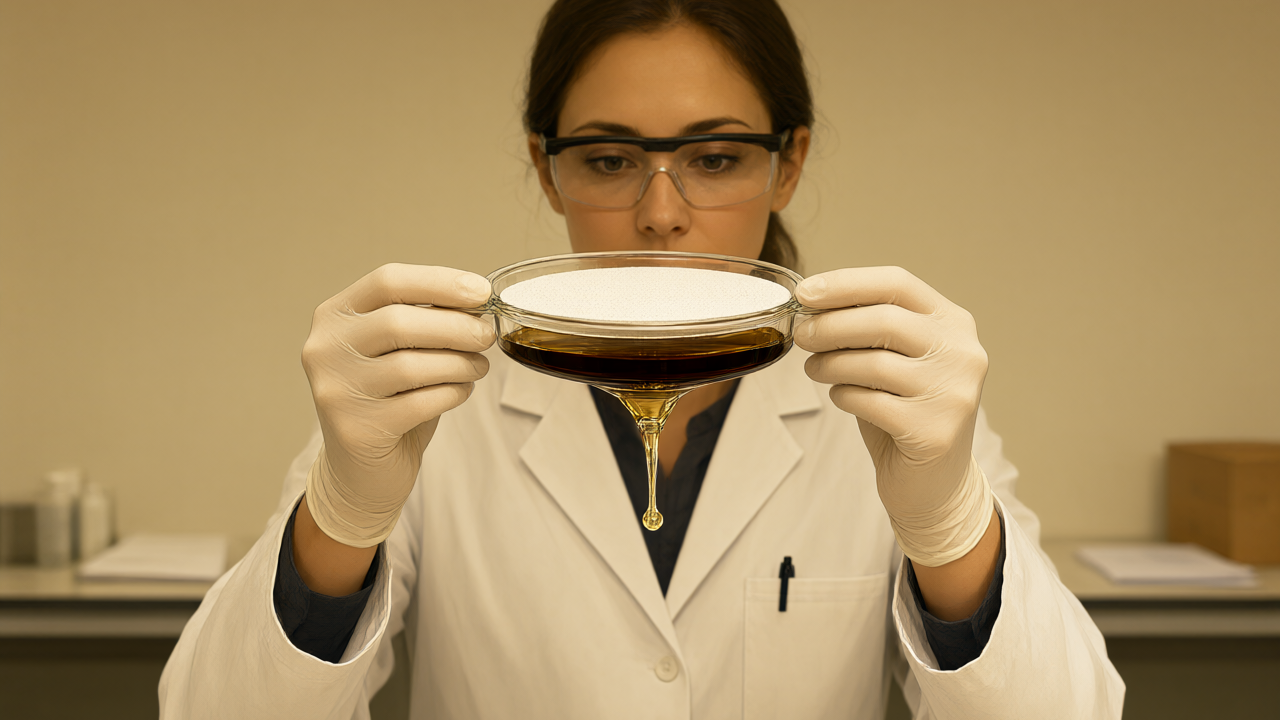
A research team led by Professor Dong-Yeun Koh (KAIST) and Professor Ryan Lively (Georgia Tech) has demonstrated a membrane capable of separating crude oil without the need for heating. The uncoated PAN membrane achieved crude oil permeation rates approximately 23 times higher than previous leading separation membranes and maintained stable performance for 28 consecutive days.
Technical Details
Unlike traditional membranes that require expensive, thin specialized coatings, this system uses a bare membrane made from porous polyacrylonitrile (PAN), a chemically stable polymer. The separation mechanism relies on a phenomenon typically viewed as a failure: fouling. As crude oil passes through the membrane, heavier hydrocarbon molecules accumulate on the inner walls of the pores. This buildup creates narrow channels measuring less than 2 nanometers across, which allow lighter fractions—such as naphtha, gasoline, and kerosene—to pass through while blocking heavier substances.
Background and Context
Conventional oil refining relies on distillation, which requires heating oil to temperatures above 350 °C. This process is extremely energy-intensive, consuming approximately 1,100 terawatt-hours (TWh) annually worldwide—an amount comparable to the output of roughly 130 nuclear power plants with one-gigawatt capacities. While membranes have been explored as alternatives to avoid extreme temperatures, previous designs were hindered by the high cost and fragility of the required precision coatings.
Significance and Outlook
The PAN membrane can be implemented as a modular filtration system installed before conventional distillation equipment, meaning refineries would not need to replace existing infrastructure. Computer simulations indicate that this integration could lead to a 36% decrease in operating costs and a 20.7% reduction in cooling water consumption. If adopted across Korea’s refining and petrochemical industries, researchers estimate the system could prevent approximately 10 million tonnes of greenhouse gas emissions annually.
Source: https://www.sciencedaily.com/releases/2026/11/261103003207.htm
Get our weekly technology intelligence — free
Receive an infographic that lets you judge at a glance whether each field’s analysis report is worth reading.
Subscribe Free — Weekly Tech Intelligence
By subscribing, you’ll receive Troy-Technical’s weekly technology intelligence newsletter.
- Your email and selected fields are used only to deliver the newsletter.
- We never share your information with third parties.
- You can unsubscribe anytime via the link in each email.
See our Privacy Policy for details.
Takes about a minute · Unsubscribe anytime