
Key Findings
The transfer printing method achieved a uniform solid electrolyte layer over an area of 6 × 20 cm (120 cm²) with an average thickness of 15 µm and a deviation of approximately 1 µm. In contrast, direct coating produced nonuniform thicknesses ranging from 10 to 25 µm over a smaller 6 × 11 cm area. Performance metrics showed that cells fabricated via transfer printing retained 83.6% of their capacity after 100 charge-discharge cycles, while directly coated cells retained only 36.1%.
Technical Details
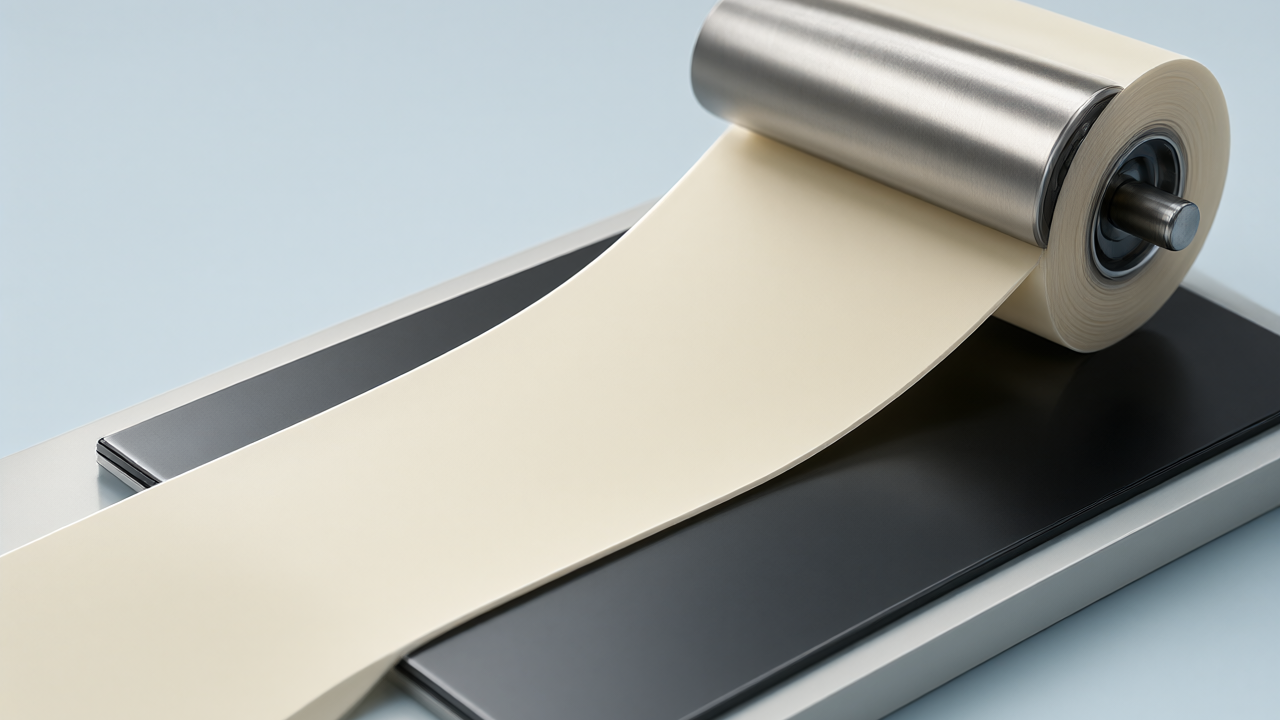
The process involves coating and drying a solid electrolyte slurry on a PET-PDMS substrate, then using a roller to pressure-laminate and transfer the thin layer onto an electrode. To optimize this without trial-and-error, the team utilized Hansen solubility parameters (HSPs) to quantify material affinity:
- Coating step: High-affinity combinations were selected to ensure uniform spreading.
- Transfer step: Low-adhesion combinations were selected to allow clean detachment from the substrate.
The resulting hybrid solid electrolyte reached an ionic conductivity of 2.83 × 10⁻⁴ S/cm at 25°C and a Li⁺ transference number of 0.69, nearly double the 0.36 measured in the PE separator control.
Background & Context
High-energy-density solid-state batteries require electrolyte layers thinner than 20 µm. However, freestanding films typically require 70–120 µm to prevent tearing, and direct slurry coating often leads to electrode deformation and nonuniformity as the liquid infiltrates the porous electrode.
Significance & Outlook
The technology enhances safety; in pouch-cell tests at 150°C for 2 hours and 30 minutes, the transfer-printed cell remained stable, whereas the PE separator-based cell suffered an internal short circuit and voltage drop after approximately 10 minutes. The research team suggests that combining HSP data with actual results could enable AI-based prescreening of candidate materials. The study was published in Advanced Functional Materials in September 2026.
Get our weekly technology intelligence — free
Receive an infographic that lets you judge at a glance whether each field’s analysis report is worth reading.
Subscribe Free — Weekly Tech Intelligence
By subscribing, you’ll receive Troy-Technical’s weekly technology intelligence newsletter.
- Your email and selected fields are used only to deliver the newsletter.
- We never share your information with third parties.
- You can unsubscribe anytime via the link in each email.
See our Privacy Policy for details.
Takes about a minute · Unsubscribe anytime