

Key Findings
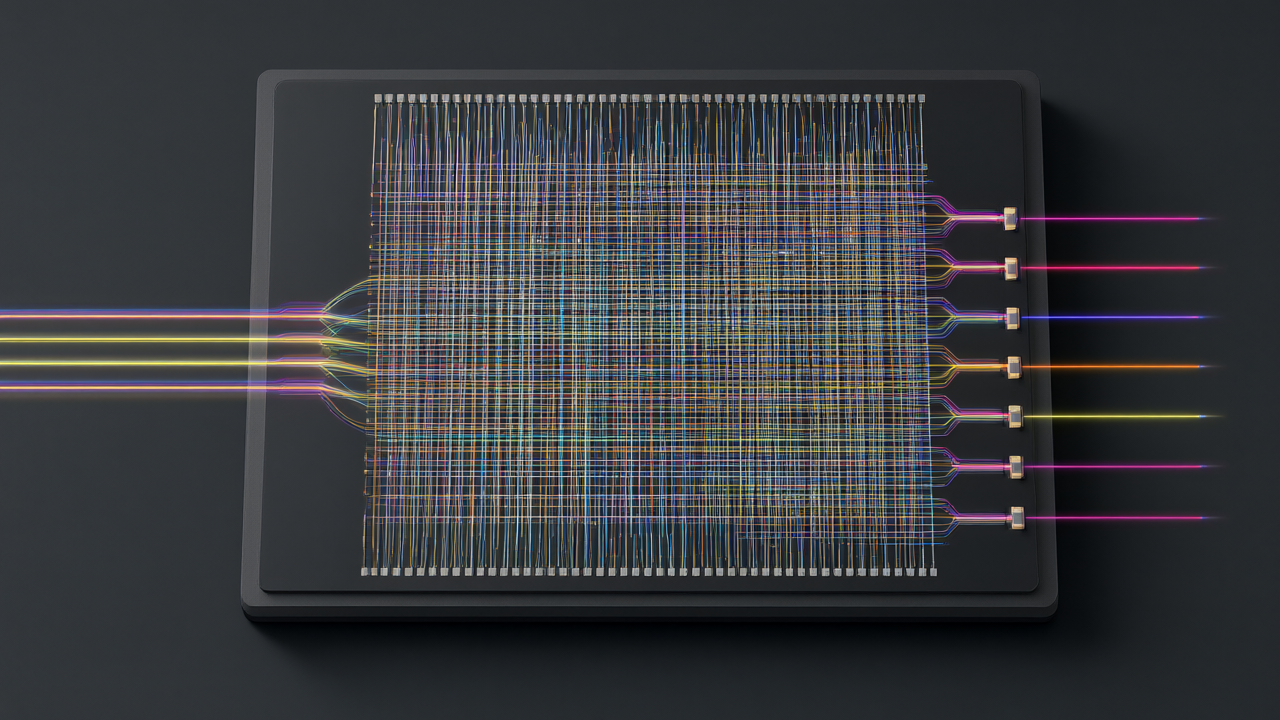
PsiQuantum has debuted a prototype 8×8 optical circuit switch that achieves an insertion loss of 1.2 dB (approximately 24% light loss) in laboratory tests. The device operates in the O-band, the standard wavelength range for GPU server links, and features a reconfiguration time of under 3 ms and 40 dB crosstalk. Unlike competitors Salience Labs and iPronics, PsiQuantum’s chip does not utilize built-in amplification to stay below the 3 dB loss ceiling tolerated by data center optics.
Technical Details
The switch is constructed using silicon nitride waveguides etched on a silicon substrate. The architecture is monolithic with no moving mirrors or microelectromechanical systems (MEMS), eliminating the mechanical wear associated with mirror-based approaches. While the current demo uses a thermally switched silicon nitride platform, the company is exploring barium titanate (BTO) as a material for future products to enable faster switching via strong light bending under voltage at gigahertz rates.
According to a 2025 Nature paper, the company’s baseline performance includes:
- Waveguide losses: 0.5 dB per meter
- Splitters: 0.5 millidecibels
- Crossings: 1.2 millidecibels
- Chip-to-fiber coupling: approximately 60 millidecibels (1.4% loss)
Background and Context
Optical switches are critical as AI clusters move massive data between GPUs, surpassing the distance and bandwidth limits of copper. While Google’s Palomar (136 ports) and Lumentum’s R300 (300 ports) handle larger scales, PsiQuantum’s 8×8 is a proof of concept. The company has already taped out a 64×64 version and is developing a 72×72 design. Nvidia, which collaborates with PsiQuantum on GPU-QPU integration and silicon photonics through NVentures, has also invested in rival iPronics.
Significance and Outlook
PsiQuantum intends to use conventional AI networking applications to reduce packaging and supply chain risks for its quantum computing components. Samples and testing kits have been delivered to hyperscalers and GPU vendors. Commercial product announcements and updates on larger devices are expected in the coming months.
Get our weekly technology intelligence — free
Receive an infographic that lets you judge at a glance whether each field’s analysis report is worth reading.
Subscribe Free — Weekly Tech Intelligence
By subscribing, you’ll receive Troy-Technical’s weekly technology intelligence newsletter.
- Your email and selected fields are used only to deliver the newsletter.
- We never share your information with third parties.
- You can unsubscribe anytime via the link in each email.
See our Privacy Policy for details.
Takes about a minute · Unsubscribe anytime