


Key Findings
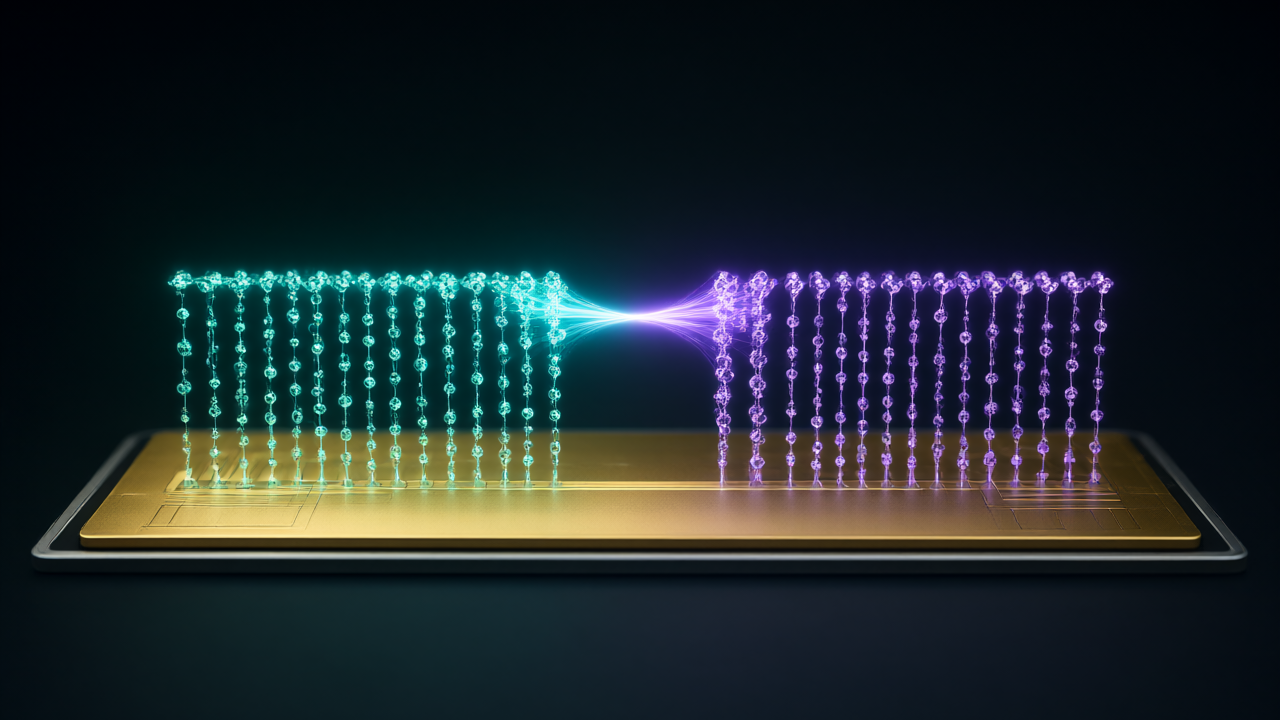
The research team, including Surabhi Luthra and Alex Owens, successfully implemented Quantum Low-Density Parity Check (QLDPC) surgery on a [[10,2,3]] generalized bicycle code using the Quantinuum H2-2 trapped ion processor. The primary achievement was the reduction of overall error rates to below 0.26% after repeating the syndrome extraction process three times. This performance marks a sharp improvement over previous lattice surgery demonstrations that were limited to single logical qubit blocks and could not achieve similar error suppression through repeated measurements.
Technical Details
The team performed surgery on a multi-qubit system by measuring an individual logical qubit within a block encoding two qubits. The process utilized seven ancillary “gadget” qubits for measurement. Initial single measurements yielded error rates of 0.72 [0.32, 1.41]% for one operator and 1.03 [0.60, 1.65]% for another. During the three rounds of syndrome extraction, unaddressed “spectator” qubits remained stable with an error rate of only 0.21 [0.04, 0.67]%. Additionally, the researchers demonstrated resource efficiency by reusing the same gadget qubits to sequentially measure two different operators (X1 then Z2), resulting in a combined error of 1.12 [0.60, 1.94]%.
Background and Context
Building practical fault-tolerant quantum computers requires reducing the number of physical qubits needed to represent a single logical qubit. QLDPC codes offer potential for significant resource reduction, acting as extra checks in a message to ensure understanding even if parts are corrupted. However, implementing these codes efficiently has been challenging. QLDPC surgery addresses this by allowing for the selective, non-destructive measurement of encoded quantum information.
Significance and Outlook
This demonstration validates the “surgery primitive,” proving that syndrome information can be extracted without collapsing the quantum state. By reusing ancillary gadget qubits, the approach minimizes resource demands. While the researchers acknowledge that scaling challenges remain—specifically whether these low error rates will hold as code blocks grow or complex logical operations are layered—the work confirms a pathway toward more efficient, scalable quantum error correction.
Source: https://quantumzeitgeist.com/quantum-surgery-logical-qubit-error-measurement/
Get our weekly technology intelligence — free
Receive an infographic that lets you judge at a glance whether each field’s analysis report is worth reading.
Subscribe Free — Weekly Tech Intelligence
By subscribing, you’ll receive Troy-Technical’s weekly technology intelligence newsletter.
- Your email and selected fields are used only to deliver the newsletter.
- We never share your information with third parties.
- You can unsubscribe anytime via the link in each email.
See our Privacy Policy for details.
Takes about a minute · Unsubscribe anytime