


Key Findings
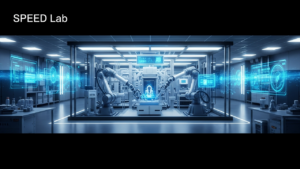
Radical AI has demonstrated an alloy discovery process capable of producing 300 new compositions in approximately 16 weeks. Based in New York and backed by RTX and Nvidia, the company utilizes a self-driving laboratory platform that integrates AI and robotics to design, manufacture, and test materials. This approach allows manufacturers to exclude specific elements—such as those vulnerable to geopolitical tensions or export restrictions—while maintaining required material properties.
Technical Details
The company employs an “active learning loop” to accelerate iterative discovery. The process follows these steps:
- AI identifies a promising composition based on user-defined constraints.
- The autonomous lab synthesizes a physical sample weighing between 50 and 200 grams.
- The sample is analyzed for chemical composition, grain structure, and mechanical properties, including hardness, tensile strength, and high-temperature performance relevant to hypersonic applications.
- Resulting data is fed back into machine-learning models to refine subsequent experiments.
Background & Context
Traditional material discovery is costly and slow, often taking 10 to 15 years to reach operation and costing over $100 million for a single system. Consequently, many aerospace and defense sectors rely on structural metals that are 20 to 50 years old. Radical AI operates downstream from mining and refining, focusing on the combination of existing refined metals. A primary example is the development of high-performance alloys for extreme-temperature environments that contain little to no hafnium, a strategic element heavily controlled by China’s supply chain.
Significance & Outlook
The technology enables “concurrent engineering,” where materials are developed specifically for the requirements of a new aircraft or engine alongside the product design itself. By reducing development timelines from 20 years to one, two, or three years, Radical AI provides a mechanism for US manufacturers to address supply chain vulnerabilities by redesigning materials around more readily available elements.
Source: https://www.mining.com/radical-ai-uses-autonomous-labs-to-accelerate-alloy-discovery/
Get our weekly technology intelligence — free
Receive an infographic that lets you judge at a glance whether each field’s analysis report is worth reading.
Subscribe Free — Weekly Tech Intelligence
By subscribing, you’ll receive Troy-Technical’s weekly technology intelligence newsletter.
- Your email and selected fields are used only to deliver the newsletter.
- We never share your information with third parties.
- You can unsubscribe anytime via the link in each email.
See our Privacy Policy for details.
Takes about a minute · Unsubscribe anytime