


Key Findings
A research team led by Lawrence Berkeley National Laboratory (Berkeley Lab) has designed two metal alloys with a body-centered cubic (BCC) atomic arrangement that exhibit remarkable resistance to fracturing across an extreme temperature range. The materials maintain ductility from liquid helium temperatures (20 Kelvin) up to 1,300 degrees centigrade. Notably, these alloys achieve a toughness of 100 MPa√m at 20K and above 250 MPa√m at room temperature, whereas the toughest existing BCC materials, such as steel, only reach 10 to 20 MPa√m at 20K.
Technical Details
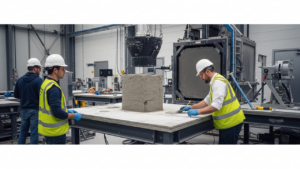
The study evaluated two distinct compositions: a binary alloy consisting of Nb 70 Ti 30 and a medium-high-entropy alloy (MHEA) with the composition Nb 45 Ta 25 Ti 15 Hf 15. Unlike traditional alloys that rely on one or two main elements with trace additives, these combine similar proportions of metals selected from two regions of the periodic table. The research involved casting and rolling samples via collaborators at UC Irvine and an Air Force materials lab, with testing conducted at Berkeley Lab and the Engin-X instrument at the ISIS Neutron and Muon Source in the United Kingdom.
Background & Context
BCC alloys are highly desired for high-temperature applications, such as rocketry and turbine blades, due to their high melting points. However, most BCC alloys are prone to cracking and typically undergo a ductile-to-brittle transition at low temperatures. While other MHEAs have been developed for extreme cold, they are often unsuitable for high heat. This research addresses the “holy grail” of creating a ductile version of BCC alloys that can withstand both extremes.
Significance & Outlook
By proving that high-temperature BCCs can overcome the ductile-to-brittle transition, this study removes a major hurdle for their practical application in spacecraft, jet engines, and city-scale energy systems. Further research is required to determine how exposure to elements and oxidation will affect long-term performance before these metals are adopted for real-world use.
Source: https://www.miragenews.com/new-metal-alloys-withstand-extreme-heat-and-cold-1775000/
Get our weekly technology intelligence — free
Receive an infographic that lets you judge at a glance whether each field’s analysis report is worth reading.
Subscribe Free — Weekly Tech Intelligence
By subscribing, you’ll receive Troy-Technical’s weekly technology intelligence newsletter.
- Your email and selected fields are used only to deliver the newsletter.
- We never share your information with third parties.
- You can unsubscribe anytime via the link in each email.
See our Privacy Policy for details.
Takes about a minute · Unsubscribe anytime