


Key Findings
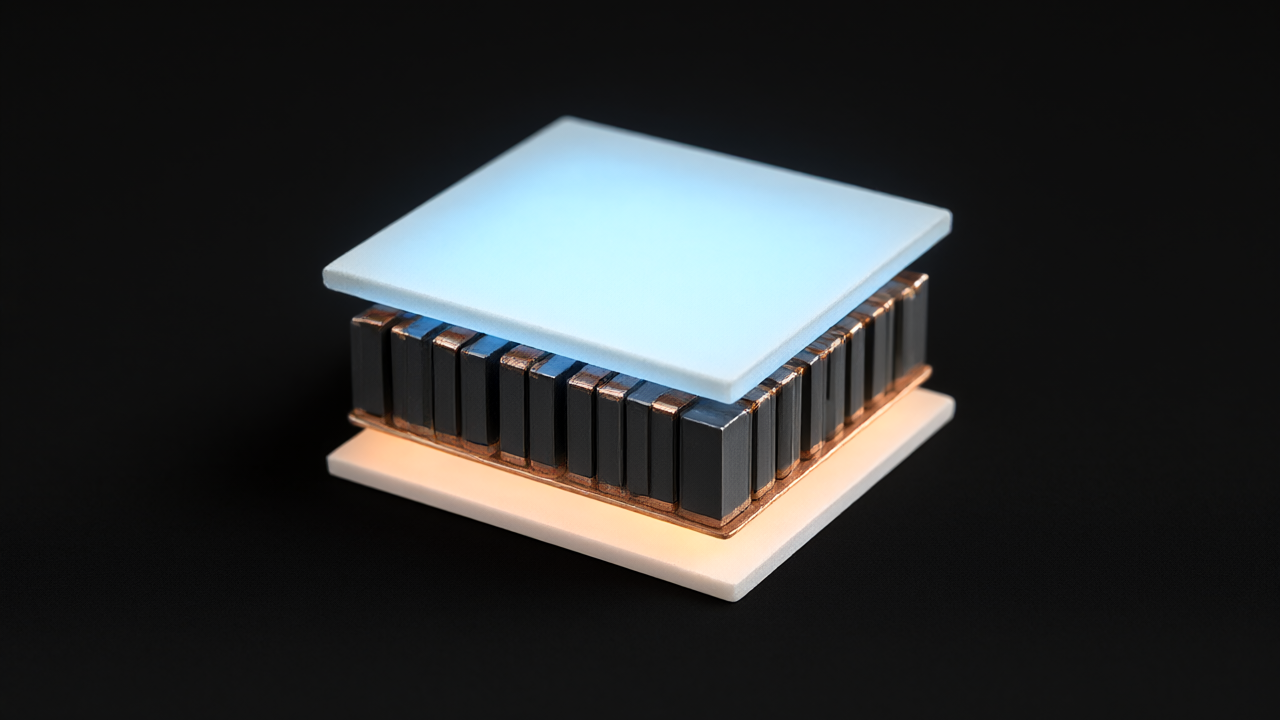
A research team led by Tongji University and Shanghai University has achieved a maximum cooling temperature span approximately 10 percent larger than that of conventional uniform reference coolers. This improvement was realized by aligning the electrical current flow with a spatially graded Seebeck coefficient in an n-type bismuth telluride alloy single crystal. The study demonstrated a directional asymmetry in performance; reversing the current direction shifted the maximum cooling temperature span by about 20 percent.
Technical Details
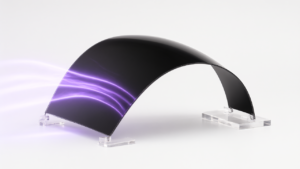
The team utilized a compositionally graded n-type Bi2Te2.7Se0.3 single crystal. While commercial thermoelectric legs of the same alloy typically show Seebeck values differing by only 2.5 percent between ends, the experimental crystal featured an internal chemical-potential gradient that spread the Seebeck coefficient across a difference of roughly 50 microvolts per kelvin. To analyze this, the researchers proposed an extended figure of merit, zextended, which accounts for total electronic entropy changes along the transport path, including variations caused by local temperature, chemical potential, and magnetic fields.
Background & Context
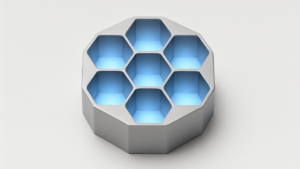
Solid-state cooling relies on the Peltier effect, where heat exchange occurs primarily at the junctions between thermoelectric materials and metallic electrodes. The Thomson effect—heat exchange within the material volume—is usually negligible because the Seebeck coefficient remains uniform. Traditionally, the maximum temperature span (ΔTmax) has been limited by the material’s intrinsic thermoelectric figure of merit (zT). This technology is currently used in portable insulin coolers, automotive miniature refrigerators, and laser temperature stabilization for fiber-optic networks.
Significance & Outlook
The cooling bonus increases as the material electronic quality factor (B) decreases. For typical bismuth telluride alloys, B is around 0.33, and it drops further at cryogenic temperatures where lattice thermal conductivity hinders performance. Consequently, the researchers identified low-temperature environments as the most promising application for this graded-property approach. While the proof-of-concept device reached a temperature difference of roughly 15 kelvins, the authors noted a thermodynamic trade-off where boosting heat absorption pulls the alloy away from its optimal average zT value.
Get our weekly technology intelligence — free
Receive an infographic that lets you judge at a glance whether each field’s analysis report is worth reading.
Subscribe Free — Weekly Tech Intelligence
By subscribing, you’ll receive Troy-Technical’s weekly technology intelligence newsletter.
- Your email and selected fields are used only to deliver the newsletter.
- We never share your information with third parties.
- You can unsubscribe anytime via the link in each email.
See our Privacy Policy for details.
Takes about a minute · Unsubscribe anytime