
Key Findings
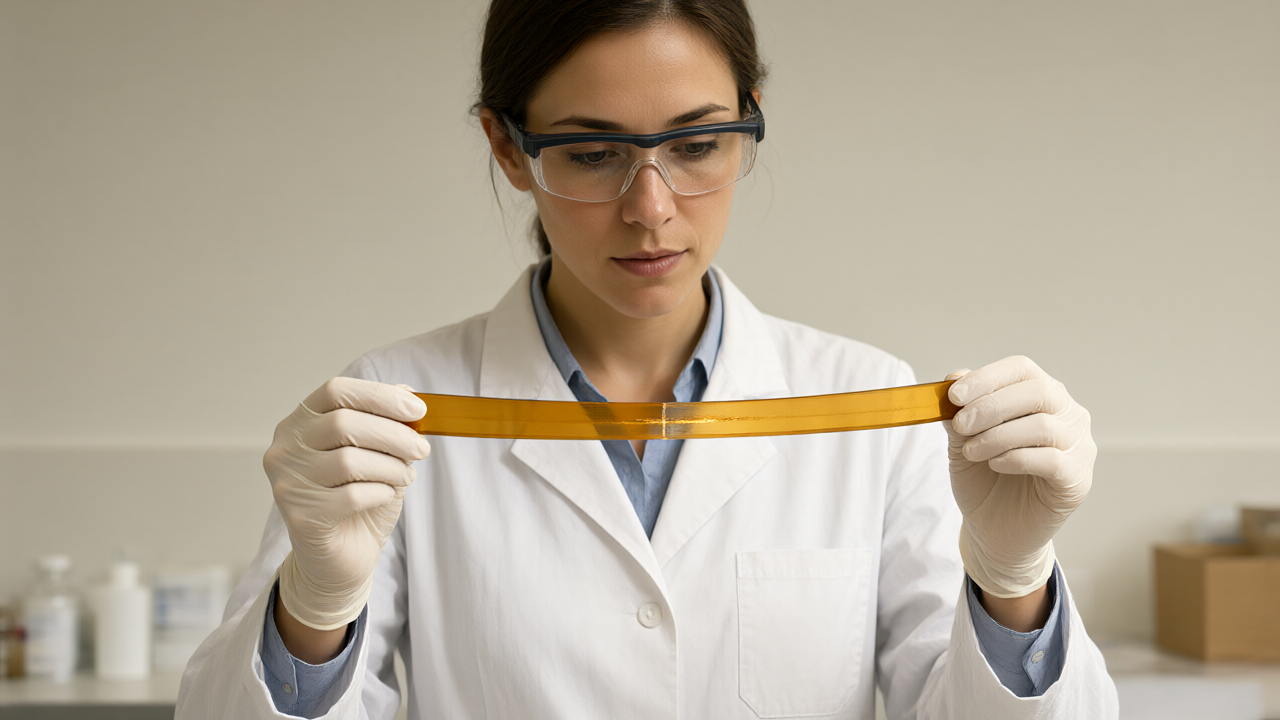
The developed PU-S elastomer demonstrates a tensile strength of 23.7 MPa and an elongation at break of 1080%, while maintaining an initial tensile modulus of 5.81 MPa. In self-healing tests conducted at 25 °C for 24 hours, the material recovered 92% of its toughness, with tensile strength returning to 19.5 MPa. In contrast, a traditional PU-O control sample achieved only 27% healing efficiency under the same conditions and only 52% when heated to 50 °C.
Technical Details
The team employed an “S-for-O” substitution strategy, replacing traditional urea chain extenders with thiourea units. Because sulfur has a larger atomic radius and lower electronegativity than oxygen, it prevents the formation of ordered, crystalline hard domains. Instead, it creates a disordered, asymmetric, and dense multi-point hydrogen bond network. FT-IR spectroscopy showed that hydrogen-bonded carbonyl groups in PU-S decreased to 60.8%, compared to 75.7% in the PU-O sample.
Molecular analysis revealed the following drivers of the healing process:
- Activation Energy: PU-S exhibited an activation energy of 41.8 kJ/mol, significantly lower than the 106.7 kJ/mol of PU-O, facilitating easier chain segment diffusion.
- Binding Energy: DFT calculations showed the thiourea-thiourea dimer binding energy is -13.05 kcal/mol, less than half of the urea-urea dimer’s -29.61 kcal/mol.
- Rheology: Storage (G’) and loss (G”) moduli crossover in the low-frequency region at 25 °C, confirming active internal dynamics at room temperature.
Background & Context
Traditional high-strength PU elastomers rely on dense hydrogen bonds to create rigid microdomains. While these provide strength, they restrict polymer chain migration, typically requiring external heat to initiate healing. This limitation has previously hindered the use of high-strength PU in flexible electronics and other dynamic environments.
Significance & Outlook
By constructing a dynamic supramolecular network that allows hydrogen bonds to break and reform easily, the researchers have created a material suitable for structural applications that require autonomous repair. The study also notes the recyclability of the PU-S elastomer as a key factor for sustainable design.
Get our weekly technology intelligence — free
Receive an infographic that lets you judge at a glance whether each field’s analysis report is worth reading.
Subscribe Free — Weekly Tech Intelligence
By subscribing, you’ll receive Troy-Technical’s weekly technology intelligence newsletter.
- Your email and selected fields are used only to deliver the newsletter.
- We never share your information with third parties.
- You can unsubscribe anytime via the link in each email.
See our Privacy Policy for details.
Takes about a minute · Unsubscribe anytime