Key Findings
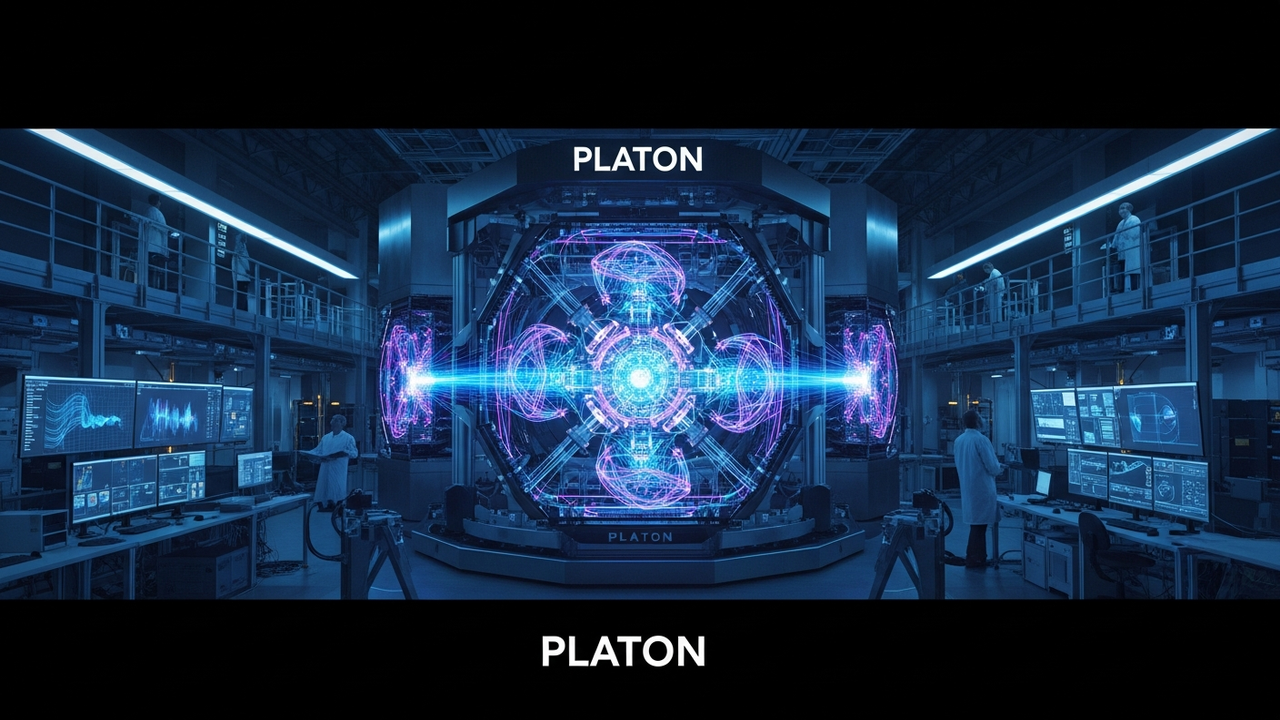
Scientists have developed a pioneering particle detector, named ‘PLATON,’ which replaces millions of individual detector components with a single block of light-generating material. This innovative technology integrates lightfield cameras, highly sensitive photon sensors, and artificial intelligence to enable the precise and rapid reconstruction of 3D particle paths, fundamentally advancing detection capabilities in materials science.
Technical / Clinical Details
The PLATON system operates by simultaneously capturing light (such as scintillation light) emitted from high-energy particle interactions within the material from multiple directions. Lightfield camera technology records both spatial and angular information of light rays, allowing a single detector array to reconstruct complex 3D light fields. Subsequently, advanced AI algorithms analyze this rich optical dataset to determine the particle’s origin, trajectory, and energy with exceptional accuracy and speed. This integrated approach eliminates the need for conventional multi-layered detectors and intricate wiring, significantly simplifying detector design while improving sensitivity and spatial resolution. Its ability to track the behavior of fast-moving, minute particles in real-time is particularly valuable for observing dynamic material processes and reactions in fine detail, offering insights into previously unobservable phenomena.
Background & Context
Particle detection is an indispensable tool in materials science, physics, and biomedical research. However, conventional detectors have faced limitations due to their complexity, cost, and spatial resolution constraints in specific applications. There has been a growing demand for more sensitive and high-resolution 3D tracking capabilities, particularly for fast-evolving phenomena and the detection of subtle material defects. Integrated, AI-driven detectors like PLATON are designed to overcome these challenges, providing a new window into understanding material behavior at near-atomic scales. This technological leap addresses the growing need for efficient and accurate characterization tools in the age of advanced materials development.
Strategic Significance & Outlook
The PLATON technology holds broad promise for applications in characterizing new materials, real-time monitoring of manufacturing processes, and fundamental physics experiments. Potential uses include defect analysis in semiconductor materials, studying biomolecular interactions for drug discovery, or serving as advanced cosmic ray detectors. This simplified yet powerful detection system is expected to accelerate research and development cycles, contributing to the creation of higher-performance functional materials. The convergence of AI and physical detection represented by PLATON is a crucial step forward in defining the future direction of scientific measurement, offering both efficiency and unprecedented data richness for scientific exploration and industrial innovation globally.
Source: https://www.sciencedaily.com/releases/2026/07/260717105001.htm
Get our weekly technology intelligence — free
Receive an infographic that lets you judge at a glance whether each field’s analysis report is worth reading.
Subscribe Free — Weekly Tech Intelligence
By subscribing, you’ll receive Troy-Technical’s weekly technology intelligence newsletter.
- Your email and selected fields are used only to deliver the newsletter.
- We never share your information with third parties.
- You can unsubscribe anytime via the link in each email.
See our Privacy Policy for details.
Takes about a minute · Unsubscribe anytime









Comments