Key Findings
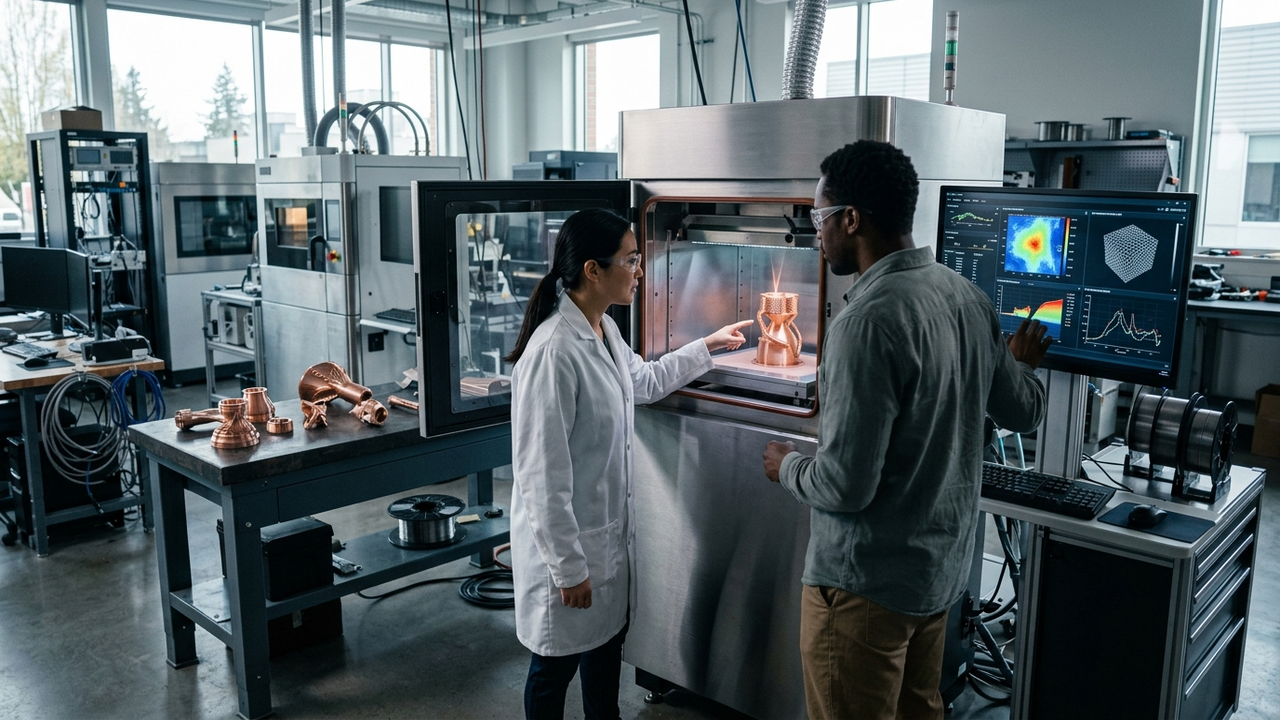
Researchers at Washington State University (WSU) have leveraged artificial intelligence (AI) to devise a significantly more efficient and cost-effective method for 3D-printing GRCop-42, a critical high-performance metal alloy predominantly utilized in the aerospace industry. This pioneering breakthrough has the potential to “democratize” the additive manufacturing of GRCop-42, rendering it accessible to a wider array of commercial 3D printers that operate at lower wattages, thereby dramatically reducing the barriers to entry for its application and research.
Technical / Clinical Details
- GRCop-42 is a copper alloy developed by NASA, renowned for its exceptional combination of high thermal conductivity and excellent high-temperature strength. These properties make it indispensable for components operating in extreme environments, such as rocket engine combustion chambers and advanced heat exchangers. Traditionally, 3D printing GRCop-42 required high-power lasers and stringent process controls due to its unique metallurgical characteristics, leading to prohibitive manufacturing costs and limited accessibility.
- The WSU team employed AI-based optimization algorithms to fine-tune the Laser Powder Bed Fusion (L-PBF) process for GRCop-42. The AI system intelligently optimized parameters such as laser power, scan speed, and powder layer thickness. This allowed for the identification of optimal manufacturing conditions that minimize material defects while ensuring the printed parts possess the desired mechanical properties and density.
- This AI-guided framework now enables the high-precision and high-density fabrication of GRCop-42 using more common, commercially available 3D printers with relatively lower laser power. This advancement significantly expands the potential user base to include more research institutions and small-to-medium enterprises (SMEs) for GRCop-42 R&D and rapid prototyping.
Background & Context
The aerospace industry continuously seeks lightweight, high-performance components, making 3D printing (additive manufacturing) a pivotal technology. While high-performance alloys like GRCop-42 offer direct performance enhancements for space exploration and defense applications, the inherent difficulties and costs associated with their traditional manufacturing have hindered widespread adoption. The integration of AI bridges the gap between material science and manufacturing processes, aligning with a global trend to streamline the complex parameter discovery for advanced material fabrication. This effort addresses strategic supply chain resilience and innovation goals for critical defense and space technologies.
Strategic Significance & Outlook
The “democratization” of GRCop-42 3D printing, achieved through WSU’s research, is poised to accelerate innovation not only within the aerospace sector but also across broader advanced manufacturing landscapes. The AI-guided framework is highly adaptable and can be applied to optimize the 3D printing of other challenging metal alloys and composite materials, setting new standards for manufacturing process optimization. Furthermore, this approach has profound implications for other scientific discovery fields, such as drug discovery, by reducing the reliance on expensive and time-consuming experimental iterations. This represents a significant step for the United States in reinforcing its leadership in advanced manufacturing technologies and fostering a more agile and innovative industrial base.
Get our weekly technology intelligence — free
Receive an infographic that lets you judge at a glance whether each field’s analysis report is worth reading.
Subscribe Free — Weekly Tech Intelligence
By subscribing, you’ll receive Troy-Technical’s weekly technology intelligence newsletter.
- Your email and selected fields are used only to deliver the newsletter.
- We never share your information with third parties.
- You can unsubscribe anytime via the link in each email.
See our Privacy Policy for details.
Takes about a minute · Unsubscribe anytime








Comments