


Key Findings
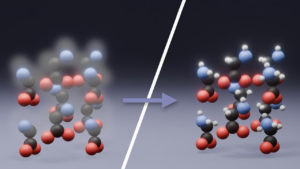
The developed equivariant diffusion model enables the generative inverse estimation of site-specific 3D atomic structures from near-edge spectra. When trained on Si–O crystals, the model demonstrates radial accuracy comparable to Extended X-ray Absorption Fine Structure (EXAFS), with a bond-distance mean absolute error (MAE) of ~0.04 Å. Notably, the model provides superior coordination number precision, with errors remaining below 2.0%, compared to approximately 20% for EXAFS.
Technical Details
Unlike conventional 1D radial distribution analysis, this generative approach reconstructs full 3D geometries, including bond angles. The model was trained exclusively on crystalline lattices but demonstrated composition-dependent transferability to amorphous systems. To validate the feasibility of the approach with experimental data, the researchers applied the model to experimental O K-edge spectra from stishovite, cristobalite, and α-quartz.
Background & Context
Extracting 3D atomic coordinates from spectroscopic data has historically been a challenging inverse problem. Traditional methods often rely on template matching, which is limited to retrieving structures from predefined reference libraries. This new approach moves beyond template matching by allowing the exploration of candidate 3D structures within a learned structural space.
Significance & Outlook
This research represents a step toward the automated and quantitative inference of 3D local structures from spectroscopic data. By overcoming the limitations of 1D analysis and predefined templates, the model provides a more flexible and precise method for determining atomic coordination. The study was supported by the Ministry of Education, Culture, Sports, Science and Technology (MEXT), the Japan Science and Technology Agency (JST), and the New Energy and Industrial Technology Development Organization (NEDO), with contributions from the University of Tokyo and Mitsubishi Chemical Corporation.
Source: https://www.nature.com/articles/s41524-026-02384-4
Get our weekly technology intelligence — free
Receive an infographic that lets you judge at a glance whether each field’s analysis report is worth reading.
Subscribe Free — Weekly Tech Intelligence
By subscribing, you’ll receive Troy-Technical’s weekly technology intelligence newsletter.
- Your email and selected fields are used only to deliver the newsletter.
- We never share your information with third parties.
- You can unsubscribe anytime via the link in each email.
See our Privacy Policy for details.
Takes about a minute · Unsubscribe anytime