


Key Findings
The primary achievement of the research team is a sharp reduction in signal interference between pressure sensors. In tests where only one of two sensors was pressed, the ratio of stray signals from the neighboring sensor dropped from 63.1% to 0.314% after the diode was applied. Even when the skin was stretched 30% in length, the interference ratio fell from 40.0% to 0.697%.
Technical Details
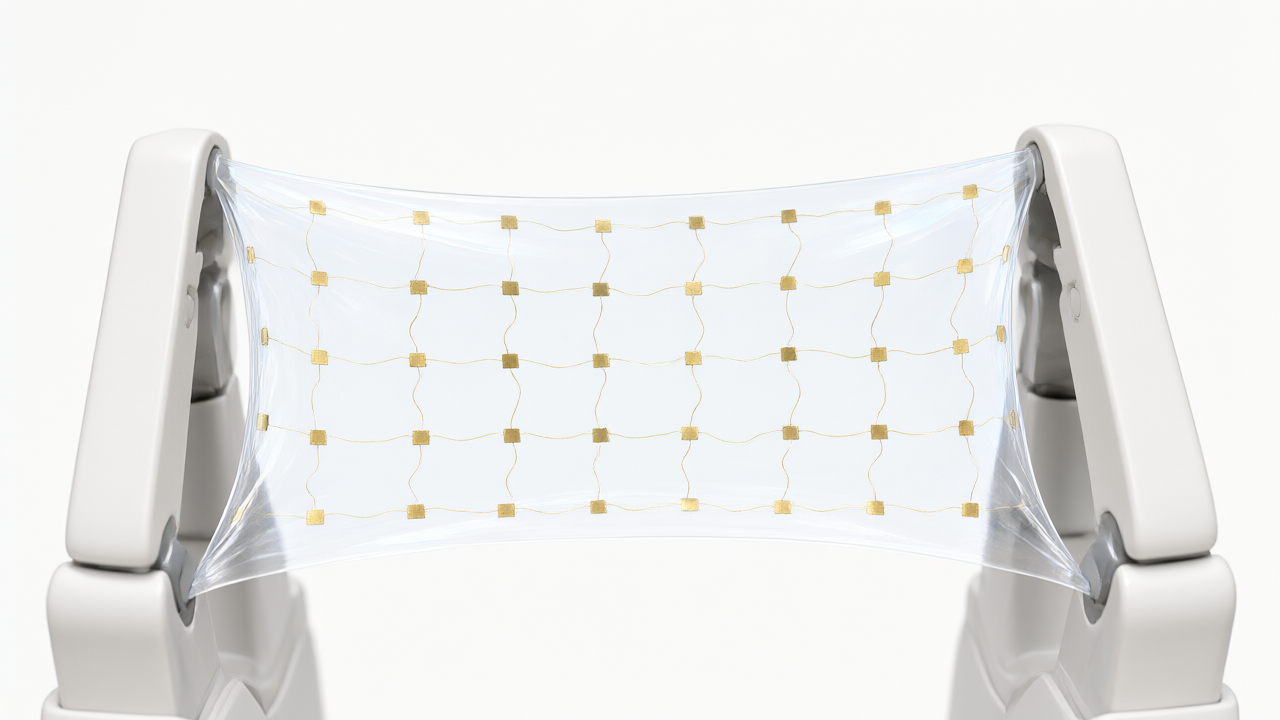
The developed stretchable organic diode is designed to block unwanted current flow between pressure sensors in an electronic skin array. Unlike conventional diodes that rely on rigid substrates and electrodes, this fully flexible organic electrochemical diode utilizes soft materials for its substrate, electrodes, semiconductor, and electrolyte. This material composition allows the device to remain functional during physical deformations, such as when a robot bends a finger.
- Durability: The diode retained its rectifying function after 1,000 cycles of stretching and releasing.
- Elasticity: The device continued to channel current in one direction when stretched 30% in length.
- Function: It allows current to flow easily in one direction while impeding flow in the opposite direction to prevent signal leakage between sensors.
Background & Context
Electronic skin identifies the location and strength of contact via pressure sensor arrays. A common technical error in these systems is the production of signals at neighboring sensors when only a single point is pressed. This research was led by Professor Shim Kyo-seung of the chemistry department at the Ulsan National Institute of Science and Technology (UNIST), with Kim Se-hyun as the first author. The study was supported by the National Research Foundation of Korea and the Ministry of Science and ICT.
Significance & Outlook
The findings, published in Science Advances on Oct. 21, demonstrate the potential for system-level integration with various stretchable electronic devices. Professor Shim noted that this technology could be applied to the development of wearable devices and electronic skin that can stretch in tandem with a robot’s movements.
Source: https://en.sedaily.com/business/2026/11/11/stretchable-diode-cuts-signal-errors-in-robot-skin
Get our weekly technology intelligence — free
Receive an infographic that lets you judge at a glance whether each field’s analysis report is worth reading.
Subscribe Free — Weekly Tech Intelligence
By subscribing, you’ll receive Troy-Technical’s weekly technology intelligence newsletter.
- Your email and selected fields are used only to deliver the newsletter.
- We never share your information with third parties.
- You can unsubscribe anytime via the link in each email.
See our Privacy Policy for details.
Takes about a minute · Unsubscribe anytime