

Key Findings
The Okinawa Institute of Science and Technology has engineered a portable sensing platform capable of identifying trace concentrations of “forever chemicals” directly in water. The system utilizes disposable fabric strips paired with a compact potentiostat dongle that connects to a smartphone or laptop, allowing users to bypass the logistical delays associated with conventional external laboratories.
Technical Details
The sensor’s core technology relies on molecularly imprinted polymers (MIPs) that act as synthetic antibodies. These polymers are fabricated around target PFAS molecules to create custom molecular pockets; once the templates are removed, the remaining cavities precisely match the shape and dimensions of the target compound. This allows for selective capture without secondary chemical reagents.
The hardware consists of the following components:
- Fabric Strips: Disposable electrodes screen-printed onto repurposed fabric. Each strip features three dark electrode prongs coated with compound-specific polymers.
- Detection Mechanism: The binding of target molecules to the polymer induces an immediate alteration in electrical current across the electrode surface, where the magnitude of the shift correlates to the PFAS concentration.
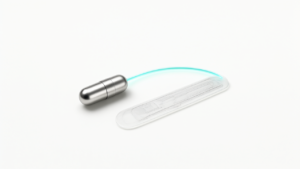
- Interface: A black potentiostat dongle that plugs into a standard laptop or smartphone to process and display the readings.
Initial experimental validation focused on perfluorooctane sulfonate (PFOS) and perfluorooctanoic acid (PFOA). The researchers demonstrated the feasibility of high-volume manufacturing by screen-printing 100 electrodes onto fabric in a few hours.
Background & Context
PFAS are synthetic compounds known for extreme stability and resistance to heat, oil, and water. While industrially valuable, they accumulate in soils, waterways, and organisms. The chemical family exceeds 10,000 substances, though only 50 to 150 are currently subject to global environmental regulations. Traditional detection requires field technicians to send samples to labs for mass spectrometry, a process that is costly and labor-intensive.
Significance & Outlook
This decentralized testing approach lowers barriers to environmental remediation. Because the polymer manufacturing is modular, the architecture can be configured to detect other compounds within the broader PFAS spectrum beyond PFOS and PFOA, empowering municipal authorities and private households to make informed remediation choices.
Get our weekly technology intelligence — free
Receive an infographic that lets you judge at a glance whether each field’s analysis report is worth reading.
Subscribe Free — Weekly Tech Intelligence
By subscribing, you’ll receive Troy-Technical’s weekly technology intelligence newsletter.
- Your email and selected fields are used only to deliver the newsletter.
- We never share your information with third parties.
- You can unsubscribe anytime via the link in each email.
See our Privacy Policy for details.
Takes about a minute · Unsubscribe anytime