Key Findings
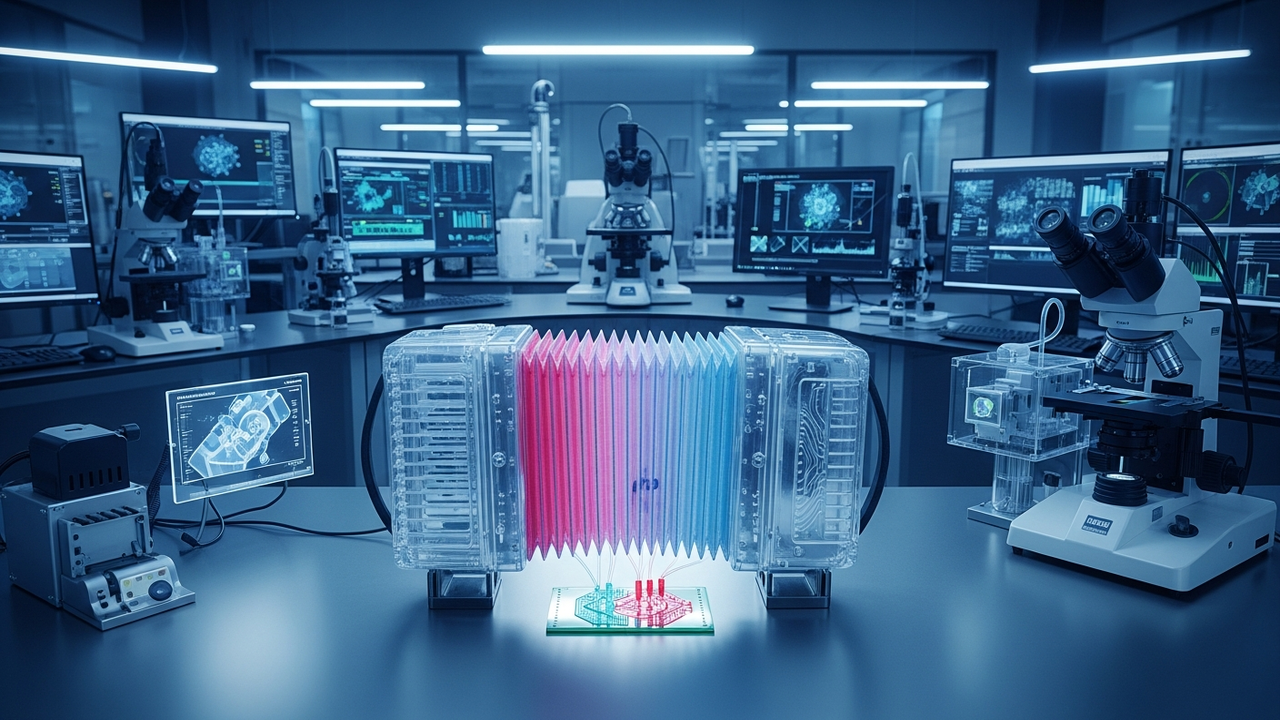
A research team at Texas A&M University has developed a groundbreaking automated fluid perfusion device, drawing inspiration from the expandable mechanism of an accordion. This technology is set to revolutionize the field of lab-on-a-chip and organ modeling, specifically by addressing a major challenge in micro-physiological systems (MPS): the accurate replication of in vivo blood flow dynamics. The innovation provides a novel platform that can significantly reduce or replace animal testing, promising enhanced precision in disease models and more efficient drug screening. The technology is currently patent-pending and has received support from NASA for its potential application in human space travel research.
Technical & Clinical Details
- Accordion-Inspired Mechanism: The device’s core innovation lies in its bellows-like structure, allowing for flexible and precise fluid delivery and aspiration. This design enables the high-fidelity replication of complex blood flow waveforms (pulsatile flow, shear stress) generated by the human heart within MPS. This significantly improves the ability to mimic dynamic physiological environments that were difficult to achieve with conventional pump systems.
- Enhanced Organ Modeling Accuracy: Accurate blood flow replication is crucial for studying endothelial cell function, pharmacokinetics, and disease progression mechanisms (e.g., atherosclerosis, thrombosis). By providing a more physiologically relevant environment on a chip, the device enhances the reliability of in vitro experiments and improves their correlation with in vivo outcomes.
- Application in Multi-Organ Systems: Beyond single-organ models, this device can contribute to providing a consistent blood flow environment when connecting multiple organ-on-a-chip systems. This capability allows for more comprehensive studies of systemic drug effects and inter-organ interactions.
- NASA Support: NASA is evaluating the device’s potential for research into the effects of microgravity on human physiology, hoping to apply it to mitigate health risks and develop countermeasures for spaceflight. This endorsement highlights the technology’s robustness and versatility.
Background & Industry Context
The ethical and cost issues associated with animal testing in drug development, along with its limitations in extrapolating to human responses, have been long-standing challenges. Micro-physiological systems (MPS), commonly known as ‘organ-on-a-chip’ technology, are viewed as next-generation tools to overcome these issues by replicating human organ function on a chip. However, to enhance the physiological relevance of MPS, accurately mimicking complex in vivo microenvironments, especially blood flow dynamics, was critical. This research technically resolves this bottleneck, significantly advancing the development of alternatives to animal testing.
Strategic Significance & Outlook
This automated fluid perfusion device has the potential to accelerate drug screening for personalized medicine, toxicity testing, and the discovery of novel disease mechanisms. If patenting and commercialization proceed, it could become an indispensable tool for the pharmaceutical industry and biotechnology companies. Furthermore, collaboration with NASA is expected to create new research opportunities in astrobiology and space medicine. In the future, integration into more complex multi-organ-on-a-chip systems will likely advance, contributing to the realization of ultimate ‘human-on-a-chip’ systems capable of comprehensively analyzing human physiological functions.
Get our weekly technology intelligence — free
Receive an infographic that lets you judge at a glance whether each field’s analysis report is worth reading.
Subscribe Free — Weekly Tech Intelligence
By subscribing, you’ll receive Troy-Technical’s weekly technology intelligence newsletter.
- Your email and selected fields are used only to deliver the newsletter.
- We never share your information with third parties.
- You can unsubscribe anytime via the link in each email.
See our Privacy Policy for details.
Takes about a minute · Unsubscribe anytime

Comments