Key Findings
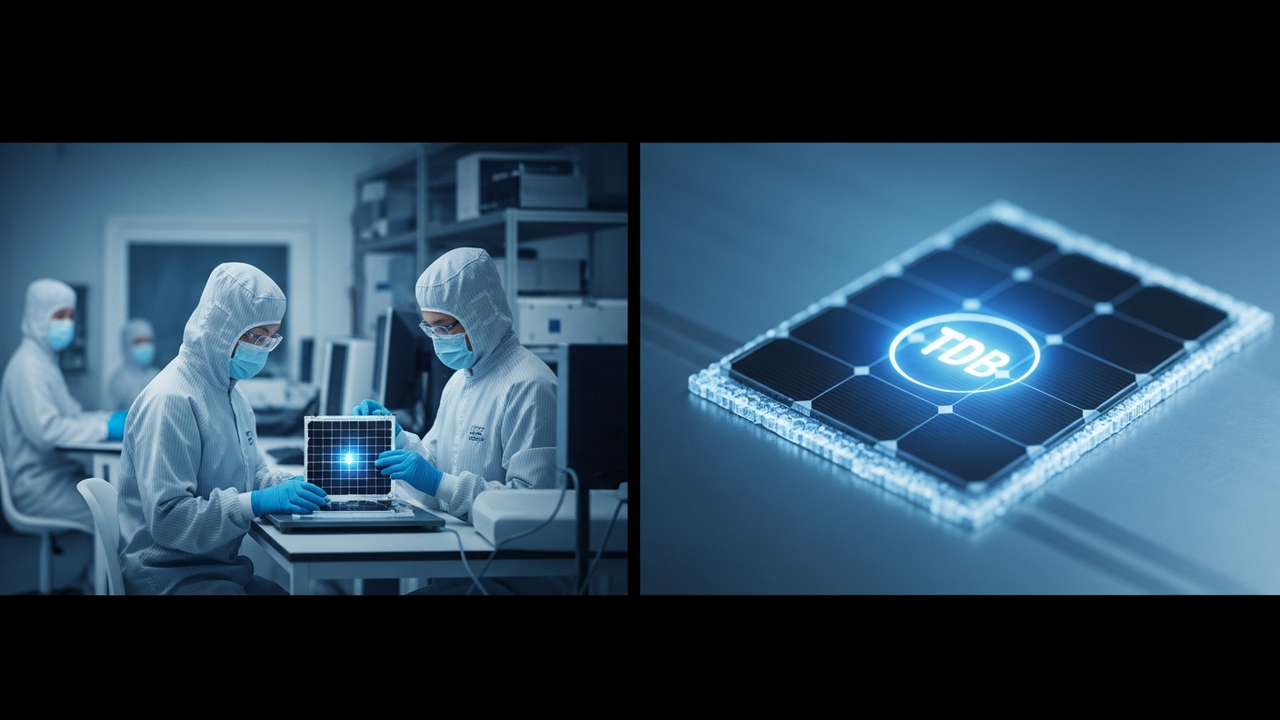
A team of Chinese scientists has established a new world record for perovskite-organic tandem solar cell efficiency, achieving a certified steady-state power conversion efficiency of 28.04%. This groundbreaking achievement significantly advances the practical application of flexible, lightweight, and highly efficient photovoltaic technology. Crucially, the introduction of a novel light-converting additive molecule, TDB, has dramatically enhanced the long-term stability of the device during both fabrication and operation.
Technical and Research Details
This tandem solar cell leverages a perovskite top layer for efficient absorption of high-energy light and an organic bottom layer for capturing near-infrared radiation, thereby utilizing a much broader spectrum of solar light than conventional single-layer devices. The core technical innovation lies in the incorporation of the TDB additive molecule. TDB effectively suppresses halide phase separation during the manufacturing process and throughout the device’s operational lifetime, leading to a substantial improvement in stability. As a result, the device successfully maintained an impressive 90% of its initial performance after 625 hours of continuous light exposure, a critical advancement in overcoming the long-standing stability issues associated with traditional perovskite solar cells. The research findings have been published in the prestigious journal “Nature,” receiving international recognition for their scientific and technological significance.
Background and Industry Context
Perovskite solar cells have garnered significant attention as a next-generation photovoltaic technology due to their outstanding optoelectronic conversion properties. The tandem architecture, combining perovskite with organic solar cells, is a particularly promising approach that exploits the advantages of both materials to achieve even higher efficiencies by absorbing a wider range of the solar spectrum. However, the stability of perovskite materials, especially degradation due to environmental factors and phase separation, has been a major barrier to commercialization. This research from China presents an innovative molecular-level solution to this stability problem, significantly paving the way for practical applications.
Outlook and Strategic Significance
This record-breaking 28.04% efficiency, coupled with dramatically improved stability, opens doors for the mass production of lightweight, flexible, and low-cost solar cells. Specifically, it is expected to accelerate the practical adoption of solar power in a wide array of applications where traditional rigid and heavy silicon solar cells are unsuitable, including wearable electronics, IoT devices, smart building facades, and even aerospace applications like space stations. This technology has the potential to play a crucial role in China’s drive to establish leadership in renewable energy technologies and could significantly impact the global energy transition.
Get our weekly technology intelligence — free
Receive an infographic that lets you judge at a glance whether each field’s analysis report is worth reading.
Subscribe Free — Weekly Tech Intelligence
By subscribing, you’ll receive Troy-Technical’s weekly technology intelligence newsletter.
- Your email and selected fields are used only to deliver the newsletter.
- We never share your information with third parties.
- You can unsubscribe anytime via the link in each email.
See our Privacy Policy for details.
Takes about a minute · Unsubscribe anytime






Comments