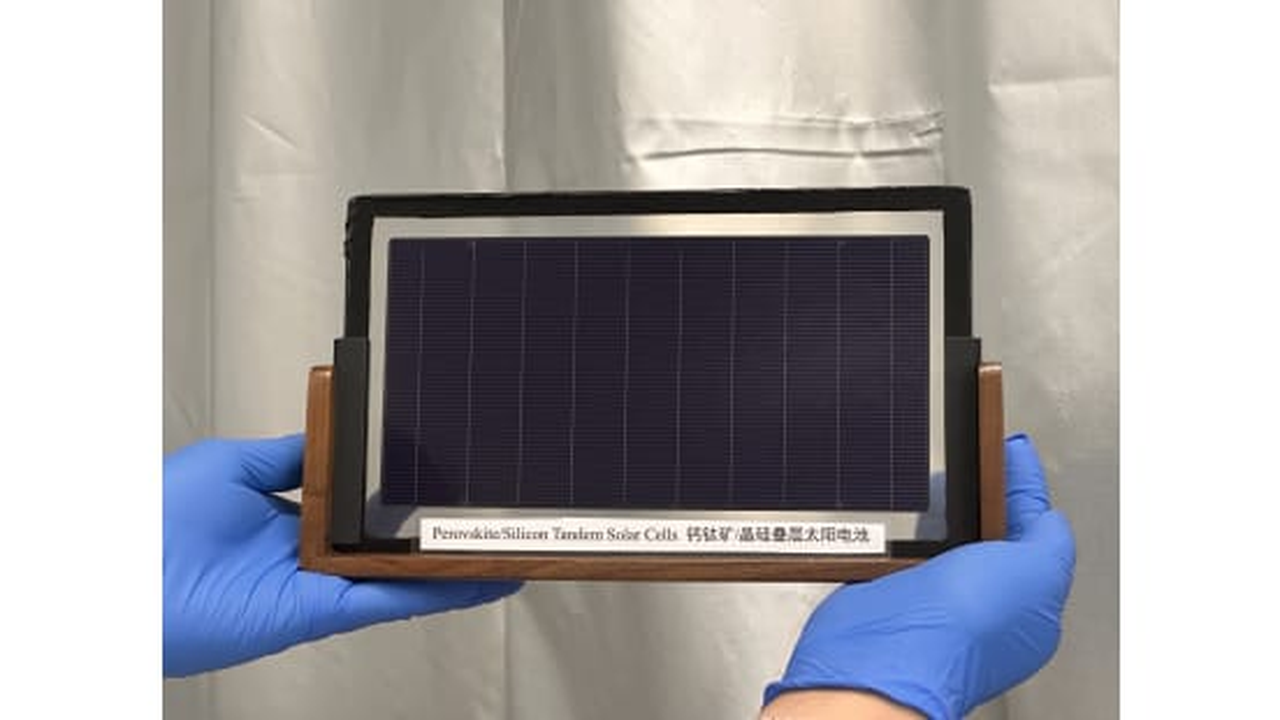
Key Findings
An international research team has successfully developed an innovative indium-free perovskite-silicon tandem solar cell, achieving a certified efficiency of 31.0% for a mini-module. This breakthrough leverages a low-damage reactive plasma deposition process for tin oxide layers, resulting in a small-area device efficiency of 33.6% and demonstrating robust performance over three months of outdoor operation.
Technical Details and Innovation
The core of this advancement lies in the precise engineering of the electron transport layer. The team employed a reactive plasma deposition (RPD) method to create dense and uniform tin oxide (SnO₂) films, which effectively replace the more expensive and supply-constrained indium tin oxide (ITO). The RPD process is crucial as it minimizes damage to underlying layers, a common issue in traditional deposition techniques. These high-quality SnO₂ films significantly improve the interface with self-assembled monolayers (SAMs), leading to a drastic reduction in non-radiative recombination losses, where charge carriers dissipate energy as heat instead of generating electricity. Furthermore, the optimized interface and dense SnO₂ layer effectively suppress the migration of halide ions, a primary cause of instability in perovskite solar cells. This intricate control over materials and interfaces enabled the achievement of 33.6% efficiency for laboratory-scale cells and a highly promising 31.0% for a practical 25.8 cm² mini-module, verified by independent certification.
Background and Industry Context
Tandem solar cells are critical for surpassing the efficiency limits of single-junction devices, and perovskite-silicon tandems are particularly promising due to their potential for high performance combined with the scalability of silicon technology. However, the reliance on indium for transparent conductive electrodes has been a challenge, given its high cost and limited global supply. The development of an indium-free solution addresses these commercial and sustainability concerns directly. This research not only offers a pathway to more cost-effective and environmentally friendly solar cells but also demonstrates a significant leap in manufacturing control and materials integration for next-generation photovoltaics.
Strategic Significance and Outlook
The achievement of 31.0% efficiency in an indium-free perovskite-silicon tandem mini-module marks a major milestone toward the widespread commercialization of this technology. The elimination of indium reduces material costs and supply chain risks, making large-scale production more viable and sustainable. This high efficiency, coupled with demonstrated outdoor stability, positions these cells as strong candidates for a variety of applications, from rooftop solar installations to flexible and portable power solutions. As the global demand for renewable energy continues to grow, such advancements in efficiency and cost-effectiveness will be crucial for accelerating the transition to a sustainable energy future. The international research team’s work paves the way for a new generation of high-performance solar technology that is both economically competitive and environmentally responsible, promising to lower the Levelized Cost of Energy (LCOE) and expand the addressable market for solar power.
Get our weekly technology intelligence — free
Receive an infographic that lets you judge at a glance whether each field’s analysis report is worth reading.
Subscribe Free — Weekly Tech Intelligence
By subscribing, you’ll receive Troy-Technical’s weekly technology intelligence newsletter.
- Your email and selected fields are used only to deliver the newsletter.
- We never share your information with third parties.
- You can unsubscribe anytime via the link in each email.
See our Privacy Policy for details.
Takes about a minute · Unsubscribe anytime








Comments