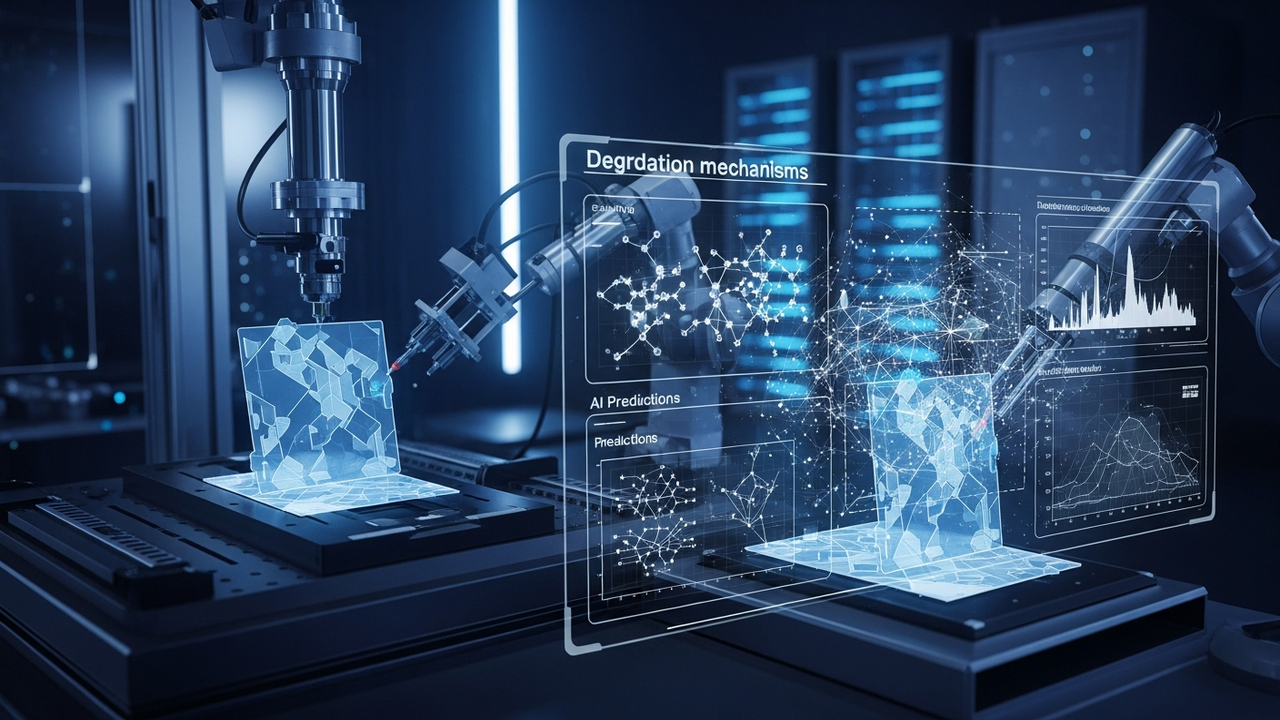
Perovskite Solar Cells for Extreme Environments: Advancing Ultra-Stable Design Through Degradation Mechanism Elucidation and AI Prediction
A comprehensive review article published in MDPI highlights the evolution of perovskite solar cells (PSCs) aimed at operating under significantly different and harsh conditions, particularly in space and extreme terrestrial environments. The paper meticulously analyzes the unique degradation mechanisms PSCs face in these specialized settings and proposes cutting-edge engineering strategies and the integration of artificial intelligence (AI) as solutions. This work significantly broadens the possibilities for energy supply in next-generation space exploration and specialized applications.
Technical and Research Details
- Primary Degradation Mechanisms: Key mechanisms hindering PSC performance in extreme environments include:
- Vacuum-Induced Volatile Desorption: In the vacuum of space, organic components and volatile additives within PSCs can desorb from the device, leading to performance degradation.
- UV-Induced Halide Segregation: Intense ultraviolet radiation accelerates the segregation of halide ions within the perovskite crystal structure, causing bandgap changes and efficiency reduction.
- Thermomechanical Failure at Embedded Interfaces: Orbital changes for spacecraft or temperature cycling on planetary surfaces can induce stress due to thermal expansion coefficient mismatches between different layers within PSCs, leading to physical damage such as interface delamination and cracks.
- Radiation Damage: Space radiation (protons, electrons, heavy ions) generates defects in perovskite materials and charge transport layers, increasing carrier recombination and decreasing efficiency.
- Advanced Engineering Strategies: To counter these degradation mechanisms, the review emphasizes the following strategies:
- Novel Material Design: Development of more robust and stable perovskite compositions (e.g., incorporating inorganic cations) and charge transport materials with extreme environment resilience.
- Interface Engineering: Improving interface stability and suppressing charge recombination through the introduction of defect passivation layers and barrier layers.
- Robust Encapsulation Technologies: Innovative encapsulation materials and structures to protect devices from moisture, oxygen, vacuum, and radiation.
- Integration of AI Prediction Monitoring: Of particular note is the proposed integration of State of Health (SOH) prediction monitoring using AI, specifically deep learning architectures. This approach enables real-time monitoring of PSC degradation and prediction of future performance decline, thereby optimizing device lifespan and enhancing mission reliability. AI also serves as a powerful tool for learning patterns from complex degradation mechanism data to guide optimal material design and operational strategies.
Background and Industry Context
Space solar power holds significant potential for sustainable space exploration and the future of energy supply on Earth. While conventional space solar cells (e.g., gallium arsenide) have faced challenges regarding high cost and weight, perovskite solar cells are emerging as an attractive alternative for space applications due to their high efficiency, lightweight nature, and flexibility. Ensuring reliability in extreme environments is key to the widespread adoption of this technology.
Future Outlook
This review article clearly defines the direction for R&D in PSCs for space and extreme environments. The combination of advanced materials science, engineering strategies, and innovative tools like AI is expected to enable the realization of ultra-stable and radiation-hardened perovskite solar cells. This will pave the way for PSCs to become a primary energy source in future space missions, high-altitude platforms, and terrestrial applications with specific power requirements.
Source: https://www.mdpi.com/2571-8797/8/4/111
Get our weekly technology intelligence — free
Receive an infographic that lets you judge at a glance whether each field’s analysis report is worth reading.
Subscribe Free — Weekly Tech Intelligence
By subscribing, you’ll receive Troy-Technical’s weekly technology intelligence newsletter.
- Your email and selected fields are used only to deliver the newsletter.
- We never share your information with third parties.
- You can unsubscribe anytime via the link in each email.
See our Privacy Policy for details.
Takes about a minute · Unsubscribe anytime

Comments