Key Findings
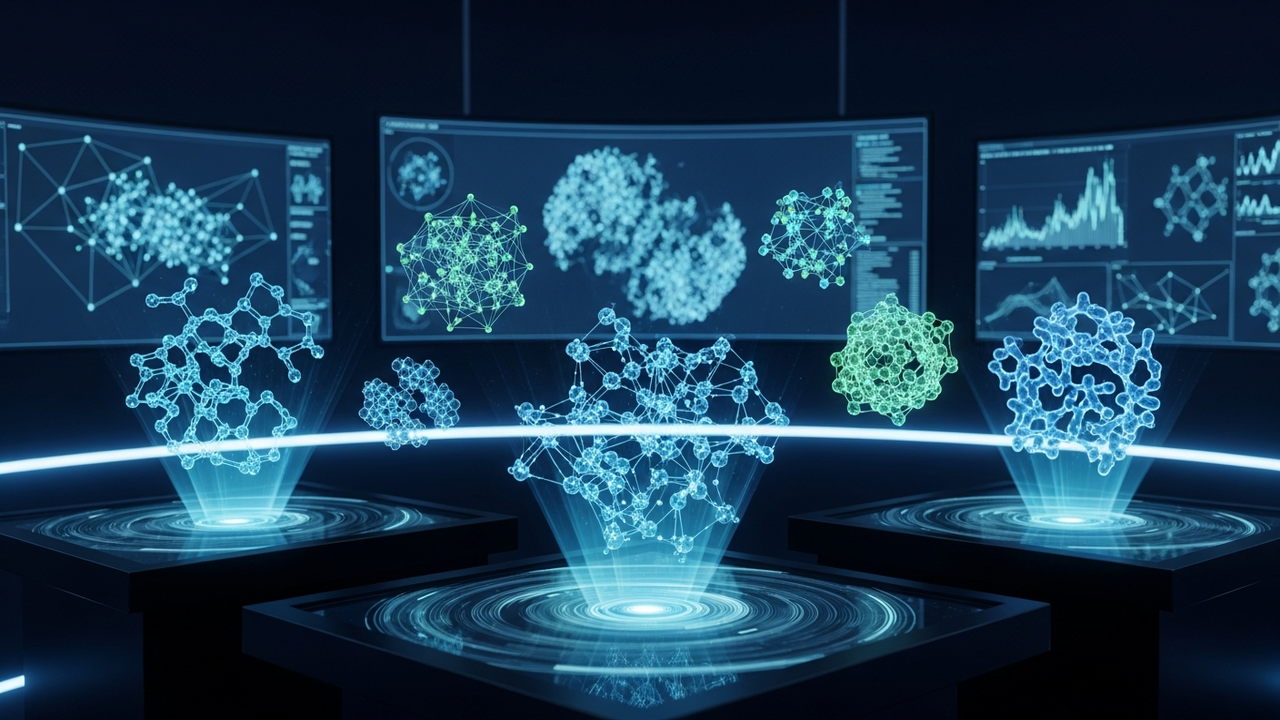
SciReasoner has been launched as an innovative multi-modal scientific foundation model, enabling structural reasoning across proteins, molecules, and crystals. This model has successfully and dramatically enhanced both predictive tasks and scientific reasoning capabilities by efficiently discretizing structural elements into a unified vocabulary.
Technical / Clinical Details
At its core, SciReasoner’s strength lies in its ability to convert diverse physicochemical structures (protein folding, molecular bonding, crystal lattices) into a common, discrete representation. This unified vocabulary allows the model to transfer knowledge across different domains and perform more generalized reasoning. As a concrete application, the model demonstrated superior accuracy in Gene Ontology (GO) prediction (predicting the function of specific proteins within a cell) compared to existing state-of-the-art models. Furthermore, its performance in retrosynthesis analysis (identifying precursors to synthesize a target molecule) in chemistry was also significantly improved. Such a multi-modal approach provides a more comprehensive and accurate understanding of complex scientific problems spanning different scales and domains. This is critical for breaking down data ‘silos’ and fostering integration between various scientific disciplines.
Background & Context
In modern scientific research, vast amounts of structural data are generated, requiring efficient analysis to derive new scientific insights. However, structures at different scales, such as proteins, molecules, and crystals, are often handled using disparate modeling methods and data formats, making cross-disciplinary reasoning challenging. With the success of foundation models in AI, there has been a strong desire for similar general-purpose models in the scientific domain. SciReasoner addresses this challenge, providing a powerful foundation for problem-solving across multiple fields, including biology, chemistry, and materials science.
Strategic Significance & Outlook
The introduction of SciReasoner holds the potential to bring about significant transformation in the process of scientific discovery. By possessing unified structural reasoning capabilities, researchers can integrate previously fragmented knowledge, generate more complex hypotheses, and accelerate the design of new materials and pharmaceuticals. In the future, by further extending this model to higher-level scientific tasks such as experimental data interpretation, novel hypothesis generation, and autonomous experimental planning, it is expected to bring us closer to realizing true ‘AI scientists.’
Source: https://arxiv.org/abs/2607.04567
Get our weekly technology intelligence — free
Receive an infographic that lets you judge at a glance whether each field’s analysis report is worth reading.
Subscribe Free — Weekly Tech Intelligence
By subscribing, you’ll receive Troy-Technical’s weekly technology intelligence newsletter.
- Your email and selected fields are used only to deliver the newsletter.
- We never share your information with third parties.
- You can unsubscribe anytime via the link in each email.
See our Privacy Policy for details.
Takes about a minute · Unsubscribe anytime








Comments