Key Findings
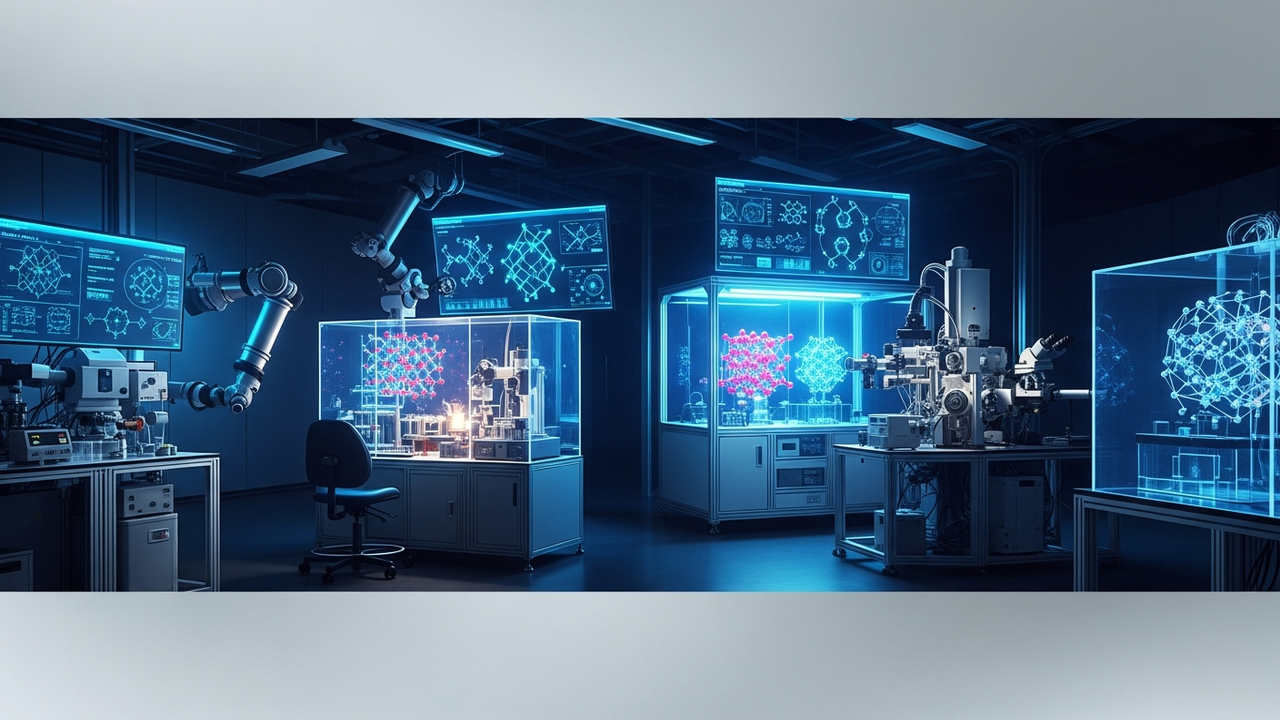
An innovative approach integrating artificial intelligence (AI) with automated high-throughput (HT) technologies has been proposed to revolutionize the discovery process of Metal-Organic Frameworks (MOFs). This promises to dramatically streamline the cycle from MOF design to synthesis, characterization, and evaluation, enabling rapid discovery of materials optimized for specific applications.
Technical / Clinical Details
This perspective details how the combination of autonomous self-driving labs (SDLs) and Large Language Models (LLMs) will transform MOF research. LLMs will serve as the ‘thinking’ core, extracting knowledge about MOF synthesis conditions and structure-function relationships from vast scientific literature and databases to propose new MOF design candidates. Simultaneously, SDLs will autonomously synthesize AI-proposed candidate materials and conduct high-throughput characterization, including X-ray diffraction, adsorption tests, and catalytic performance evaluations. This closed-loop system allows AI to learn from experimental results and plan and execute the next optimization cycle, significantly accelerating the pace of MOF discovery compared to traditional human-driven trial-and-error processes. For example, MOFs with specific functionalities, such as CO2 capture, hydrogen storage, or catalytic reactions, can be identified and optimized in much shorter timeframes.
Background & Context
MOFs, with their high porosity, tunable pore structures, and diverse compositions, are next-generation materials expected to have wide-ranging applications in gas storage and separation, catalysis, sensors, and drug delivery. However, their immense combinatorial possibilities (due to the variety of metal nodes and organic linkers) have made experimental discovery of optimal MOFs extremely challenging, representing a time-consuming and costly bottleneck. Advances in AI and automation technologies are emerging as indispensable tools to efficiently navigate this exploration space and accelerate MOF discovery.
Strategic Significance & Outlook
The creation of MOF laboratories integrating AI and autonomous labs signifies a paradigm shift in MOF research. This will allow researchers to dedicate more time to leveraging the deep insights provided by AI and tackling complex problem-solving. In the future, this AI-driven approach will enable rapid and targeted discoveries, contributing to solving major societal challenges related to new energy materials, environmental technologies, and precision chemical production. This technology is expected to play a crucial role in accelerating the commercialization of MOFs and bringing new value to industries.
Source: https://www.osti.gov/servlets/purl/3370420
Get our weekly technology intelligence — free
Receive an infographic that lets you judge at a glance whether each field’s analysis report is worth reading.
Subscribe Free — Weekly Tech Intelligence
By subscribing, you’ll receive Troy-Technical’s weekly technology intelligence newsletter.
- Your email and selected fields are used only to deliver the newsletter.
- We never share your information with third parties.
- You can unsubscribe anytime via the link in each email.
See our Privacy Policy for details.
Takes about a minute · Unsubscribe anytime





Comments