
An innovative optical coupler emerging from MIT’s FUTUR-IC program promises to dramatically enhance AI chip data transfer capabilities and fundamentally alter the energy efficiency landscape of AI data centers. This technology will enable AI chips to transfer over 1 petabit per second (Pbps) of data, with a target of 10 Pbps by 2030.
Technical Details
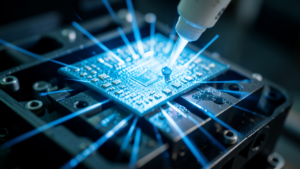
This breakthrough is achieved through ‘electronic-photonic integration’ technology, which integrates both electronic and optical circuits onto a single chip. Traditional electrical signal data transmission has faced significant challenges with power consumption and heat generation due to the enormous data volumes and computational demands of AI data centers. The new optical coupler overcomes these physical limitations by enabling on-chip, light-based data transmission. Specifically, optical signals can transmit data far faster and with significantly lower energy consumption than electrical signals, thus dramatically improving the overall power efficiency of data centers. This technology is expected to eliminate data transfer bottlenecks, accelerating AI model training and inference.
Background & Context
The evolution of AI has heightened its dependence on high-performance hardware, making data center power consumption a global concern. Conventional copper interconnects generate heat due to electrical resistance, leading to increased power consumption. This issue is exacerbated as AI workloads scale, with projections suggesting that continued growth of AI data centers at the current pace could place significant strain on global power grids. Consequently, leading chip manufacturers like Nvidia, AMD, Broadcom, and Marvell are making multi-billion dollar investments in photonic technologies, including Co-Packaged Optics (CPO) and silicon photonics. They recognize optical technology as key to sustainable AI computing scaling and are already integrating it into their next-generation products.
Strategic Significance & Outlook
MIT’s technology offers a promising solution to the AI data center power consumption problem, establishing a foundation for further AI development. If 10 Pbps data transfer speeds are realized in the future, it would enable the efficient processing of massive models and complex tasks currently unimaginable in AI systems. This could revolutionize all fields where AI is applied, such as autonomous driving, new drug discovery, and climate change modeling. As commercialization progresses, it will also lead to reduced data center operational costs, making it an attractive sector for investors. International collaboration and standardization will be key to accelerating the widespread adoption of this technology.
Source: https://marketwise.com/investing/mit-electronic-photonic-integration-ai-data-center-energy-crisis/
Get our weekly technology intelligence — free
Receive an infographic that lets you judge at a glance whether each field’s analysis report is worth reading.
Subscribe Free — Weekly Tech Intelligence
By subscribing, you’ll receive Troy-Technical’s weekly technology intelligence newsletter.
- Your email and selected fields are used only to deliver the newsletter.
- We never share your information with third parties.
- You can unsubscribe anytime via the link in each email.
See our Privacy Policy for details.
Takes about a minute · Unsubscribe anytime




Comments