Key Findings
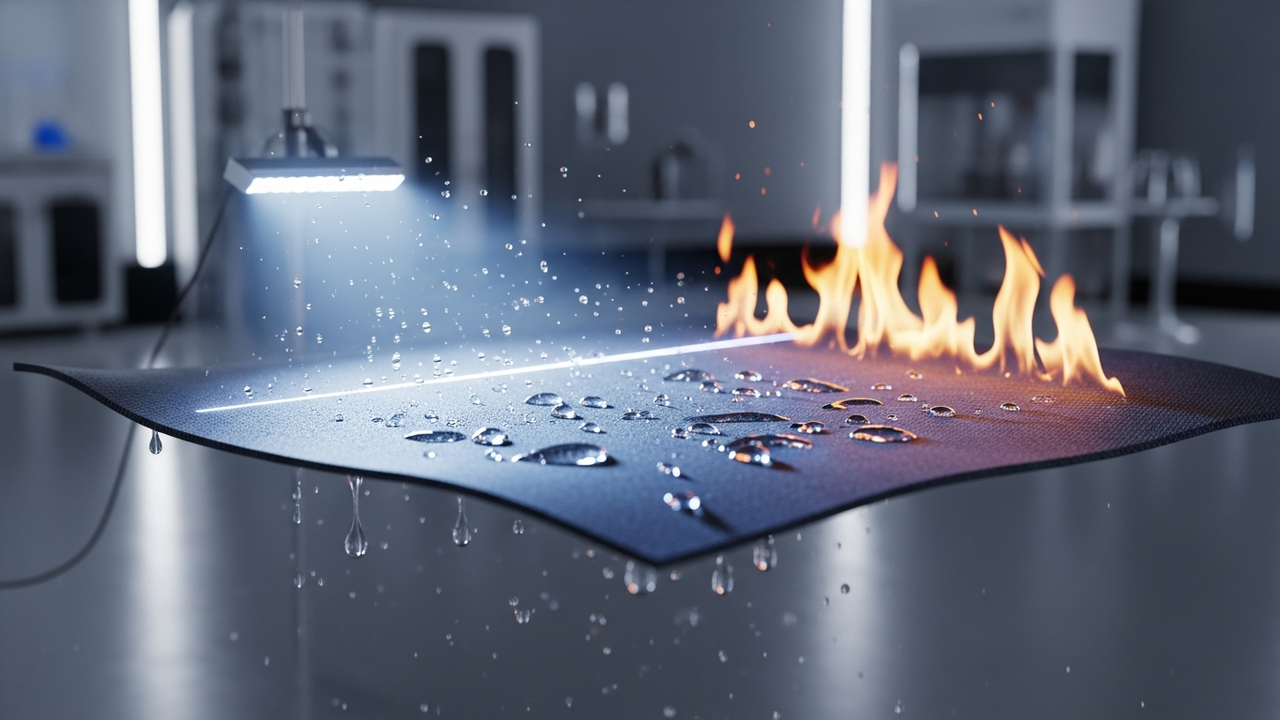
In recent research, a multifunctional aramid fabric has been developed, highly integrating four functions: superhydrophobicity, self-cleaning, photocatalysis, and flame retardancy. This groundbreaking fabric simultaneously provides these complex properties in a single material, significantly enhancing protective performance and durability, especially in harsh environments. Specifically, it achieves excellent superhydrophobicity with a water contact angle of 153.74° and a sliding angle of 6.9°, and also possesses a photocatalytic function that degrades pollutants under sunlight. This technology holds the potential to revolutionize various fields, including protective clothing, outdoor textiles, and environmental purification systems.
Technical / Clinical Details
This multifunctional aramid fabric was achieved through the synergistic effect of multiple advanced material technologies. First, the aramid fiber substrate ensures the stability and durability of the coating due to its excellent strength and heat resistance. Next, an S-scheme heterojunction photocatalyst consisting of TiO2 (titanium dioxide) and g-C3N4 (graphitic carbon nitride) is immobilized on the fabric surface. This photocatalyst absorbs sunlight (especially UV and visible light) to induce powerful redox reactions, efficiently degrading organic pollutants like phenanthrene. Experiments demonstrated its ability to degrade approximately 85% of phenanthrene under solar irradiation. Furthermore, a composite coating of polydimethylsiloxane (PDMS) and phosphorylated chitosan (PCS) is applied, which imparts superhydrophobicity and significantly enhances flame retardancy. PCS, due to its phosphorus content, forms a char layer during combustion, blocking heat and oxygen supply, thereby delaying fabric ignition. As a result, this fabric showed a 5% increase in Limiting Oxygen Index (LOI) and an approximately 80% reduction in burning drips compared to conventional flame-retardant aramid fabrics. Excellent washing durability and UV resistance were also confirmed, with superhydrophobicity and flame retardancy maintained after 10 washing cycles.
Background & Context
Protective clothing and functional textiles are essential for ensuring the safety of individuals working in hazardous environments, such as firefighters, military personnel, and chemical plant workers. These applications simultaneously demand protection from fire, liquid repellency against chemicals, and prevention of dirt accumulation. However, achieving these multiple functions in a single fabric has been a significant challenge. Conventional technologies often required different treatments for each function, leading to increased costs, reduced durability, and discomfort. This research represents a breakthrough in the design and manufacturing of multifunctional textiles, contributing to the realization of more high-performance and safer protective gear.
Strategic Significance & Outlook
This multifunctional aramid fabric is expected to be commercialized in a wide range of application areas, including fire suits, military uniforms, industrial protective gear, outdoor tents, and self-cleaning filters. Future research will focus on scaling up the manufacturing process, further improving cost-efficiency, and optimizing photocatalytic degradation efficiency against different types of pollutants. Customization of functions (e.g., antibacterial properties, electromagnetic shielding) tailored to specific industrial needs is also envisioned. This technology is poised to make a significant impact on the functional textile market and holds the potential to establish new standards that contribute to human safety and environmental protection.
Source: https://pubs.acs.org/doi/10.1021/acsapm.6c00834
Get our weekly technology intelligence — free
Receive an infographic that lets you judge at a glance whether each field’s analysis report is worth reading.
Subscribe Free — Weekly Tech Intelligence
By subscribing, you’ll receive Troy-Technical’s weekly technology intelligence newsletter.
- Your email and selected fields are used only to deliver the newsletter.
- We never share your information with third parties.
- You can unsubscribe anytime via the link in each email.
See our Privacy Policy for details.
Takes about a minute · Unsubscribe anytime




Comments