Key Findings
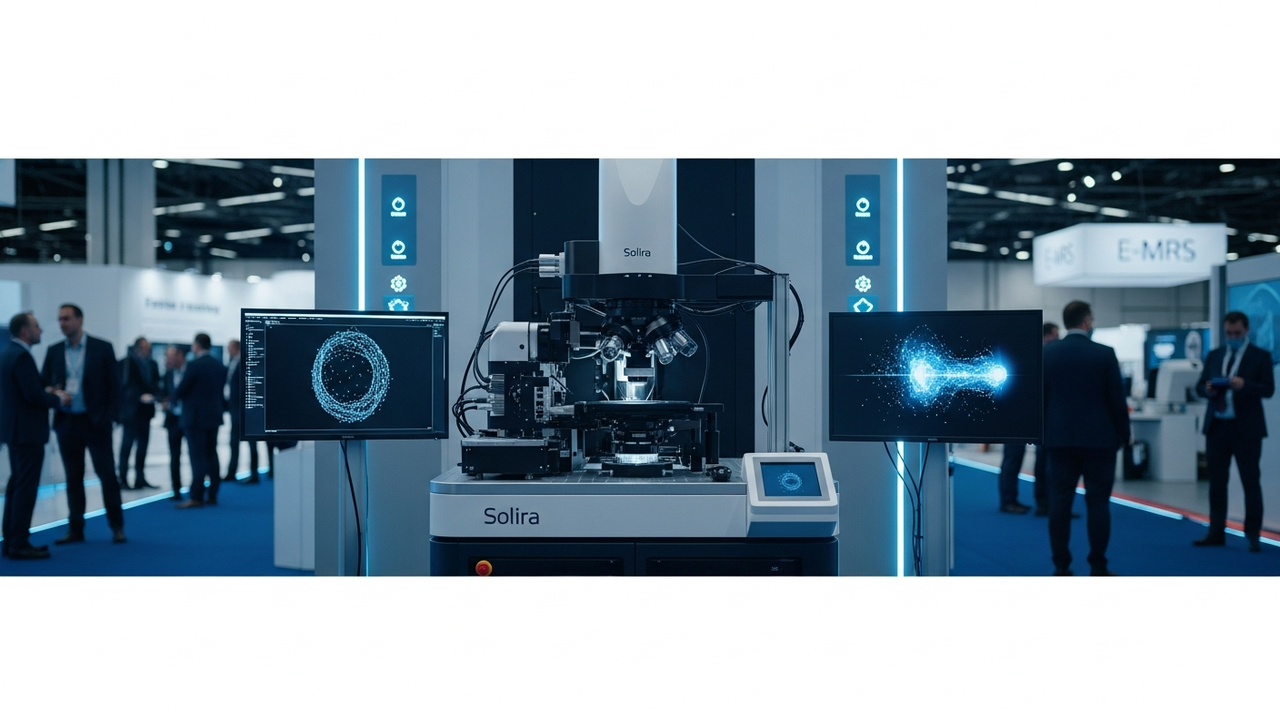
PicoQuant officially unveiled its innovative time-resolved photoluminescence (TRPL) microscope system, ‘Solira,’ at the E-MRS Spring Meeting 2026, designed for comprehensive characterization of advanced materials. This new system promises to elucidate the dynamics of electronic excited states in materials science research with unprecedented precision.
Technical / Clinical Details
The Solira system integrates high-resolution optical microscopy with ultrafast time-resolved measurement capabilities based on Time-Correlated Single Photon Counting (TCSPC) technology. This allows users to simultaneously measure photoluminescence lifetime, spectrum, quantum efficiency, and their spatial distribution within materials. It proves particularly effective in a wide range of advanced materials research, including defect analysis in semiconductor devices, charge carrier dynamics in perovskite solar cells, and photophysical characterization of quantum dots. Solira combines nanometer-scale spatial resolution with picosecond-level temporal resolution, enabling detailed mapping of electron and exciton transport mechanisms and recombination pathways within materials. This provides data crucial for deeply understanding the fundamental physical phenomena that determine material performance.
Background & Context
Precise understanding and control of optical and electronic properties of materials are essential for developing next-generation electronic devices, solar cells, quantum technologies, and photocatalysts. Traditional characterization methods have struggled to simultaneously acquire spatial and temporal information with high accuracy, often failing to capture the true behavior of materials. PicoQuant’s Solira addresses these challenges, offering a powerful solution for materials scientists to conduct more efficient and accurate research. This is expected to accelerate the R&D cycle and shorten the time from new material discovery to practical application.
Strategic Significance & Outlook
PicoQuant’s Solira time-resolved photoluminescence microscope has the potential to become a standard analytical instrument in the field of materials science. This technology will play a crucial role, particularly in quality control within the semiconductor industry, the development of new energy materials, and fundamental physics research. Future applications are also envisioned for more complex multi-layered materials and biomaterials, further expanding the frontiers of materials research. With the introduction of Solira, researchers will be able to uncover hidden material properties and contribute to the creation of higher-performance and more innovative products.
Source: https://www.azom.com/news.aspx?newsID=65629
Get our weekly technology intelligence — free
Receive an infographic that lets you judge at a glance whether each field’s analysis report is worth reading.
Subscribe Free — Weekly Tech Intelligence
By subscribing, you’ll receive Troy-Technical’s weekly technology intelligence newsletter.
- Your email and selected fields are used only to deliver the newsletter.
- We never share your information with third parties.
- You can unsubscribe anytime via the link in each email.
See our Privacy Policy for details.
Takes about a minute · Unsubscribe anytime








Comments