Key Findings
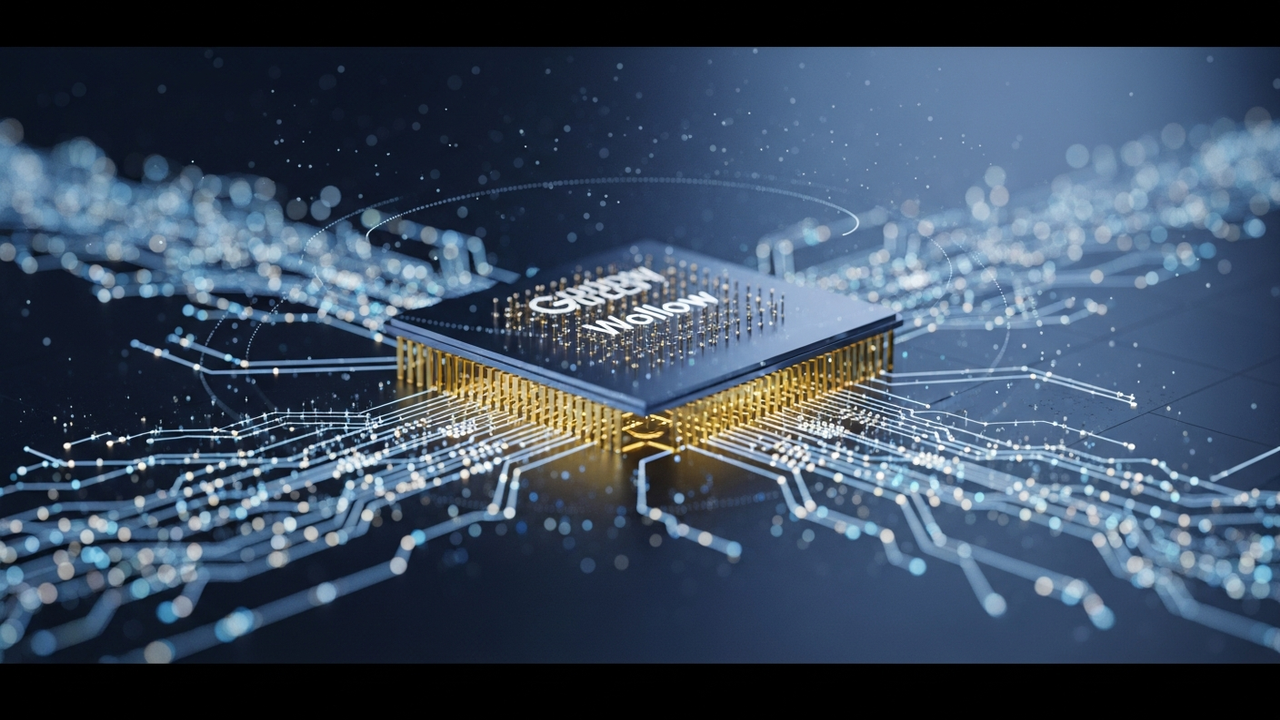
Google Quantum AI and Google DeepMind researchers have published a paper in Nature detailing a breakthrough in quantum error correction (QEC) where a reinforcement learning (RL) agent successfully self-calibrates a quantum processor during active error correction. This method improved the stability of the logical error rate (LER) by a factor of 3.5. Demonstrated on Google’s Willow superconducting quantum chip, this achievement yielded a record logical error per cycle of 7.72(9)×10⁻⁴ for a distance-7 surface code, marking the first time RL-controlled QEC has been shown at the scale of a full error-corrected processor.
Technical / Clinical Details
The Willow quantum chip, a 105-qubit superconducting processor, previously made history by achieving below-threshold quantum error correction, meaning increasing the system size can reduce overall error rates. The newly developed RL framework addresses the inherent fragility of qubits by continuously adapting to environmental drifts and calibrating the processor without pausing computations. This real-time, autonomous calibration significantly mitigates the challenge of frequent recalibration, which is a major bottleneck for scaling superconducting quantum computers. The use of surface codes, a promising QEC scheme, facilitated the encoding of multiple physical qubits into logical qubits to achieve this robust performance.
Background & Context
Quantum error correction is a critical prerequisite for building fault-tolerant quantum computers, as physical qubits are highly susceptible to noise and decoherence. However, implementing effective QEC has been a long-standing challenge due to the complexity of real-time error detection and correction, often requiring substantial classical computational resources and frequent manual adjustments. This work represents a significant convergence of artificial intelligence and quantum computing, where AI provides the necessary intelligence to manage the delicate quantum state and ensure operational stability.
Strategic Significance & Outlook
This breakthrough has profound implications for the development of practical, large-scale fault-tolerant quantum computers and accelerates the timeline for real-world applications. By enabling quantum systems to self-calibrate and maintain stable logical error rates, Google’s work paves the way for running deeper, more complex quantum algorithms with greater reliability. This advancement is particularly crucial for fields like quantum machine learning, which can now leverage more stable quantum hardware, and for post-quantum cryptography, as it clarifies the timeline for a cryptographically relevant quantum computer. The ability to achieve such performance indicates a significant step towards unlocking quantum computing’s transformative potential in drug discovery, materials science, and complex optimization problems.
Source: https://quantumcomputingreport.com/reinforcement-learning-quantum-error-correction/
Get our weekly technology intelligence — free
Receive an infographic that lets you judge at a glance whether each field’s analysis report is worth reading.
Subscribe Free — Weekly Tech Intelligence
By subscribing, you’ll receive Troy-Technical’s weekly technology intelligence newsletter.
- Your email and selected fields are used only to deliver the newsletter.
- We never share your information with third parties.
- You can unsubscribe anytime via the link in each email.
See our Privacy Policy for details.
Takes about a minute · Unsubscribe anytime



Comments