Key Findings
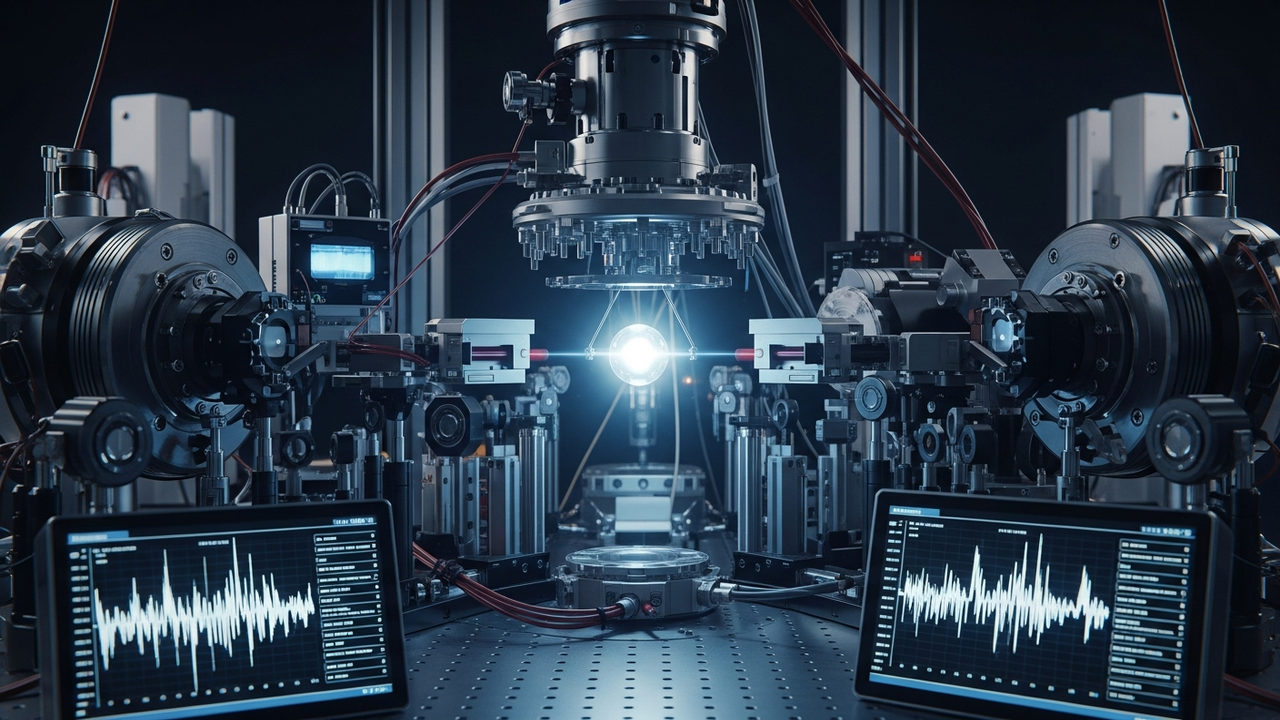
Researchers at MIT and Caltech have achieved a significant breakthrough in quantum error correction (QEC) by successfully encoding a logical qubit within a single ion. This novel approach has demonstrated a remarkable reduction in errors by up to 2.2-fold and an extension of the qubit’s coherence lifetime by up to 1.5 times. This advancement potentially offers a less resource-intensive alternative to standard QEC protocols, which typically demand a large overhead of physical qubits.
Technical / Clinical Details
Unlike conventional QEC schemes that use multiple physical qubits to form a logical qubit for redundancy, this research cleverly leverages additional quantum states residing within a single atomic ion. This allows for the encoding of quantum information into a more robust, protected logical qubit using a minimal physical footprint. A key innovation is the development of an autonomous error correction scheme that operates without requiring mid-circuit measurements. Mid-circuit measurements can themselves introduce errors or cause decoherence, so their elimination or reduction contributes to cleaner and more efficient QEC. By exploiting intrinsic properties of the single particle, this method simplifies the hardware requirements for achieving fault tolerance, paving the way for more scalable quantum processors.
Background & Context
Qubits are inherently fragile and highly susceptible to noise and decoherence from their environment, leading to errors during quantum computations. This error problem remains one of the most formidable barriers to building large-scale, practical quantum computers. Efficient and resource-effective quantum error correction is therefore paramount for achieving fault-tolerant quantum computing. The ability to realize QEC within a minimalist, single-ion system pushes the theoretical boundaries of quantum error correction and opens new avenues for hardware architectures.
Strategic Significance & Outlook
This breakthrough from MIT and Caltech represents a crucial step towards the realization of fault-tolerant quantum computing, offering a new paradigm for constructing high-performance logical qubits with fewer physical resources. The enhanced qubit stability and reduced error rates will enable the execution of larger and more complex quantum algorithms, accelerating applications in areas where quantum computers promise transformative impacts, such as drug discovery, materials science, financial modeling, and artificial intelligence. This research suggests that multiplexing within single particles and autonomous error correction schemes could play a more central role in the design of future quantum computing systems.
Source: https://quantumzeitgeist.substack.com/p/mit-and-caltech-researchers-create
Get our weekly technology intelligence — free
Receive an infographic that lets you judge at a glance whether each field’s analysis report is worth reading.
Subscribe Free — Weekly Tech Intelligence
By subscribing, you’ll receive Troy-Technical’s weekly technology intelligence newsletter.
- Your email and selected fields are used only to deliver the newsletter.
- We never share your information with third parties.
- You can unsubscribe anytime via the link in each email.
See our Privacy Policy for details.
Takes about a minute · Unsubscribe anytime





Comments