Key Findings
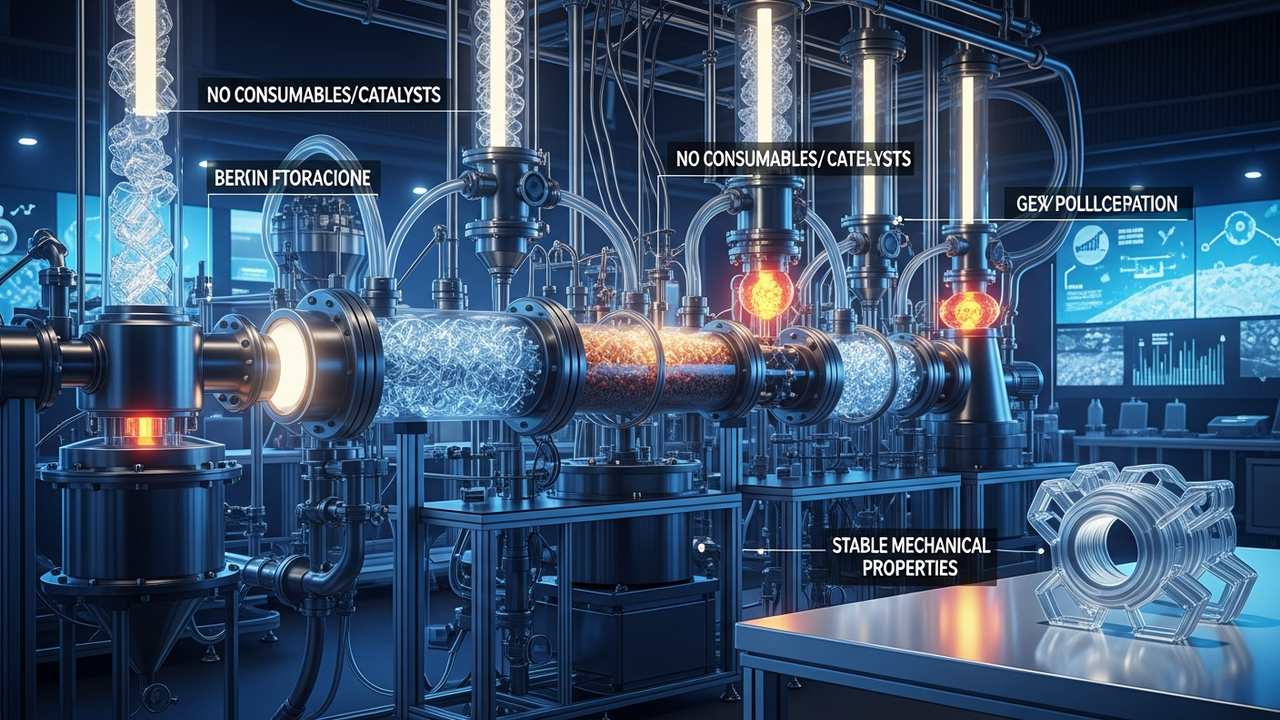
Groundbreaking research published in the Journal of the American Chemical Society reports the development of novel polyketimine networks that are highly dynamic yet maintain robust mechanical properties during use. This innovative material addresses existing challenges in plastic recycling by demonstrating “closed-loop recyclability” under mild conditions, critically requiring no consumable reagents or external catalysts. This achievement offers an exceptionally promising strategy for significantly mitigating plastic pollution and represents a major breakthrough in sustainable polymer material design.
Technical Details
The escalating plastic pollution crisis has spurred the development of degradable plastics, but many of these materials present a trade-off between stability during use and efficiency in the recycling process. Materials that degrade easily often lack durability, while durable materials are difficult to recycle. The polyketimine network developed in this study overcomes this fundamental trade-off.
- Dynamic Networks with Stability: Polyketimines form “dynamic covalent bonds” through reversible imine linkages (C=N) that can undergo association and dissociation reactions. This allows the material to possess self-healing capabilities and re-processability while maintaining an overall stable network structure. This ensures the material remains robust against external stresses during its service life.
- Closed-Loop Recyclability: Remarkably, this polyketimine network can be completely depolymerized back to its original monomers under specific mild conditions (e.g., changes in pH or exposure to specific solvents), without the need for consumable reagents or catalysts. This brings significant benefits, making the recycling process environmentally friendly and economically viable. The depolymerized monomers can be purified and then reused for polymer synthesis, achieving true “closed-loop” recycling.
- Topological Programmability: The dynamic nature of this network potentially allows for programmatic control over the material’s topology (structural arrangement). This provides flexibility to tailor the material’s mechanical, thermal, and other functional properties for specific applications.
This technology holds the potential to make plastic waste recycling far more efficient and sustainable within the waste hierarchy.
Background & Industry Context
Plastic pollution is a severe global environmental issue, prompting governments and corporations worldwide to invest heavily in reducing single-use plastics, increasing recycling rates, and developing biodegradable materials. Existing recycling technologies, particularly mechanical recycling, face challenges such as material quality degradation and difficulties in processing mixed plastic waste. While chemical recycling is considered a promising alternative, it often requires high temperatures, high pressures, or specific catalysts and reagents, which can themselves contribute to energy consumption and environmental burden. The results of this research offer a low-energy and clean solution to these challenges.
Strategic Significance & Outlook
This polyketimine network is expected to significantly impact the future development of high-performance, recyclable plastic materials. Applications are anticipated in industries requiring high-performance polymers, such as automotive, electronics, and packaging. For investors, it offers opportunities in the new frontier of circular materials technology. For engineers and researchers, it provides inspiration for next-generation material design aimed at achieving a zero-waste society. If commercialized, this technology is expected to dramatically reduce the environmental impact of plastics and accelerate the transition to a more sustainable society.
Source: https://pubs.acs.org/doi/10.1021/jacs.6c00544
Get our weekly technology intelligence — free
Receive an infographic that lets you judge at a glance whether each field’s analysis report is worth reading.
Subscribe Free — Weekly Tech Intelligence
By subscribing, you’ll receive Troy-Technical’s weekly technology intelligence newsletter.
- Your email and selected fields are used only to deliver the newsletter.
- We never share your information with third parties.
- You can unsubscribe anytime via the link in each email.
See our Privacy Policy for details.
Takes about a minute · Unsubscribe anytime








Comments