Key Findings
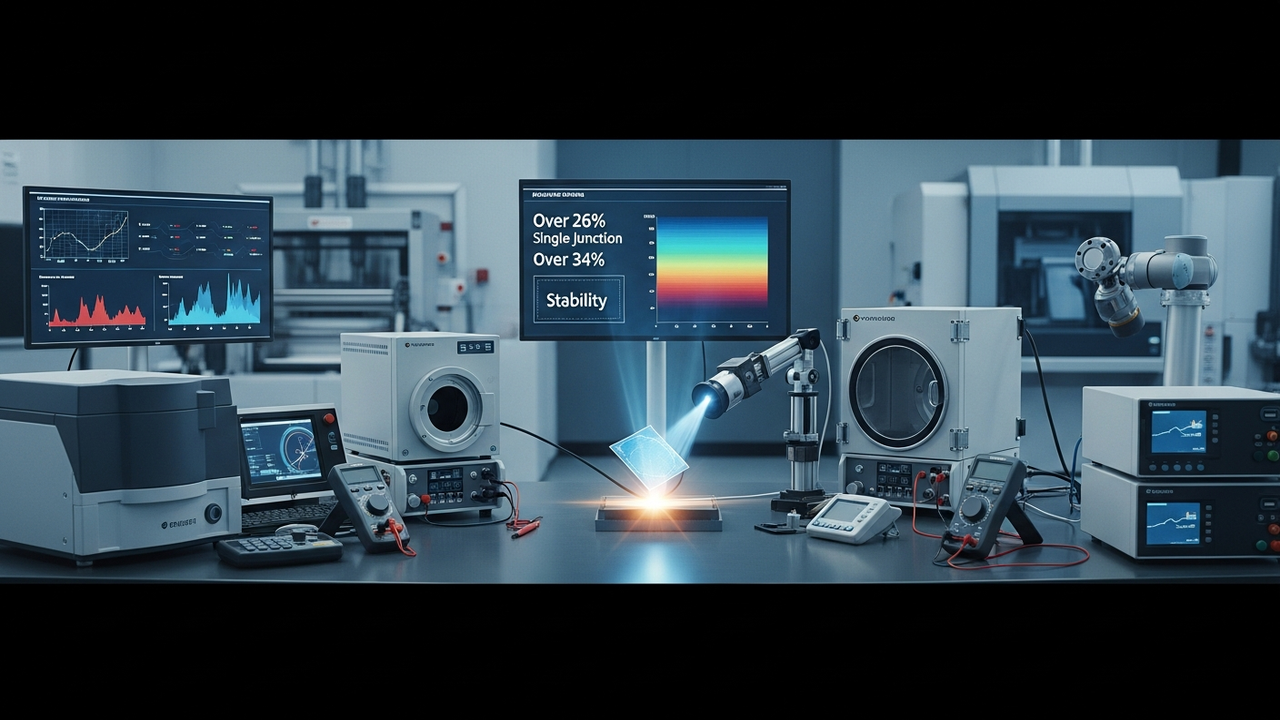
The U.S. Department of Energy (DOE) is robustly supporting comprehensive research and development projects aimed at improving the efficiency and lifespan, reducing manufacturing costs, and ultimately accelerating the commercialization of metal-halide perovskite solar cells. Latest efficiency charts from the National Renewable Energy Laboratory (NREL) indicate that perovskite solar cells have achieved over 26% power conversion efficiency in small-area devices, with perovskite-silicon tandem cells reaching an astonishing nearly 34% efficiency. These figures highlight the potential for perovskite technology to rival, and even surpass, existing solar cell technologies, underscoring the success of the DOE’s focused efforts on identified key challenges.
Technical / Clinical Details
The research supported by the DOE involves a multi-pronged approach to maximize perovskite solar cell performance. Specifically, efforts are concentrated on four critical areas: 1. **Cell Stability:** Developing material science and interfacial engineering solutions to suppress degradation from environmental factors (humidity, heat, light) and ensure practical device lifetimes. 2. **Scalable Efficiency:** Advancing technologies to maintain and improve high efficiencies achieved in small-area devices when scaled to larger modules (e.g., large-area deposition techniques, defect control). 3. **Manufacturability:** Developing and optimizing low-cost, efficient, and high-throughput manufacturing processes (e.g., solution processing, roll-to-roll printing). 4. **Technical Validation:** Ensuring rigorous, independent evaluation and certification of performance and reliability by third-party institutions. Through these initiatives, the DOE aims to establish perovskite solar cells as a reliable and economically viable energy solution.
Background & Context
As the global transition to clean energy accelerates, solar photovoltaics play an indispensable role. However, conventional silicon solar cells are approaching their theoretical efficiency limits, fueling expectations for more efficient and cost-effective next-generation technologies. Perovskite solar cells, with their high potential, are widely recognized as this ‘next frontier.’ The strategic investment by the U.S. Department of Energy is designed to unlock the full market-disrupting potential of this technology and ensure the U.S. maintains global leadership in renewable energy. This R&D effort aims to remove technical barriers and foster domestic innovation and manufacturing capabilities, thereby achieving both energy security and economic growth.
Strategic Significance & Outlook
The DOE’s continued support for R&D projects will significantly accelerate the commercialization of perovskite solar cell technology. As demonstrated by the over 34% efficiency in tandem cells, this technology has the potential to substantially exceed the theoretical limits of single-junction silicon cells. Once challenges in stability, scalability, manufacturability, and validation are addressed, perovskite solar cells are poised to replace or complement existing technologies in a wide array of applications, including residential, commercial, and utility-scale power generation. This will further reduce the cost of solar electricity, making clean energy accessible in more regions and providing an indispensable contribution to achieving global decarbonization goals.
Source: https://www.energy.gov/cmei/systems/perovskite-solar-cells
Get our weekly technology intelligence — free
Receive an infographic that lets you judge at a glance whether each field’s analysis report is worth reading.
Subscribe Free — Weekly Tech Intelligence
By subscribing, you’ll receive Troy-Technical’s weekly technology intelligence newsletter.
- Your email and selected fields are used only to deliver the newsletter.
- We never share your information with third parties.
- You can unsubscribe anytime via the link in each email.
See our Privacy Policy for details.
Takes about a minute · Unsubscribe anytime







Comments