Background
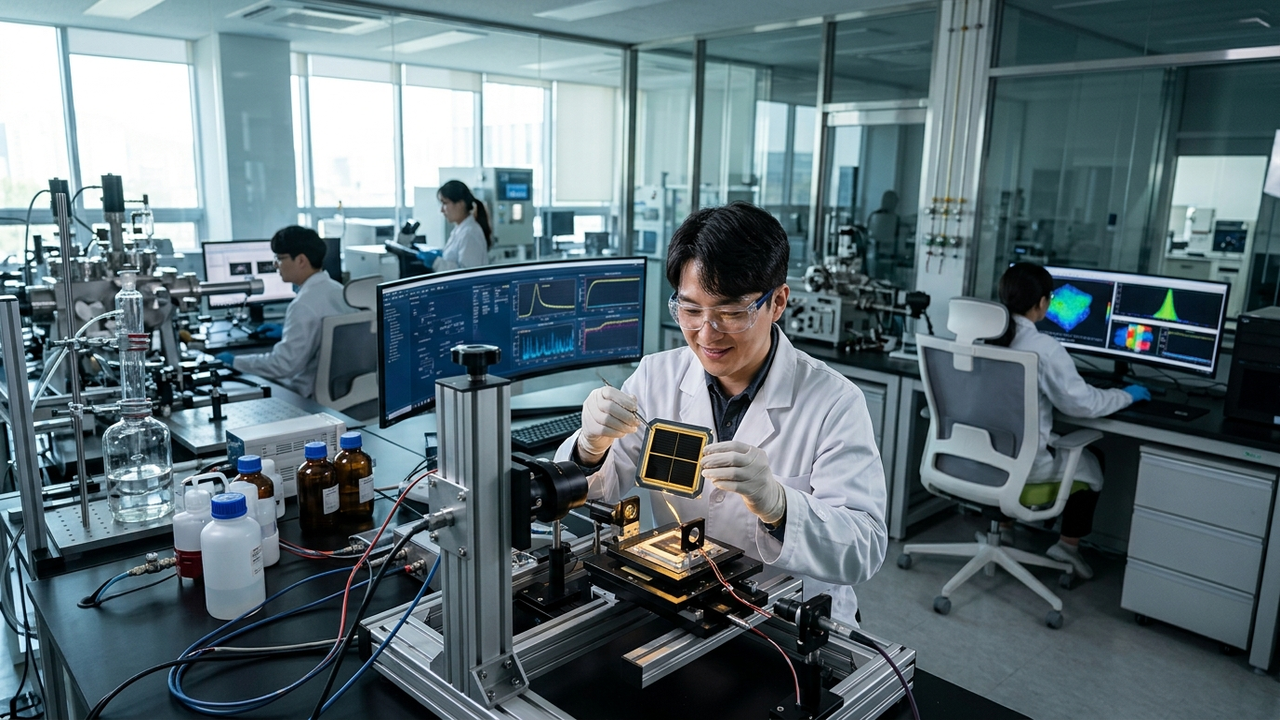
Tandem solar cells, which integrate two different light-absorbing materials, are pivotal for achieving efficiencies beyond the theoretical limits of single-junction devices. Perovskite solar cells, with their high efficiency and tunable bandgaps, are ideal candidates for topping traditional thin-film technologies like Copper Indium Gallium Selenide (CIGS), known for their excellent stability and absorption properties.
Key Findings
The Korea Institute of Energy Research (KIER) has made a significant leap forward in photovoltaic technology by announcing a certified world-record efficiency of 26.7% for their perovskite/CIGS tandem solar cells. This impressive figure was rigorously verified by the Fraunhofer Institute for Solar Energy Systems (ISE) in Germany, a globally recognized authority in solar cell performance validation. Further reinforcing its significance, this achievement has been officially recognized and listed in the “Best Research-Cell Efficiencies Chart” maintained by the US National Laboratory of the Rockies (NLR), formerly known as NREL (National Renewable Energy Laboratory). This dual certification from highly respected international bodies underscores the robustness and credibility of KIER’s breakthrough.
Significance & Outlook
The attainment of 26.7% efficiency represents a major advancement in the field of next-generation thin-film photovoltaics. By effectively combining the strengths of perovskite and CIGS materials, KIER has demonstrated a clear pathway to overcome the efficiency limitations of conventional solar cells. This breakthrough is expected to accelerate the commercialization of high-efficiency tandem solar modules, offering enhanced energy output per unit area. This could lead to more cost-effective solar installations, expanding the utility of solar energy in diverse applications, from large-scale power generation to building-integrated photovoltaics, and reinforcing South Korea’s position as a leader in advanced energy research.
Get our weekly technology intelligence — free
Receive an infographic that lets you judge at a glance whether each field’s analysis report is worth reading.
Subscribe Free — Weekly Tech Intelligence
By subscribing, you’ll receive Troy-Technical’s weekly technology intelligence newsletter.
- Your email and selected fields are used only to deliver the newsletter.
- We never share your information with third parties.
- You can unsubscribe anytime via the link in each email.
See our Privacy Policy for details.
Takes about a minute · Unsubscribe anytime








Comments